Markets rebound as China reopens

But China shares slide to 8-month low
China markets played catch-up as they reopened after a week-long break. The China50 index fell to the lowest since June 6 last year, extending the latest decline to a third day. Chinese authorities had announced a slew of measures over the weekend aimed at supporting markets. 1.2 trillion yuan ($171 billion) of liquidity was added to local markets, while the 7-day and 14-day reverse repo rates at this morning’s market operations were trimmed by 10 bps to 2.40% and 2.55%, respectively.
In addition, banks were told to lend more and not call in loans to companies in Hubei province and other affected regions, while night trading sessions for futures were suspended. Some share pledge contracts were allowed to be extended while asset-management rules were also relaxed.
Other shares have technical rebound
US indices recovered slightly from Friday’s sell-off, rising between 0.40% and 0.49%, with the NAS100 index out-performing, while Japan and Hong Kong indices both rallied more than 0.9%.
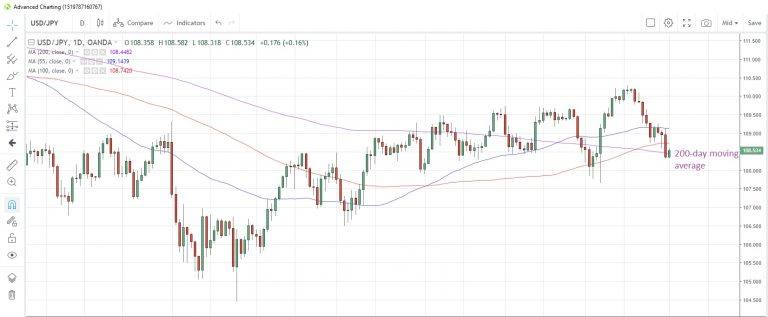
USD/JPY also recovered, rising for the first time in four days and regaining the 200-day moving average at 108.45. GBP/USD fell for the first time in three days after it was reported Boris Johnson plans to walk away from talks about the relationship between the UK and the EU if he doesn’t get the deal he wants.
USD/JPY Daily Chart
Source: OANDA fxTrade
Virus-hit PMIs
Not only are virus fears hitting risk appetite, but it’s now starting to have an impact on the Purchasing Managers’ Indices across the globe. Last Friday, the US Chicago PMI for January missed estimates by a mile, coming in at 42.9 versus 48.8 expected, the weakest reading in five years.
This morning, South Korea’s Nikkei Markit PMI slid to 49.8 from 50.1 while Japan’s Jibun Bank reading slumped to 48.8. China’s Caixin manufacturing PMI also slid to 51.1 from 51.5. There were also weaker readings from Thailand, Vietnam, Malaysia and Indonesia.
The exception to the lower reading was CBA’s January reading for January, which perked up to 49.6 from 49.1, but has been stuck in contraction territory for the past six months. The Philippines also posted a higher reading than the previous month.
Aussie gains as PMI tops forecast
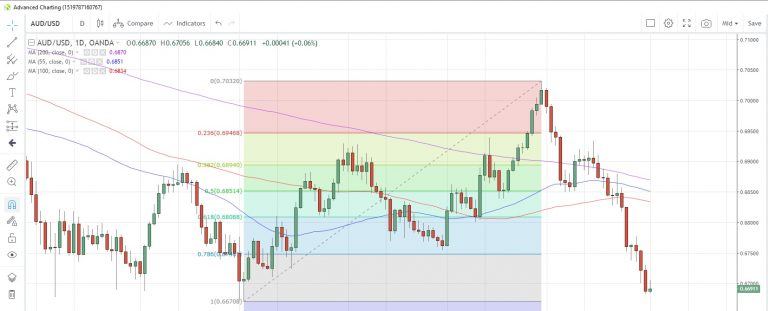
The better-than-expected PMI reading out of Australia gave the Australian dollar a much-needed lift, at least temporarily. AUD/USD was up 0.25% at 0.6704, the first advance in four days, while AUD/JPY climbed 0.45% to 72.77, also the first positive day in four days.
AUD/USD Daily Chart
Source: OANDA fxTrade
Coronavirus update
As of this morning, the total number of cases reported has hit 17,370 with the number of deaths escalating to 362, with the first one reported outside of the Chinese mainland in the Philippines. The next most-infected country is Japan with 20 cases. The number of individuals who have actually recovered from the virus has risen to 486. (Source: John Hopkins University)
Hong Kong has announced that local schools would be closed until at least March 2 while civil servants were requested to work from home. Some parts of China remain closed for another week.
The PMI fest continues
The beginning of the month brings with it the usual array of PMI data across the globe. We get the final readings from Markit for Germany, the Euro-zone, the UK and the US, while the ISM reports its own PMI numbers for the US. The ISM data is expected to show an improvement to 48.5 from 47.2, according to the latest survey of economists, but it’s worth noting the huge miss on the Chicago PMI on Friday mentioned above.
Author
Andrew Robinson
MarketPulse
A seasoned professional with more than 30 years’ experience in foreign exchange, interest rates and commodities, Andrew Robinson is a senior market analyst with OANDA, responsible for providing timely and relevant market commentar

















