Markets dive again [Video]
![Markets dive again [Video]](https://editorial.fxstreet.com/images/TechnicalAnalysis/Intermarket/Correlation/greasy-gears-in-the-machine-gm503847604-82780433_XtraLarge.jpg)

US Dollar: Dec '22 USD is Down at 105.340.
Energies: Jan '23 Crude is Down at 73.89.
Financials: The Mar '23 30 Year T-Bond is Down 8 ticks and trading at 130.05.
Indices: The Dec '22 S&P 500 Emini ES contract is 32 ticks Lower and trading at 3937.00.
Gold: The Feb'23 Gold contract is trading Up at 1786.70. Gold is 43 ticks Higher than its close.
Initial conclusion
This is not a correlated market. The dollar is Down, and Crude is Down which is not normal, and the 30 Year T-Bond is trading Lower. The Financials should always correlate with the US dollar such that if the dollar is lower, then the bonds should follow and vice-versa. The S&P is Lower, and Crude is trading Lower which is not correlated. Gold is trading Higher which is correlated with the US dollar trading Down. I tend to believe that Gold has an inverse relationship with the US Dollar as when the US Dollar is down, Gold tends to rise in value and vice-versa. Think of it as a seesaw, when one is up the other should be down. I point this out to you to make you aware that when we don't have a correlated market, it means something is wrong. As traders you need to be aware of this and proceed with your eyes wide open. Currently all of Asia is trading lf Lower. Europe is trading mainly Lower with the exception of the Milan exchange which is Higher at this time.
Possible challenges to traders today
-
Revised Nonfarm Productivity is out at 8:30 AM EST. This is not Major.
-
Revised Unit Labor Costs is out at 8:30 AM EST. This is not Major.
-
Crude Oil Inventories are out at 10:30 AM EST. This is Major.
-
Consumer Credit is out at 3 PM EST. This is Major.
Treasuries
Traders, please note that we've changed the Bond instrument from the 30 year (ZB) to the 10 year (ZN). They work exactly the same.
We've elected to switch gears a bit and show correlation between the 10-year bond (ZN) and the S&P futures contract. The S&P contract is the Standard and Poor's, and the purpose is to show reverse correlation between the two instruments. Remember it's likened to a seesaw, when up goes up the other should go down and vice versa.
Yesterday the Bonds hit a High at around 8:50 AM EST. The S&P hit a Low at around that time and the Bonds moved Lower shortly thereafter. If you look at the charts below ZN gave a signal at around 8:50 AM and the S&P gave a signal at around the same time. Look at the charts below and you'll see a pattern for both assets. ZN hit a High at around 8:50 AM and the S&P moved Higher shortly thereafter. These charts represent the newest version of MultiCharts and I've changed the timeframe to a 15-minute chart to display better. This represented a Short opportunity on the 10-year note, as a trader you could have netted about a dozen plus ticks per contract on this trade. Each tick is worth $15.625. Please note: the front month for the ZN is now Dec '22. The S&P contract is also Dec' 22. I've changed the format to Renko Bars such that it may be more apparent and visible.
Charts courtesy of MultiCharts built on an AMP platform
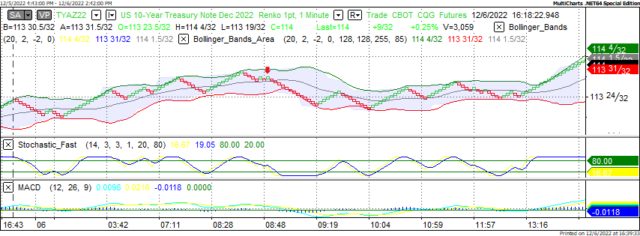
ZN - Dec 2022 - 12/06/22
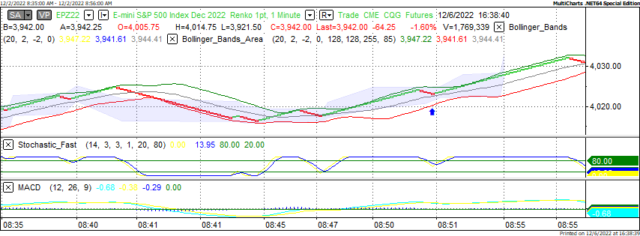
S&P - Dec 2022 - 12/06/22
Bias
Yesterday we gave the markets a Neutral bias as we didn't much in the way of correlation yesterday morning. The markets veered to the Downside as the Dow dropped 351 points and the other indices lost ground as well. Today we aren't dealing with a correlated market and our bias is Neutral.
Could this change? Of Course. Remember anything can happen in a volatile market.
Commentary
Yesterday we didn't get any sense of market direction or correlation. The indices and instruments were all over the place Tuesday morning. The Dow dropped 351 points and the other indices lost ground as well. Today we don't have much in the way of economic news to drive the markets. We have revised numbers for Productivity and Non-Farm Labor Costs. Additionally, we have Consumer Credit numbers out at 3 PM. Will this serve to change market direction? We shall see...
Author
Nick Mastrandrea
Market Tea Leaves

















