March flashlight for the FOMC blackout period – The flashlight needs fresh batteries

Summary
The FOMC downshifted its pace of policy tightening, lifting the fed funds rate by 25 bps to a range of 4.50-4.75%, at the conclusion of its last meeting on February 1. Since then, the ground under the Fed has shifted enormously.
The economic data have been decisively strong since the FOMC last met. Nonfarm payrolls rose by a combined 815K in January and February, and the inflation data remained uncomfortably high over the same period. Furthermore, upward revisions to the hiring and inflation data covering the end of last year suggest that the strength cannot be fully chocked up to an unusually warm first two months of the year. Rather, it appears monetary policy tightening to date has had a less potent effect on dampening demand growth and inflation than many observers would have thought previously.
In isolation, the recent economic data are supportive of further tightening at the March 22 FOMC meeting. However, recent developments in the financial system have clouded the outlook to a considerable degree. Financial conditions tightened abruptly following the failures of Silicon Valley Bank (SVB) and Signature Bank on March 10 and 12, respectively. Financial markets have been highly volatile but clearly have reduced the amount of anticipated policy tightening by the Federal Reserve.
Further hiking the fed funds rate would be a crystal-clear signal of the FOMC's commitment to reducing inflation while also displaying confidence in the measures put in place to stem recent financial market stress.
However, the dust is still settling from the nation's second and third largest bank failures in history. We look for the FOMC to briefly pause its tightening efforts to ensure the situation is under control. In our view, the last thing the FOMC wants is more financial instability that threatens the banking system and forestalls any additional rate hikes down the road. But, neither a hike nor a pause would surprise us.
If, as we anticipate, the FOMC opts to hold the fed funds rate at 4.50-4.75% at next week's meeting, it could use the "dot plot" to clearly signal that the tightening cycle is unlikely to be over just yet. Between the economic data's recent strength and the presumption that efforts to stem stress in the financial system will be effective, we expect the median dot for 2023 to move up 25 bps to a range of 5.25-5.50%.
With some FOMC members likely to believe that rates will also need to be held above neutral for longer, we expect the median estimate for the fed funds rate at the end of 2024 to move up 25 bps from its December range of 4.00-4.25%.
What a difference a week makes
The most recent FOMC inter-meeting period has been quite the roller coaster ride. Since the FOMC concluded its past meeting on February 1, data have suggested that the economy has significantly more positive momentum than previously believed. The resilience of the labor market and inflation in particular raised the prospect of the Committee re-accelerating the pace of rate hikes. With Chair Powell appearing open to such a move, the odds of a 50 bps move seemed a bit better-than-not in the days leading up to the blackout period. As recently as March 8, markets were priced for roughly a 70% change of a 50 bps rate hike.
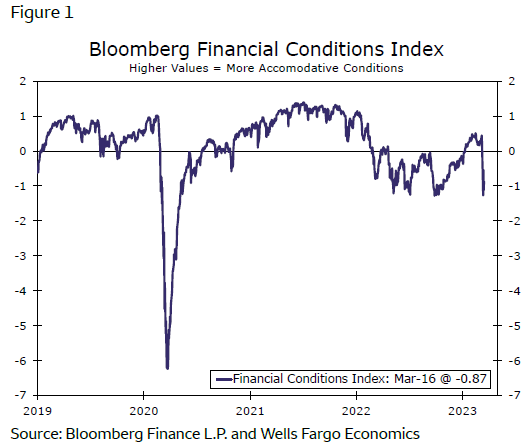
How quickly the world can change. Financial conditions tightened abruptly following the failures of Silicon Valley Bank (SVB) and Signature Bank on March 10 and 12, respectively (Figure 1). Policymakers responded swiftly to stem concerns that other financial institutions may find themselves in a similar position. On Sunday, March 12, the Federal Reserve announced a new lending facility—the Bank Term Funding Program—which allows eligible depository institutions to borrow against Treasury securities, mortgage-backed-securities and certain other securities at par. In addition, the Fed, FDIC and Treasury Department issued a joint statement on March 12 that included an assurance that even depositors with balances above the $250,000 FDIC insured threshold would be made whole.
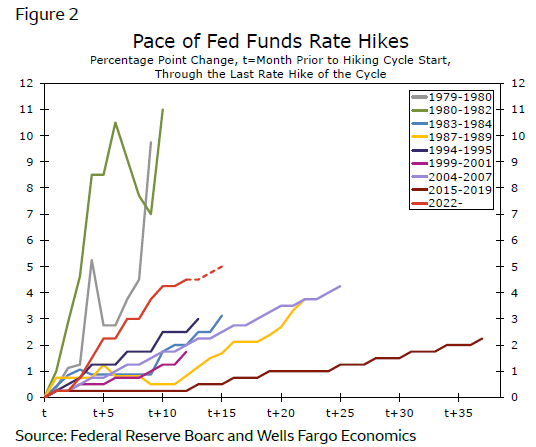
We covered these bank failures and the policy response in a recent special report. Both SVB and Signature Bank had some unique characteristics that made them particularly susceptible to a bank run. However, the failures brought to light the risks to financial stability that lurk behind the most aggressive monetary policy tightening in four decades (Figure 2). The FOMC was already performing a delicate dance by trying to rein in inflation without inflicting undue harm on the labor market. The recent financial market turmoil adds another dimension as policymakers must balance their efforts to quell inflation against the risk of igniting additional financial system stress.
Author
Wells Fargo Research Team
Wells Fargo