Manufacturing activity in the Eurozone drops further in May, remains in growth territory

- Headline manufacturing PMI in the Eurozone confirmed flash estimate of 55.5 in May, decelerating from 56.2 in April.
- The Eurozone and German manufacturing PMIs both decelerated to the lowest reading in last 15 months.
- The level of the economic activity in the Eurozone remains still robust, well above 50.0 line separating the economic expansion from recession.
The Eurozone
The manufacturing activity in the Eurozone registered the slowest pace of expansion in last 15 months, copying the development in Germany, the Eurozone’s largest country. The headline manufacturing PMI fell to 55.5 in May, confirming the flash estimate published earlier in May, but it was down from 56.2 in April and off multi-year high from the turn of this year.
“Slowing export sales have been a key drag on both production and order book growth, with the May survey indicating that new export orders rose at the weakest rate for nearly two years, linked in part to the appreciation of the euro alongside reports of weakened demand for imports from key markets, notably the US,” Chris Williamson, chief business economist at IHS/Markit noted in the report.
Germany
German manufacturing PMI fell to the lowest level in last 15 months in May as sector experiences further slowdown after reaching a multi-year peak at the turn of this year. The headline manufacturing PMI fell further to 56.9 in May, down from 58.1 in April. While the manufacturing PMI remaining well above 50.0 line dividing the economic expansion from contraction the sector is still experiencing a robust overall rate of expansion.
“Capacity constraints have been a big part of the lowdown seen so far in 2018, and May’s survey continued to highlight widespread delays in supply chains and found evidence of this resulting in lost sales. A slowdown in global trade flows has added to the equation, with a sharp deterioration of export order growth to a two-year low the most worrying development to come out of the latest figures,” Phil Smith, principal economist at IHS Markit wrote in the report.
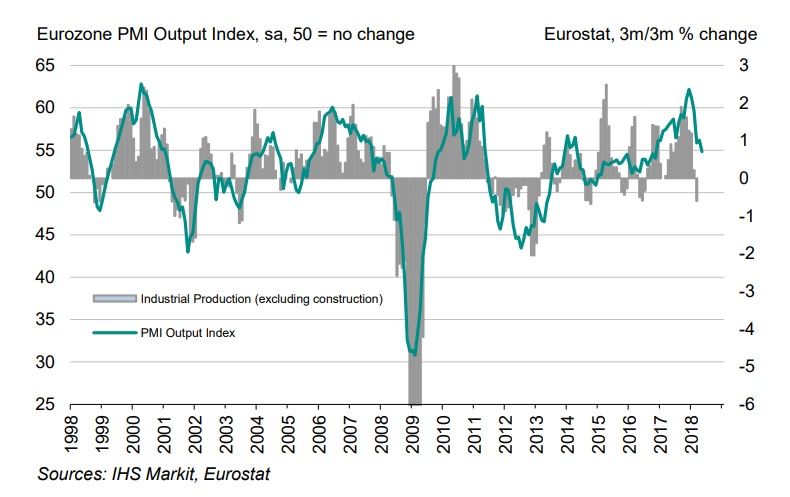
The Eurozone manufacturing PMI and GDP growth

France
French manufacturing PMI rose to 54.4 in May signalling twentieth successive improvement in the activity of the French manufacturing sector. The manufacturing PMI reading in May while the UK government supposedly agreed to create the was up from 53.8 in April, and highlighted a second successive acceleration in the overall rate of strengthening in business conditions.
“Overall growth, as highlighted by the headline PMI, remains in growth territory. While the rate of expansion remains strongly above the long-run series average, it is substantially weaker than
seen in the second half of 2017,” Alex Gill, the economist at IHS/Markit and the author of the report wrote in the release.
Italy
The manufacturing activity in Italy is noticeably losing the steam as well after reaching a near seven-year high. The manufacturing PMI fell to 52.7 during May, down from 53.5 in the previous month and the lowest level for a year-and-a-half.
“Whilst a number of temporary factors (such as poor weather in the first quarter) have exacerbated the downward trend, the slowdown continues to be primarily linked to global capacity constraints, which has led to sharply rising delivery times and difficulties in sourcing inputs for production. Subsequent rises in costs are not helping either, with commodities and raw materials widely reported to be up in price,” Paul Smith, the economist at IHS/Markit and the author of the report noted.
Spain
Spanish manufacturing PMI decelerated to 53.4 in May, down from 54.4 in April. Although signalling a solid strengthening of the sector, the rate of improvement was the weakest since August last year.
“The latest Spain Manufacturing PMI reinforces the impression that growth peaked around the turn of the year. Recent months have seen the sector move into a lower gear, but increases in output and new orders remained solid in May. The latest employment data provide some cause for optimism, with the rate of job creation rebounding. This suggests that firms are still optimistic that output requirements will continue to improve in coming months, a finding backed up by continued optimism regarding the year-ahead outlook,” Andrew Harket, the associate director at IHS/Markit wrote in the report.
Author
Mario Blascak, PhD
Independent Analyst
Dr. Mário Blaščák worked in professional finance and banking for 15 years before moving to journalism. While working for Austrian and German banks, he specialized in covering markets and macroeconomics.