|

FTSE 100: Seasonal gains in sight? [Video]

Listen to the latest seasonal insights for the FTSE 100.

Medium-term buyers in major world indices are still expected due to the large US stimulus package passed ($1.9 trillion) and potentially still to come ($3 trillion). This means that any medium-term dips lower major equities should find buyers.

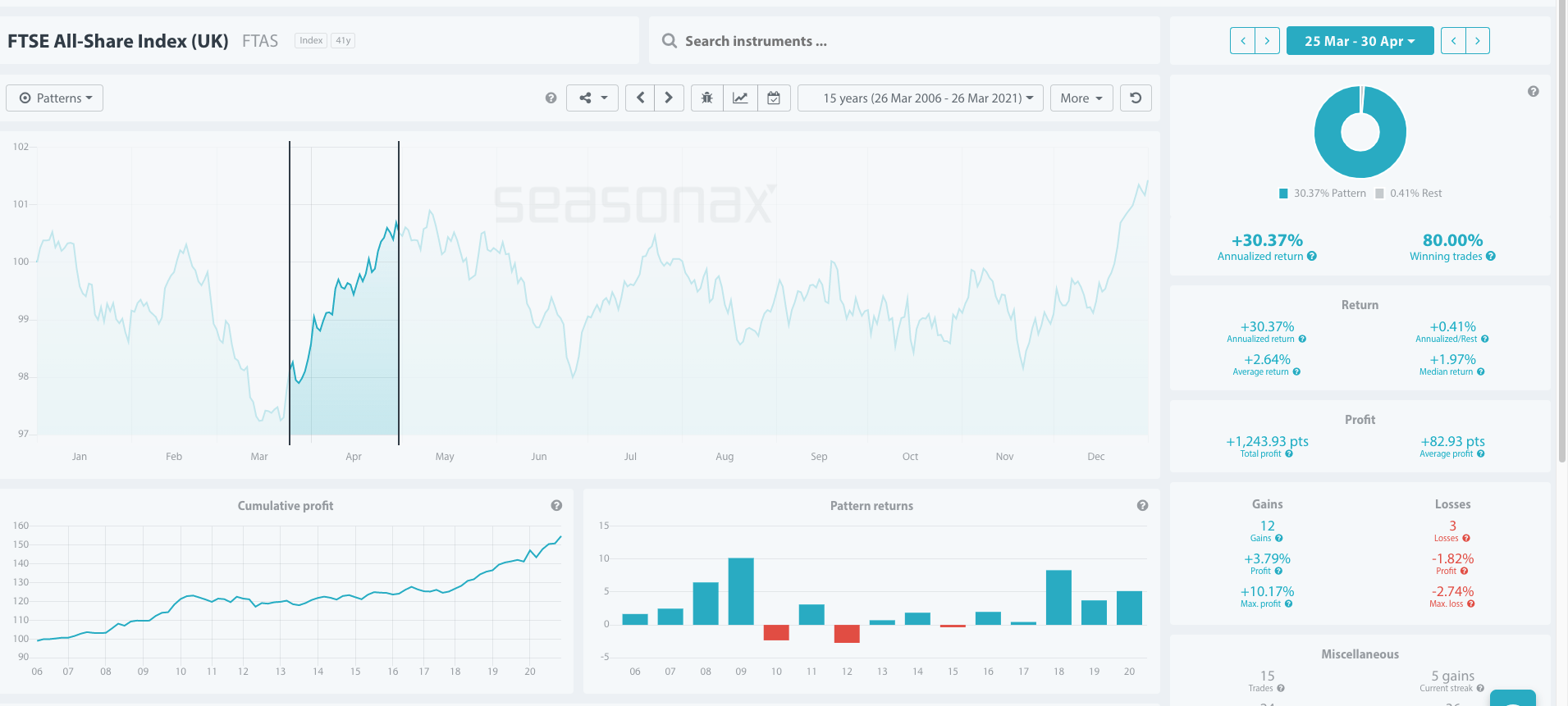
The UK FTSE 100 index is entering into a strong time of year where it tends to see seasonal gains. Over the last 15 years, the FTSE 100 has risen 12 times between March 25 and April 30. The average return over the last 15 years has been +2.64%. The maximum profit was +10.17% in 2009. There have been 3 losses in the last 15 years. The largest drop was in 2012 with a -2.74% fall.

This seasonal period is one of the strongest patterns for the FTSE 100 and is only to be surpassed by the November to December period over the last 15 years.

Trade risks

  • There is a growing risk that investors consider equity markets overbought and that could see a correction. It is hard to know when that correction will come, but investors need to be aware of the potential risk.

  • There is also a risk that a breakdown in the EU-UK trade relationship drags on UK stocks as post Brexit arrangements are still not fully formed.

  • Finally, any new strong COVID-19 variant could invalidate this outlook and cause FTSE100 selling.

  • Month-end flows are expected to see falls in equity markets and demand in the bond market.
FTSE

Learn more about HYCM


Author

Giles Coghlan LLB, Lth, MA

Giles is the chief market analyst for Financial Source. His goal is to help you find simple, high-conviction fundamental trade opportunities. He has regular media presentations being featured in National and International Press.


More from Giles Coghlan LLB, Lth, MA
Share:

Editor's Picks

EUR/USD: US Dollar comeback in the makes?

The US Dollar stands victorious at the end of another week, with the EUR/USD pair trading near a four-week low of 1.1742, while the USD retains its strength despite some discouraging American data released at the end of the week. The pair edged higher on Friday, after the United States Supreme Court ruled against President Donald Trump's tariffs, although the advance is not enough to change the latest USD flow.

GBP/USD braces for more pain, as 200-day SMA tested

GBP/USD broke the previous week’s consolidation to the downside, as sellers returned with pomp, smashing the major back toward the levels last seen in late January. The pair tested bids below the 1.3450 barrier as the US Dollar strength largely played out throughout the week, while the Pound Sterling stepped back on expectations of divergent monetary policy outlooks between the Bank of England and the US Federal Reserve.

Gold rises to near $5,100 as Trump’s tariffs boost haven demand, US-Iran talks eyed

Gold price edges higher to near $5,095 during the early Asian session on Monday. The precious metal extends the rally amid US President Donald Trump’s tariff threats and uncertainty, boosting safe-haven flows. 

Week ahead: Markets brace for heightened volatility as event risk dominates

Dollar strength dominates markets as risk appetite remains subdued. A Supreme Court ruling, geopolitics and Fed developments are in focus. Pivotal Nvidia earnings on Wednesday as investors question tech sector weakness. Yen and aussie diverge; both pound and euro could recoup their losses.

Broadening drivers of growth: Unpacking GDP and looking ahead

This week’s data delivered a familiar theme with an important twist. The U.S. economy continues to be shaped by powerful forces in high-tech and AI-related investment, but recent releases suggest the growth story may finally be broadening. At the same time, trade flows are moving in a less supportive direction, reminding us that not all parts of the economy are pulling in sync.

Ripple bulls defend key support amid waning retail demand and ETF inflows

XRP ticks up above $1.40 support, but waning retail demand suggests caution. XRP attracts $4 million in spot ETF inflows on Thursday, signaling renewed institutional investor interest.