Lagarde: Inflation Oui, rate hikes Non, growth N'est-ce Pas
- ECB leaves rates, asset policies unchanged as expected.
- Lagarde signals a new assessment in June.
- Cites the risks of the Ukraine war to growth while acknowledging inflation.

Facing the risks of European war for the first time in two generations, the ECB will keep its economic support untouched despite inflation that has rocketed to nearly four times its official target.
Bank President Christine Lagard, who is recovering from covid, said in her virtual press conference that exiting bond-buying is a necessary precursor for a rate increase, which could occur “anywhere between a week to several months” after the end. The ECB’s -0.5% deposit rate and 0.0% interest rate were left untouched.
“Monthly net purchases under the APP will amount to 40 billion euros in April, 30 billion euros in May and 20 billion euros in June,” noted the policy statement accompanying the rate decision.
Ms Lagarde repeated the bank’s previous promise to end bond purchases in the third quarter but declined to be more precise despite reporters' questions. At the 10 billion euros monthly reduction in the bank’s statement the program would end with the final tranche in August.
Futures markets are currently pricing 0.25% increases at the September and December ECB meetings.
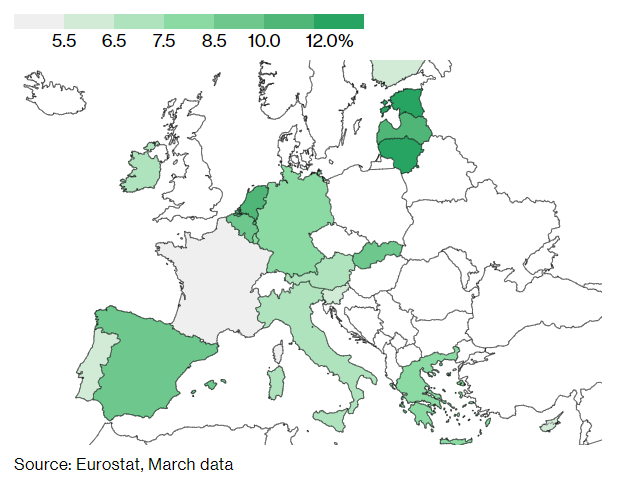
Eurozone inflation was 7.5% in March with some countries like Spain higher and others as Germany lower. The ECB’s official inflation target is 2%.
Eurozone inflation
Ms Lagarde acknowledged that inflation is rising. “Upside risks surrounding the inflation outlook have also intensified, especially in the near-term,” she noted. “The last thing we want to see is inflation expectations at risk of being de-anchored,” she said.
The European Central Bank is far behind the Federal Reserve, which has hiked 25 basis points once and is expected to enact a 50 point increase at its May 4 meeting and to begin a $95 billion monthly reduction of its $9 trillion balance sheet. The Bank of Canada has raised its overnight rate twice, the last time 0.5% at its April 13 meeting. The Bank of England raised its base rate by 0.25% to 0.75% in March.
Russia’s invasion of Ukraine and the subsequent sanctions on Moscow and the possibility of cuts in natural gas supplies to Western Europe have played havoc with the Eurozone economy.
Several economic institutes advising the German government warned that an interruption of Russian energy supplies to the country could strike a 220 billion euro ($240 billion) blow to the economy, equal to 6.5% of annual output. Germany imports about half of its natural gas from Russia.
Moscow has not threatened to cut off the flow and, except for higher prices, gas has continued to stream unimpeded to Germany since the invasion began on March 24.
Markets were unimpressed with the ECB’s caution. The EUR/USD closed about 60 points lower on the day at 1.0825 but it had traded as low as 1.0758 during Mr Lagrde’s press conference.
-637855753548941048.png)
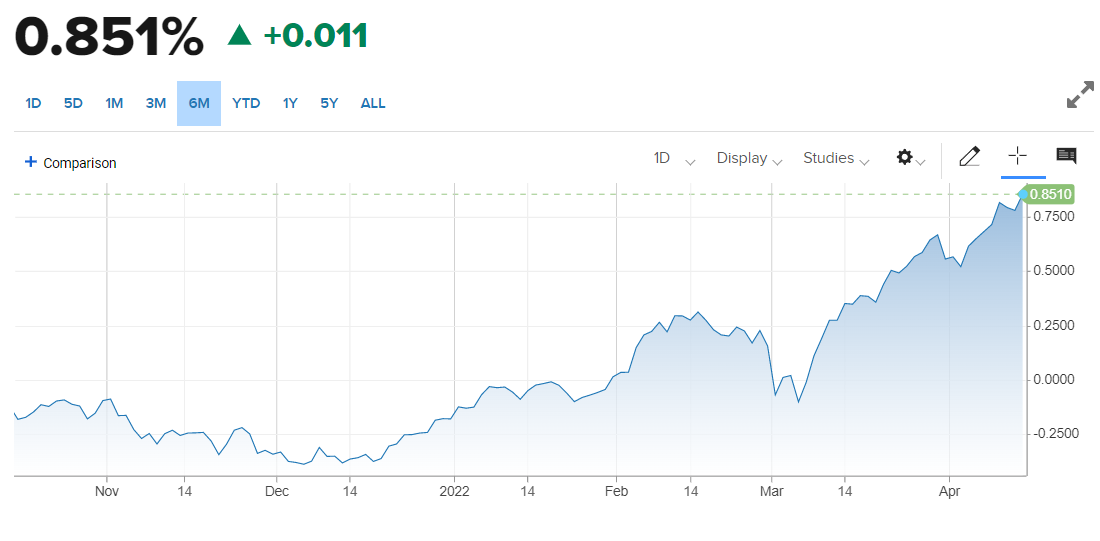
German and French bond yields rose with the 10-year returns closing at 0.851% and 1.337% respectively.
10-year Bund
CNBC
Author

Joseph Trevisani
FXStreet
Joseph Trevisani began his thirty-year career in the financial markets at Credit Suisse in New York and Singapore where he worked for 12 years as an interbank currency trader and trading desk manager.