Kiwi surges on less-dovish RBNZ


NZD/USD rises more than 1.5%
It wasn’t the fact that the RBNZ kept rates at record lows at this morning’s meeting that boosted the kiwi, it was more the expectations the markets had built up for a more dovish statement. The Bank stated it sees keeping the Overnight Cash Rate (benchmark) rate unchanged at 1.75% through to November 2020, hiking it to 1.84% in December 2020 and 2.36% by March 2022.
In the post-meeting press conference, RBNZ Governor Orr said the chances of a rate cut had not increased and risks are finely balanced, as is the outlook. The expansionary level of interest rates is expected to support a pickup in New Zealand’s GDP growth during 2019.
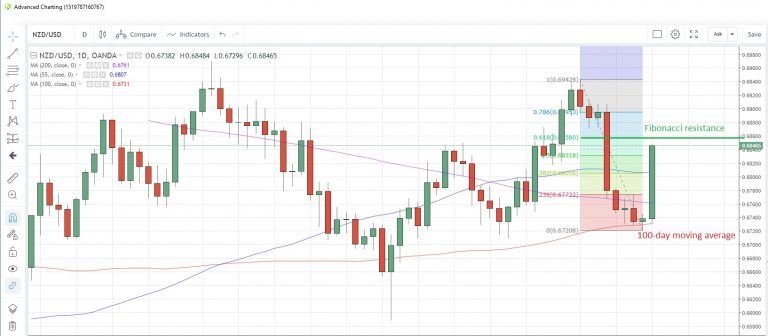
NZD/USD surged more than 1.5%, peaking at 0.6849, the highest level in a week and recouping more than 50% of this month’s decline. Next resistance point could come in at 0.6858, which is the 61.8% Fibonacci retracement of that drop.
NZD/USD Daily Chart
Source: OANDA fxTrade
Sentiment improves across asset classes
The positive close on Wall Street yesterday continued into Asia this morning, with most indices in the black by lunchtime. US futures are suggesting a 0.3% higher open for both the US30 index and the S&P500 CFD, while Japan shares rose more than 1% and China A50 shares a more modest 0.1%.
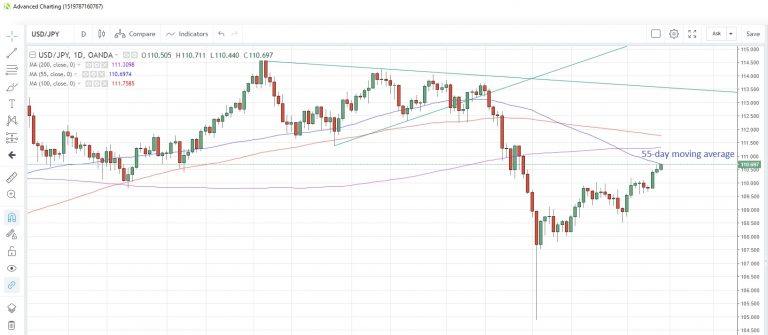
Beta-risk currency the Aussie dollar was dragged higher by its kiwi counterpart, touching the highest in a week versus the US dollar, while USD/JPY climbed 0.13% to 110.63, testing the 55-day moving average at 110.70, as the safe-haven yen was less in demand. Crude oil edged higher as trade negotiation hopes rekindled expectations of a pickup in global demand.
USD/JPY Daily Chart
Source: OANDA fxTrade
Mnuchin has high hopes for meeting
US Treasury Secretary Mnuchin said he hopes for “productive” trade meetings in China from tomorrow. He and US Trade Representative Lighthizer have been in Beijing since yesterday. His case may have been helped by a receding threat of higher US tariffs on March 1 after US President Trump said Tuesday he could let the deadline for a trade deal slide “for a little while”.
Consumer price data in focus
Today we see consumer price changes in January from both the UK and the US. Both are expected to show a similar picture of softening price pressures, a theme which has characterized this data point across the globe since the start of the year. UK prices are seen advancing 1.9% y/y after a 2.1% gain in December, while the US version is expected to rise just 1.5% y/y from 1.9%.
Aside from prices data, Euro-zone industrial production is expected to contract for a second straight month in December, falling 0.4% m/m this time, and continuing the spate of softer economic data from the region.
Speeches from Fed’s Bostic and Mester complete the US session, along with the weekly crude oil stocks from EIA.
Author
Andrew Robinson
MarketPulse
A seasoned professional with more than 30 years’ experience in foreign exchange, interest rates and commodities, Andrew Robinson is a senior market analyst with OANDA, responsible for providing timely and relevant market commentar

















