Keep calm in a 2026 metals mania


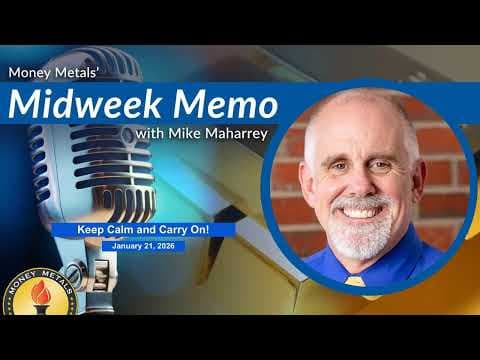
Mike Maharrey opens the Money Metals Midweek Memo with a mindset for chaotic times. He borrows from the famous keep calm & carry on message that originated as a British government propaganda campaign in 1939 during World War II. His point is modern and simple. Stay grounded even when the headlines and prices are screaming.
That grounding feels necessary in a market where the numbers are turning into a daily spectacle. Maharrey says gold is trading well over $4,800 an ounce and cites $4,876 as the level pushing toward $5,000 in 2026. Silver is trading over $95. Record prices keep showing up, and he says the excitement is also feeding rumors, conspiracy theories, and overheated claims.
Why breaking news gets it wrong
Maharrey leans on his time in television news to explain why early narratives so often fail. He worked about 5 years producing web content for the NBC affiliate in Lexington, Kentucky, and watched stories evolve from first reports to final confirmation. In his experience, the first wave is frequently incomplete or incorrect because information comes in fragments.
He gives a personal example from 9/11. The first report he saw described a small plane hitting one of the towers, a detail that turned out to be drastically wrong as the picture became clear. He also describes a psychology class exercise at the University of Kentucky that revealed how unreliable eyewitness memory can be. People in the same room saw the same event and gave wildly different descriptions.
Bias, balance, and integrity
He ties those media dynamics to something bigger than precious metals. People interpret information through presuppositions, and those biases shape what they think they saw. He argues that true, unbiased news is impossible, but balance is still a worthwhile goal. You try to put assumptions aside and report what you can verify.
He also draws a line for his own work. He says he has editorial license, but he does not want to ignore facts or use fear to hype gold and silver. He stresses integrity as something you choose in real time, including admitting mistakes when you make them. Then he does exactly that.
The China Silver export rules correction
Maharrey says he overstated the likely impact of Chinese silver export rules that went into effect on January 1st, 2026.
Last week, he reported that China might be trying to control the silver market through more restrictive export rules that could worsen a global shortage. He says that was not an unreasonable concern given China’s history of using export controls to shape markets for rare earth metals, but new analysis suggests the effect may be limited.
He recaps what analysts thought at first. Under the policy framework, only large state-approved companies with an annual silver production capacity of 80 tons and a credit line exceeding $30 million can legally export silver. The initial interpretation was that hundreds of smaller exporters would be locked out and global supply would tighten further.
Then he explains what Metals Focus found. Metals Focus is an independent consultancy based in London with a team on the ground in Shanghai, and their assessment is that China was already regulating and licensing silver exports. Smaller exporters were already excluded. The new rules appear to be tweaks in an existing framework rather than a sudden new wave of export restrictions, and the updates tend to occur on a two-year cycle.
The numbers matter here. Metals Focus compared the new approved exporter list with the prior version and found only minor changes. There are now 44 approved silver exporters for the 2026 2027 cycle, up from 42 for the 2025 2026 cycle. Maharrey also notes that China removed silver export quota restrictions a few years ago, and that remains true under the current rules.
What still might change in practice
He does not claim the story is finished. He says exporters may now have to obtain approval for individual overseas shipments, which could add friction. He cites Trivia China, saying that even without quotas or national security scrutiny, licensing can raise costs for exporters and customers. He also cites CIRS, noting that licensing regimes can be one license, one shipment, or one license, multiple shipments, depending on the category.
The key issue is ambiguity. The publicly available catalog summaries do not clearly establish that silver is always one order and one approval. Metals Focus says the announcement should have little impact on global silver trade flows or market tightness, and that a misunderstanding likely contributed to the market treating it as a bullish signal.
Maharrey says the measured approach is to watch how the policy is applied rather than insisting China is definitely trying to corner silver. Skepticism toward Chinese policy is reasonable, he says, but certainty without evidence is where hype begins.
The Silver shortage that does not go away
He argues that even if policy adds friction, it does not change the core reality. The silver market is structurally short on metal. He cites a structural market deficit of 148.9 million ounces last year, meaning consumers used 148.9 million more ounces than were produced by mines or recycling. He says the 4-year shortfall totals 678 million ounces, and he expects the deficit to push over 800 million ounces once 2025 numbers are in, roughly equal to an entire year of global silver mine output.
He restates the point for emphasis. Over the last 5 years, the silver market has consumed six years of global mine output. Metal can be shifted between hubs like New York, London, and Shanghai, but that does not solve the shortage. Users must pull from above-ground stocks, and holders are less willing to sell at current prices, which he says helps drive prices higher.
He also notes policy risk is not limited to China. The US Geological Survey recently designated silver a critical mineral. He says the critical mineral list was established in 2017 and guides federal strategy on investment and mine permitting decisions, and that designation could influence the market through future policy choices.
The US mint rumor and what the notice really said
Maharrey then tackles a second overhyped story. A rumor circulated that the US Mint is running out of silver. People pointed to a notice on the Mint’s website stating that due to rapidly rising metal costs, silver numismatic products were temporarily removed from sale while pricing is evaluated, and that American Eagle silver bullion coins remain available through authorized purchasers.
His interpretation is straightforward. The notice refers to numismatic products, meaning collectible items, not standard bullion. When spot prices rise rapidly, fixed pricing for proof and burnished collectibles can lag and even dip below spot, so the Mint pauses sales to adjust pricing rather than sell at a loss. He emphasizes that the US Mint does not sell bullion American Eagle coins directly to the public, which is why the notice points buyers to authorized purchasers.
He credits his colleague Joshua D Glawson’s analysis and summarizes the basic lesson. People saw a headline, filled in the blanks, and treated it as proof that the market was out of metal. In reality, it was pricing and bureaucracy, not an empty vault.
Money Metals operations in a surge
Maharrey acknowledges real stress in the retail market. Some dealers are having trouble sourcing silver, especially smaller shops, but he says he spoke with CEO Stefan Gleason and was assured Money Metals has plenty of inventory. He supports that with personal observation from visiting the Idaho operation and seeing the inventory at the depository.
He shares a concrete snapshot of how far prices have run. While prepping the show, he says the melt value of a 90 percent silver 1964 quarter was over $17. He highlights junk silver as pre 1965 dimes, quarters, and half dollars, and notes that Money Metals still has some supply, including quarters under spot if purchased in high enough volume.
He says the main issue they are facing is processing speed. Order volume is overwhelming, and there can be shipping delays. Phone lines may also be backed up at 800 8001865. He says the company has hired 55 new employees since Christmas Day to address order flow and call volume.
He adds that Money Metals has not imposed order minimums or raised thresholds for free shipping the way some other dealers have. He says there is no guarantee that never changes depending on market conditions, but it would be a last resort because they value smaller customers and first-time precious metals investors.
The closing message on Dollars and allocation
Maharrey finishes by returning to the emotional temperature of the moment. Do not let hype or fear drive you. Be skeptical, even of him. He says de-dollarization is not an imminent collapse but a death by a million paper cuts, and he warns that even modest reductions in global dollar demand could push inflationary pressure back into the United States as dollars flow home.
He tells a story about a retired friend who asked what to do with a pile of cash after selling a business. Maharrey says he is not a certified financial planner, but he would not hold money you do not plan to spend within the next year or two in cash because purchasing power is eroding.
He expects the Federal Reserve to keep cutting interest rates and says the Fed is engaged in quantitative easing. He also says Donald Trump will choose a new Fed chair soon and expects the next chair to be more open to easy monetary policy than Jerome Powell.
He says he believes in diversification, but not the traditional 60/40 portfolio. He prefers a 60/20/20 approach with 20 percent in precious metals and 20 percent in bonds.
He reiterates his core refrain…
Do not save in dollars. Save in real money, and if you want growth, consider assets like stocks, including mining stocks.
He wraps with the same steady posture he started with. Keep calm. Carry on. Keep thinking. Keep your integrity intact as the bull market roars.
To receive free commentary and analysis on the gold and silver markets, click here to be added to the Money Metals news service.
Author
Joshua D. Glawson
Money Metals Exchange
Joshua D. Glawson is a writer on such topics as philosophy, politics, economics, finance, and personal development. He graduated with a Bachelor in Political Science from the University of California Irvine. His website is JoshuaDGlawson.com.

















