July ECB cheat sheet: Currency heatwave


We expect a hold by the ECB on Thursday, but there are risks of a modest dovish tilt given tariff uncertainty and the euro’s recent strength. Ultimately, Fed decisions will drive EUR/USD more than the ECB’s, but signs of discontent with levels above 1.20 can cap the euro’s short-term gains. Expect rates to be particularly sensitive to trade comments.
Euro can become prominent in policy discussion
In broad terms, the euro has not been a significant consideration for the ECB in the post-pandemic period, provided it remains within the 1.00-1.20 range against the USD. When the euro fell below parity in 2022, the ECB’s hawkish stance was widely interpreted – including by us – as partly aimed at supporting the currency to mitigate imported inflation. With the EUR now approaching the upper bound of this range following a strong appreciation, FX has returned to the ECB’s focus, as reflected not only in market participants’ attention but increasingly in official communications from Governing Council members.
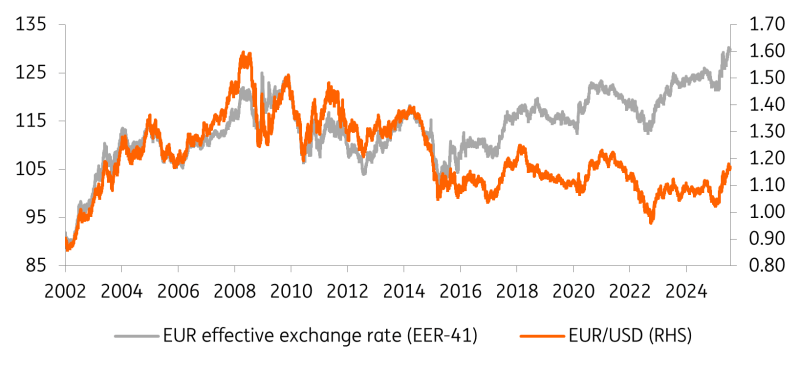
During an interview in Sintra, the ECB’s Vice President Luis de Guindos uncharacteristically mentioned a specific level for EUR/USD: 1.20 – beyond which things could become more “complicated”. We wouldn’t take this comment at face value, as the rate of change generally matters more than a specific level for central banks. But Guindos hasn’t been the only Governing Council member willing to put the exchange rate on the table, and (as shown below) the euro is very strong on a trade-weighted basis.
We think a relatively quiet July meeting could feature some heightened scrutiny on how comfortable policymakers would be with another euro rally. FX considerations may not make their way to official communication, but could help tilt the balance to a more dovish overall tone.
Euro is very strong on a trade-weighted basis
Source: ING, Refinitiv
The ECB has limited control over EUR/USD
If indeed the ECB wants to do something about the euro, the good news is that the beta of EUR/USD to short-term rate swaps in our model is at the highest since 2022. The bad news is that it’s less than half the beta of 2022. And remember EUR/USD reacts to the ECB:Fed pricing differential. The ECB is at the end of its easing cycle, while the scope for surprises on the dovish side by the Fed is much larger.
To put it simply, Fed pricing – therefore US data – has an asymmetrically larger impact on EUR/USD, even when excluding other dominant US-centred themes (de-dollarisation, USD hedging flows, policy uncertainty, debt sustainability concerns). While support for a more dovish stance to limit the euro’s strength may emerge, the effective FX outcome would depend more on the Fed than the ECB itself.
For what concerns this meeting, expect any mention by the ECB of EUR strength being taken into account to hit the euro. EUR/USD remains overbought and our tactical preference remains bearish, regardless of the ECB’s communication.
Rates may be sensitive to the ECB’s take on trade tensions
Market pricing is strongly anchored around an ECB landing zone of 1.75%, but the timing of the next cut is still up for debate. For this meeting, a zero probability is priced and this increases to approximately 50% for September. But with the many uncertainties, we doubt markets will get more clarity about the timing during this meeting.
One of these uncertainties is trade tensions, to which markets seem to have turned more sensitive again this week. The ECB’s take on the potential tariff risks may therefore be a trigger of material rate moves. A more disconcerting tone could have markets reconsidering a 1.5% landing zone, as it did just after 'Liberation Day'. On the other hand, with the aforementioned downside inflation risks, a more optimistic take is unlikely to move rates up by much.
Read the original analysis: July ECB cheat sheet: Currency heatwave
Author
ING Global Economics Team
ING Economic and Financial Analysis
From Trump to trade, FX to Brexit, ING’s global economists have it covered. Go to ING.com/THINK to stay a step ahead.

















