The Fed is supposed to be focused on inflation and its trajectories and lags

Outlook: We get the least of the labor market data today, jobless claims. Last week the analysts made hay out of the big rise in continuing claims, and they will likely do it again.
The sub-par ADP outcome has inspired the gloomsters to come out in droves, again, saying the idea of a soft landing is foolish. It will be recession (and this promotes the notion of lots of rate cuts and starting soon). We have been hearing the recession story for over a year and somehow it never comes….
But again, job growth might be modest but it’s not horribly low and as we wrote yesterday, modest job growth is not the same thing as a labor market that is no longer tight. It’s still tight, just not suffocating.
Let’s jump overboard and assume nonfarm payrolls rivals the ADP in terms of disappointing to the downside. Remember a few years ago we expected something like 120,000 and got 43,000? Stuff like this can happen, although probably not right when striking workers are back.
But the point is whether from the various jobs reports we can legitimately deduce that if jobs are disappointing—not falling but rising less than seems robust—the economy is in trouble. Well, maybe, but probably not. First there is the weird Covid effect, which apparently took a whole lot of folks out of the labor market. Presumably there are conditions that would bring them back, like better wages and nearly as important, working conditions. This includes fairer practices for temps, for example.
Second, we seem to be alone in always mentioning the gray and black economy. It gets a nod now and then, but it could be a big deal. If just 10% of the workforce is working off the books, that’s about 16 million persons. Aside from the tax implications, these are people ordering pizzas, buying cars and stocking up for Christmas.
Third, there is the productivity factor. Jobs lost in manufacturing (-15,000 in one month) and hospitality (-7,000), for example, are perhaps being replaced with various electronic capabilities. Japan has managed productivity gains in the absence of more workers.
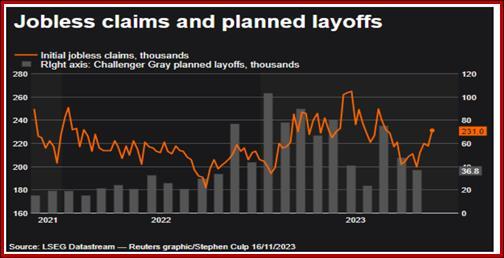
Having said all that, Reuters has a scary chart showing jobless claims perhaps turning a corner and the Challenger planned layoffs not too bad but a lot higher than in 2021.
Bottom line—it can be a mistake to infer so much from the jobs data. It’s misleading. In a free economy the size of the US, that should not be a surprise. The US is more like (say) Italy than the highly regulated Germany.
And besides, jobs are a level or two away from inflation. The Fed is supposed to be focused on inflation and its trajectories and lags. At a guess, the Fed looks at the jobs data and puts it in the drawer.
Keep the job data shortcomings in mind when looking at the rate cut problem. We are not alone in discerning two camps in the Fed rate cut battle. There’s one that sees multiple cuts starting in March if not earlier and cuts totaling 1% if not more. The more modest, sane and historically consistent camo has two cuts at most and starting in July, if not later.
The FT had a story yesterday on a study done of 40 “leading academic economists” that shows almost two-thirds expect the start of cuts in Q3 next year and 50 bp at most. The study was done at the U of Chicago Business School (seriously, deeply conservative). One argument: the economy is running along robustly and doesn’t need rate cuts to goose it into gear. Others point to the perpetual problem of oil prices coming back to deliver an inflation spike.
Besides, the core PCE price index is not likely to hit the 2% target even by Dec 2024. It will likely be 2.7%. And growth will taper off to 1.5% next year from the stratospheric levels now. The economists do not, apparently, believe this is a reason for the Fed to cut rates. It’s still a soft landing. As for QT, that will keep going and end perhaps in Q3 next year.
This should all sound familiar because it’s the narrative we have been expressing for some time, but here comes the hard part—an economist is someone who, if you forget a phone number, is willing to forecast it for you. Like so many economists, they seem divorced from markets and not willing to give any credit whatever to folks who are, after all, placing bets. But those bettors are not choosing random numbers. They think the deck is stacked or the wheel is rigged, and they can see in what way, hence the seemingly lop-sided bets.
Of course that’s true only of the leaders of the non-conformist crowd. Most of the crowd is literally crowd-following and don’t know jack. It’s not realistic to dismiss all of the crowd simply because it’s a crowd and by definition irrational.
We rail against the lack of respect the markets show the Fed, but in many instances, the crowd is correct to say the Fed is almost always behind the curve. Look how long it took for the Fed to figure out that inflation was rising horribly to 8.93% in June 2022. Granted, the Fed had started hiking in March from effectively zero in Q1, but the May hike was “only” 50 bp. Then the Fed acted decisively, with 75 bp per meeting for the next four meetings.
So, the Fed did the right thing, but the critics say it should have foreseen that supply chain issues and the post-Covid consumer behavior was always going to drive inflation to 9%. This means the market thinks the Fed’s crystal ball is cloudy while its own is clear, and that’s not a bad analogy. The market was right; the Fed was wrong.
That doesn’t mean the market is right this time, although we saw a mention the other day that the Taylor Rule would have Fed funds at zero by now. That is probably an exaggeration but checking legit sources like the regional Feds, we do not find an updated version, although many sites offer calculators. This is far down in the weeds and doesn’t help this week (all the estimates are higher than Fed funds now).
Tidbit: Technical analyst McClelland, a smart guy, suggests the Fed should be looking at the 2-year yield rather than anything else. He has a dandy chart showing a tight correlation of the 2-year with the Fed funds target rate. At the moment, the 2-year is dipping, suggesting the Fed is behind the curve—again.
Well, probably not. The 2-year is tracking the Fed funds rate, but that doesn’t mean it has predictive power, let alone prescriptive capability. Still, an interesting chart.
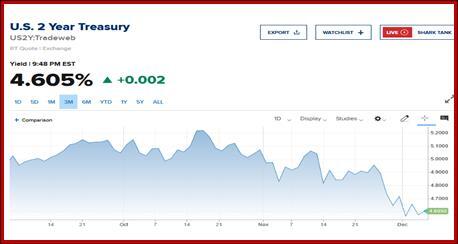
We guess an equally important point is when the yield curve un-inverts. The inverted yield curve is seriously abnormal. If the 2-year is dipping and we need to expect normalization, that means the 10-year has fallen too much and “should” go back to 5%. It would take some bad last-mile inflation news to get that effect. Just saying.
Forecast: We try not to be a stopped clock—right twice a day. But it seems clear the bond market rally is overdone and has to get unwound at some point. On the yield differential basis, that’s dollar-supportive, but don’t hold your breath.
It’s not enough to state decisively, but it looks like the dollar’s pushback momentum is faltering. A big problem is failure in some cases (AUD) but continuation is others (EUR).
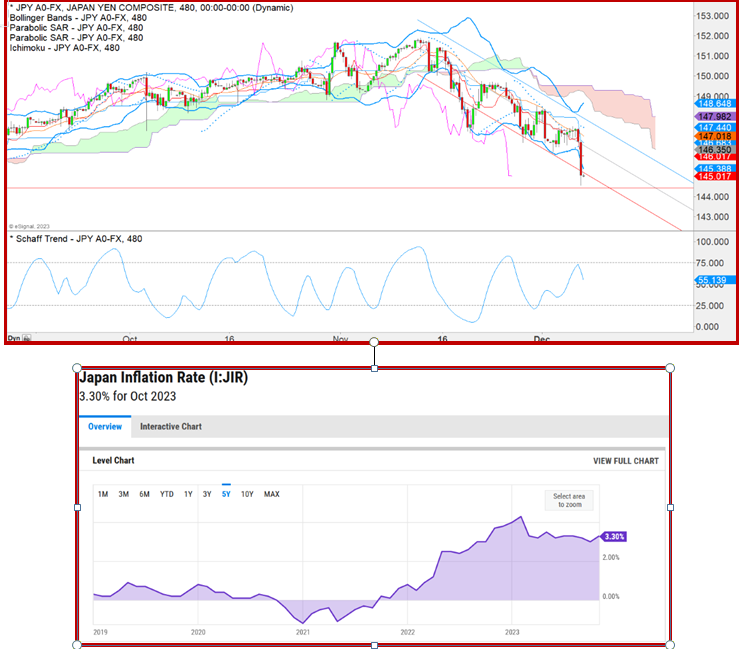
Not to be rude to Mr. Ueda, but he had to know his comments, repeated in spirit after meeting with PM Kishida (they talked about wages), would set off the dollar/yen to the lowest since last Sept 1 (144.43). The chart is of 8-hour bars. So what is he up to? The Treasury is not going to name Japan a currency manipulator but that’s what it just did. The excuse is probably to rein in speculators or something. It’s also the anniversary of Pearl Harbor.
The yen might be a distraction from the other currencies where central banks have a more conventional view of the inflation/interest rate relationship, but it could also be a cat among the pigeons—causing everyone to question the inflation mandate. Chief Ueda may be just giving lip-service to it since inflation has not fallen enough in Japan to justify talk of changing rates, at least not now (3.30% at the latest and moving down glacially). The inflation chart is from Y-Charts.
This is an excerpt from “The Rockefeller Morning Briefing,” which is far larger (about 10 pages). The Briefing has been published every day for over 25 years and represents experienced analysis and insight. The report offers deep background and is not intended to guide FX trading. Rockefeller produces other reports (in spot and futures) for trading purposes.
To get a two-week trial of the full reports plus traders advice for only $3.95. Click here!
This is an excerpt from “The Rockefeller Morning Briefing,” which is far larger (about 10 pages). The Briefing has been published every day for over 25 years and represents experienced analysis and insight. The report offers deep background and is not intended to guide FX trading. Rockefeller produces other reports (in spot and futures) for trading purposes.
To get a two-week trial of the full reports plus traders advice for only $3.95. Click here!
Author
Barbara Rockefeller
Rockefeller Treasury Services, Inc.
Experience Before founding Rockefeller Treasury, Barbara worked at Citibank and other banks as a risk manager, new product developer (Cititrend), FX trader, advisor and loan officer. Miss Rockefeller is engaged to perform FX-relat

















