Japan’s recent data are boosting BoJ rate hike odds


Inflation, Retail Sales, and industrial production: Signals for Japan's economic outlook
Recent data on inflation, retail sales, and industrial production reveal a nuanced picture of Japan's economic trajectory, highlighting both challenges and opportunities for the Japanese economy, with implications for the Bank of Japan’s (BOJ) monetary policy as it navigates toward normalization.
Inflation: Rising costs amid waning subsidies
In November, inflation in Tokyo, a key bellwether for nationwide price trends, accelerated for the first time in three months. The Tokyo core consumer price index (CPI) rose by 2.2% year-on-year, surpassing market expectations of 2.1% and climbing from October’s 1.8% increase. This uptick was driven by rising electricity and gas bills, a result of the government scaling back utility subsidies introduced earlier in the year to counter soaring summer energy costs.
Energy prices rose by 7.4% in November as the effects of these subsidies faded, while food costs also surged. Prices for non-perishable food items increased 4% year-on-year, with significant spikes in specific items like rice (up 62.8%, the largest recorded increase since 1971), chocolate (28.5%), and coffee beans (23.3%).
Beyond food and energy, service-sector inflation gained momentum, with prices rising 0.9% in November year-on-year compared to 0.8% in October. This steady increase reflects businesses passing higher labor costs onto consumers, a sign of sustained wage growth. Notably, another core inflation index that excludes both fresh food and fuel—closely watched by the BOJ as a measure of demand-driven inflation—rose by 1.9% in November, slightly up from 1.8% in October.
The acceleration in service prices and broader inflation suggests that the BOJ’s efforts to foster demand-driven price increases are yielding results. Masato Koike, senior economist at Sompo Institute Plus, remarked, "Prices are rising not just for food but also for services, which is positive news for the BOJ in normalizing policy."
As Tokyo’s inflation trends often set the tone for nationwide data, the upcoming release of the November CPI figures on December 20 will offer further clarity on the inflationary trajectory and its implications for the Japanese economy in 2024. In October, the annual Japanese inflation rate reached its lowest reading since the beginning of the year by falling to 2.3%, from 2.5% in September.
Retail Sales: Mixed signals from consumer spending
Retail sales data for October revealed a modest monthly increase of 0.1%, bringing the total sales value to ¥13.8 trillion (~$91.8 billion). While this fell short of investor expectations, year-on-year sales growth reached 1.6%, nearly double September’s 0.7% rise. The annual gain reflects improved consumer demand, as the volume of goods sold grew by 4.8% compared to the same period in 2023.
Despite the modest monthly growth, October’s retail performance highlights resilience in consumer spending, even amid rising prices. Increased retail activity aligns with the BOJ’s broader goal of creating a virtuous cycle of spending and price growth. However, the modest growth rate on a monthly basis points to lingering caution among consumers, potentially influenced by higher living costs.
Industrial production: A bright spot in October
Preliminary data for the industrial production provided a positive surprise, with output rising 3.0% in October from the previous month, significantly outpacing September’s 1.6% increase.
Industrial output expanded for the second straight month and the strongest rise since the month of July. Industrial output increased by 1.6% year-over-year in October, marking a significant turnaround from the 2.6% decline in September and ending a three-month streak of declines.
This robust performance potentially signals renewed momentum in the manufacturing sector, buoyed by stronger demand both domestically and internationally. The October surge in production could be reflecting resilience in Japan’s industrial base, an essential driver of the broader economy. Stronger output not only supports employment but also helps mitigate the impact of rising input costs on businesses.
Implications for Japan’s economy and policy
On one hand, rising inflation aligns with the BOJ’s long-term goal of achieving sustainable price growth towards its 2% target. On the other hand, the modest growth in retail sales highlights the ongoing challenges for consumer confidence in the face of higher costs.
The better-than-expected growth in industrial production offers a stabilizing counterweight, suggesting that Japan's economic recovery remains on track. Furthermore, the consumer confidence index rose to 36.4 in November 2024, up from October’s five-month low of 36.2, reflecting improved household sentiment across key areas such as income growth, willingness to purchase durable goods, and overall livelihood. Sustaining this momentum could bolster economic stability and further drive domestic consumption.
For the BOJ, the acceleration in inflation and improving consumer demand are positive signs, reinforcing the case for eventually keeping phasing out ultra-loose monetary policies. However, analysts are divided about the next move from the BOJ.
While some believe that this data could support the idea of an interest-rate increase during the BOJ’s next meeting late December, pushing the Japanese Yen (JPY) higher, others believe that such a move might not happen before 2025. As Japanese policymakers should be careful not to stifle economic momentum, particularly if consumer spending remains fragile, there are other risks that need to be taken into account such as geopolitical tensions and the impact of US policies on global trade and prices.
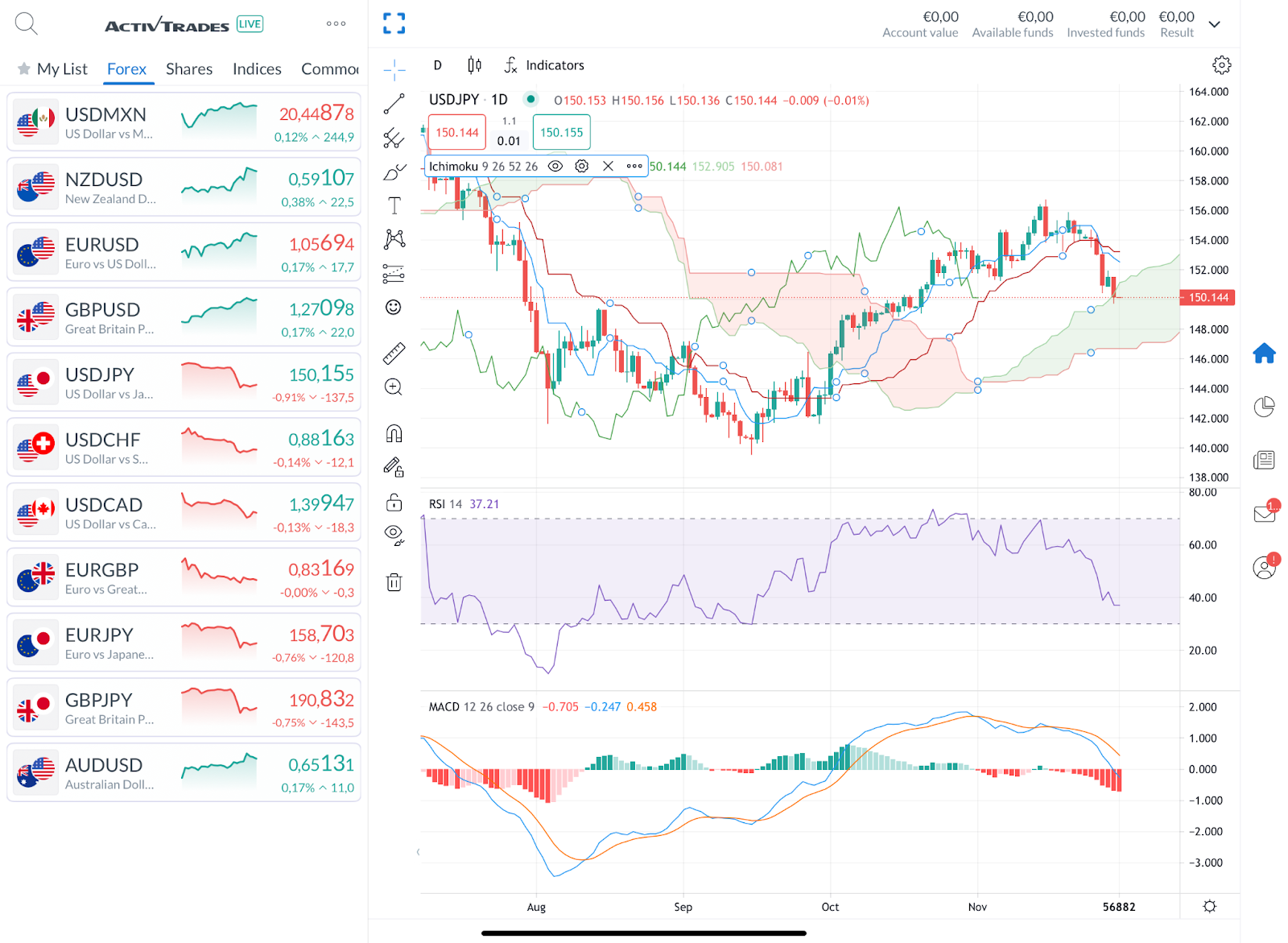
Daily USD/JPY Chart from the ActivTrader’s Trading Platform
The information provided does not constitute investment research. The material has not been prepared in accordance with the legal requirements designed to promote the independence of investment research and as such is to be considered to be a marketing communication.
All information has been prepared by ActivTrades (“AT”). The information does not contain a record of AT’s prices, or an offer of or solicitation for a transaction in any financial instrument. No representation or warranty is given as to the accuracy or completeness of this information.
Any material provided does not have regard to the specific investment objective and financial situation of any person who may receive it. Past performance is not a reliable indicator of future performance. AT provides an execution-only service. Consequently, any person acting on the information provided does so at their own risk.
Stay up to date with what's moving and shaking on the world's markets and never miss another important headline again! Check ActivTrades daily news and analyses here.
Author
Carolane de Palmas
ActivTrades
Carolane graduated with a Masters in Corporate Finance & Financial Markets and got the AMF Certification (Financial Markets Regulator in France). Afterward, she became an independent trader, investing mostly in European and American stocks/indices.

















