Japanese Yen yawns as Tokyo Core CPI jumps

The Japanese yen is drifting on Tuesday. In the European session, USD/JPY is trading at 150.44, down 0.05%.
Tokyo rises 2.5% as expected
Today’s release of Tokyo Core CPI, which excludes fresh food and is considered Japan’s important inflation indicator, had no effect on the Japanese yen, as February’s gain of 2.5% y/y was in line with market expectations. Still, this marked a significant jump after the revised 1.8% gain in January. The ‘core core’ CPI release, which strips away fresh food and fuel costs, dipped to 3.1% in February, down from 3.3% a month earlier.
All eyes are on the Bank of Japan meeting on March 18-19, with investors on the alert for signs that the central bank plans to phase out its ultra-loose monetary policy. The BoJ is unlikely to make a major move at the upcoming meeting, although investors have been burned more than once by the BoJ catching the markets off guard. A pivot in policy is more likely in June.
With speculation running high that something is afoot at the BoJ, every development related to the BoJ has the potential to be a market mover. Last Thursday, BoJ board member Hajime Takata said that the BoJ must overhaul is ultra-loose monetary policy, including an end to negative rates and removing bond yield control. Takata hinted that the BoJ was close to its 2% inflation target, and the yen climbed as much as 1% following Takata’s comments . However, the yen pared much of these gains later that day after BoJ Governor Ueda distanced himself from Takata’s comments, saying that the BoJ was not close to sustainably achieving the 2% target.
This was followed by a report on Monday that the government was preparing to announce that deflation was officially over. This would have been a symbolic move but would likely be viewed by the markets as another signal that Tokyo is planning to remove negative interest rates in the next several months. It didn’t take long for Finance Minister Suzuki to deny the report earlier today.
The back-and-forth we are seeing only heightens the uncertainly ahead of next week’s meeting and that could mean more volatility for the Japanese yen in the coming days.
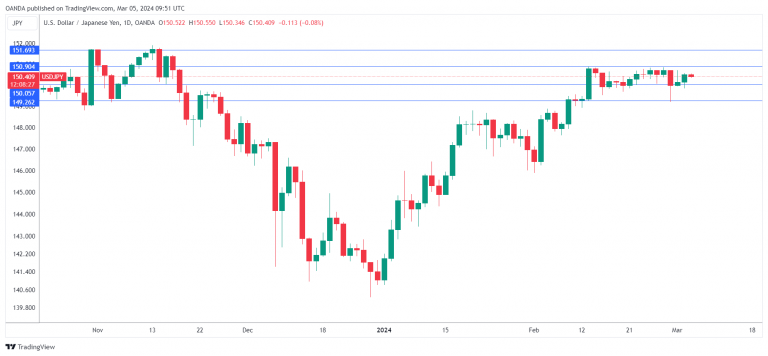
USD/JPY technical
-
There is resistance at 150.90 at 151.69.
-
150.05 and 149.26 are providing support.
Author

Kenny Fisher
MarketPulse
A highly experienced financial market analyst with a focus on fundamental analysis, Kenneth Fisher’s daily commentary covers a broad range of markets including forex, equities and commodities.


![How Wall Street rigs the game [Video]](https://editorial.fxsstatic.com/images/i/market-chaos-01.jpg)