|

Japan: Consumer spending is suffering

The Japanese economy ended 2019 on a negative note.

As has happened before, consumer spending was hit by the VAT hike introduced in October.

Typhoon Hagibis also put a significant dent in domestic demand, particularly in the area of private sector business investment.

The start of 2020 looks difficult given the Coronavirus outbreak and the close economic relations between Japan and China.

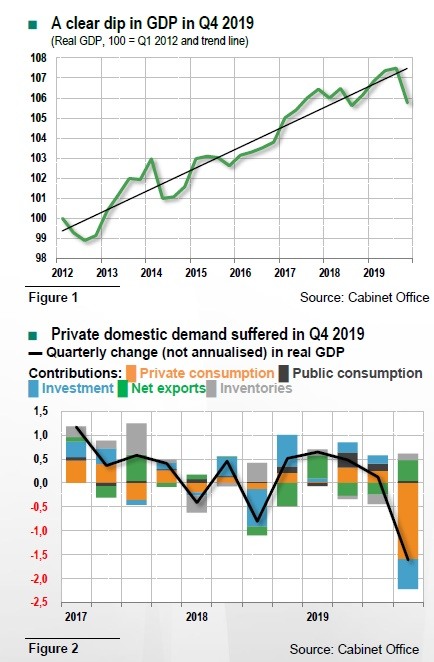
Japan experienced a sharp contraction in GDP in the fourth quarter of 2019 (Figures 1 and 2). GDP fell by -1.6% (quarteron- quarter, non-annualised), its biggest contraction since the - 1.9% fall in the second quarter of 2014. This poor performance was due to falling private domestic demand. Consumer spending was hit particularly hard. Over the year as a whole, the Japanese economy grew by 0.7%.
fxsoriginal

Collapse in private consumption, significant weakness in business investment

The Japanese economy suffered from two sizeable shocks in the final quarter of 2019.

First, having delayed its implementation, the authorities decided at last to increase VAT from 8% to 10% in October 2019. This was the 3rd increase since the tax was introduced (1997, 2014 and now 2019). The last time the rate was raised, Japanese consumers significantly reduced their spending. The fall in private consumption of around 3% (q/q) in the 4th quarter of 2019 is less than the 4.8% contraction in Q2 2014 when VAT was raised from 5% to 8%.

The fourth quarter was also affected by a typhoon which did significant damage to domestic demand. Against this background, private non-residential investment fell by nearly 4% (q/q) in Q4 2019 relative to Q3. A quiet decent growth of public sector investment came nowhere near offsetting the drop in investment by private companies.

Download The Full Ecoflash

Author

BNP Paribas Team

BNP Paribas Team

BNP Paribas

BNP Paribas Economic Research Department is a worldwide function, part of Corporate and Investment Banking, at the service of both the Bank and its customers.


More from BNP Paribas Team
Share:

Editor's Picks

USD/JPY consolidates near 160.50 intervention zone ahead of FOMC decision

USD/JPY remains close to the 160.50 intervention zone during the Asian session on Wednesday. Despite the BoJ's rate hike to its highest level since 1995, Japan's borrowing costs remain significantly lower than those of peer nations such as the US. Moreover, the BoJ's more cautious stance on bonds undermines the Japanese Yen and supports the currency pair. Meanwhile, the US Dollar remains on the back foot amid the optimism over the US-Iran peace deal and ahead of the Fed policy decision, capping spot prices.

AUD/USD holds steady above 0.7050; looks to Fed decision for fresh impetus

AUD/USD is seen consolidating above mid-0.7000s during the Asian session as traders await the outcome of a two-day FOMC meeting later this Wednesday. In the meantime, the optimism over an interim peace deal between the US and Iran keeps the US Dollar bulls on the defensive. This, along with the RBA's hawkish pause on Tuesday, acts as a tailwind for the currency pair.

Gold: $4,000 or $4,500? The Fed may decide Gold’s next big move

Gold now surrenders part of its initial advance and recedes to the vicinity of the $4,350 mark per troy ounce on Tuesday. The early enthusiasm sparked by the US-Iran peace deal has faded somewhat, prompting investors to adopt a more prudent stance as they await further details of the agreement and key guidance from the Fed.

XRP pulls back as subdued ETF inflows, layered resistance cap upside
Ripple (XRP) remains elevated above $1.23 at the time of writing on Tuesday, struggling amid a capped upside. Despite an improved overall market sentiment driven by news of a peace agreement between the United States and Iran to end the war in the Middle East, capital inflows remain notably subdued.
1% rate, 160 Yen: Why Japan’s historic hike changed little
The Bank of Japan (BoJ) pushed its short-term policy rate to 1% on Tuesday, the highest setting since 1995 and a 31-year milestone in a normalization cycle barely two years old. It is the kind of number that should mark a turning point for the Yen, and it did almost nothing.
Why a hawkish RBA is no longer enough to lift the Australian Dollar

The Reserve Bank of Australia delivered more than what markets expected: a hawkish hold that should have supported the Aussie. But markets widely ignored it, focusing instead on slowing economic growth and proving that central bank messaging alone isn’t always enough to drive currencies.