|

Italy stages a recovery

The Italian real GDP over the past three years is higher than previously estimated, thanks to the 2024 general revision of the national accounts. This revision, which is undertaken every five years and was published by the Italian National Institute of Statistics (Istat) on 23 September1, includes the basis change with reference year 2021. As a result, real GDP is finally, albeit only slightly, above the level posted before the 2008 financial crisis (0.6 pp higher in Q2 2024 than in Q4 2007).
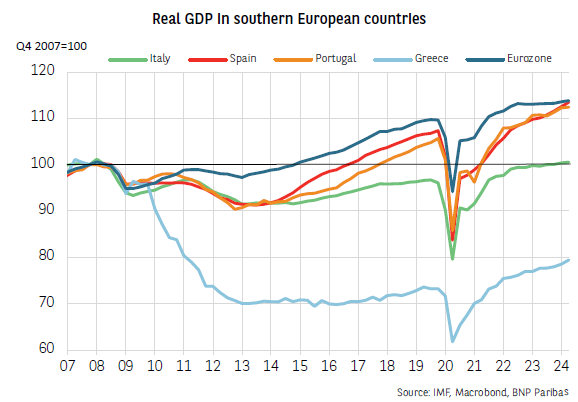
Italy is thus the last of the four “major countries“ in the Eurozone to have returned, albeit very belatedly, to its pre-financial crisis level. Focusing on the southern European countries (PIGS), with the exception of Greece, Spain had recovered to this level by the end of 2016, followed by Portugal at the end of 2017.

During the post-sovereign debt crisis period, i.e. from 2014, Italy’s real GDP grew significantly more slowly than Spain’s and Portugal’s. In the end, it took until the post-Covid period for activity to finally take off, with average annual growth of 4.8% between 2021 and 20232, compared to 3.3% for the Eurozone. This recovery was driven by the rebound in private consumption and the Superbonus tax incentive scheme for energy-efficient building renovation, which has significantly stimulated construction investment3.

The simultaneous revision of the national accounts and public finance aggregates has also led to a slight improvement in the fiscal deficit for 2022 and 2023. In the end, the fiscal deficit stood at -8.1% and -7.2% of GDP for 2022 and 2023 (compared to the estimates of -8.6% and -7.4% from last April), which, nevertheless, is still far above the level set out in the SGP’s rules.

Download The Full Eco Flash

Author

BNP Paribas Team

BNP Paribas Team

BNP Paribas

BNP Paribas Economic Research Department is a worldwide function, part of Corporate and Investment Banking, at the service of both the Bank and its customers.


More from BNP Paribas Team
Share:

Markets move fast. We move first.

Orange Juice Newsletter brings you expert driven insights - not headlines. Every day on your inbox.

By subscribing you agree to our Terms and conditions.

Editor's Picks

EUR/USD flatlines below 1.1800 amid trading lull, awaits Fed Minutes

EUR/USD trades around a flatline below 1.1800 in European trading on Tuesday. The pair lacks any trading impetus as the US Dollar moves little amid market caution ahead of the Fed's December Meeting Minutes release, which could offer insights into the Federal Reserve’s 2026 outlook.

GBP/USD retakes 1.3500 despite the year-end grind

GBP/USD finds fresh demand and retakes 1.3500 on Tuesday as markets grind through the last trading week of the year. Despite the latest uptick, the pair is unlikely to see further progress due to the year-end holiday volumes.

Gold holds the bounce on Fed rate cut bets, safe-haven flows

Gold holds the rebound near $4,350 in the European trading hours on Tuesday. The precious metal recovers some lost ground after falling 4.5% in the previous session, which was Gold's largest single-day loss since October. Increased margin requirements on gold and silver futures by the Chicago Mercantile Exchange Group, one of the world’s largest trading floors for commodities, prompted widespread profit-taking and portfolio rebalancing.

Tron steadies as Justin Sun invests $18 million in Tron Inc.

Tron (TRX) trades above $0.2800 at press time on Monday, hovering below the 50-day Exponential Moving Average (EMA) at $0.2859.

Economic outlook 2026-2027 in advanced countries: Solidity test

After a year marked by global economic resilience and ending on a note of optimism, 2026 looks promising and could be a year of solid economic performance. In our baseline scenario, we expect most of the supportive factors at work in 2025 to continue to play a role in 2026.

Crypto market outlook for 2026

Year 2025 was volatile, as crypto often is.  Among positive catalysts were favourable regulatory changes in the U.S., rise of Digital Asset Treasuries (DAT), adoption of AI and tokenization of Real-World-Assets (RWA).