|

Italian Banks and BTPs: a dangerous liaisons

Following the Brexit and following Trump’s election, market focus obviously turns to the Italian Referendum. Among political and market commentators, there is a feeling that Renzi’s premiership is clearly at risk: The No campaign is ahead in pools and, in particular, the protest vote seems to have no intention to stop, especially in Europe.

As a result of this political turmoil, Italian government bonds remain constantly under pressure and the underperformance of the Italian 10Y generic BTP versus the Spanish 10Y generic BONOS, since the referendum announcement day (April 2016), already sent a clear message in that sense.
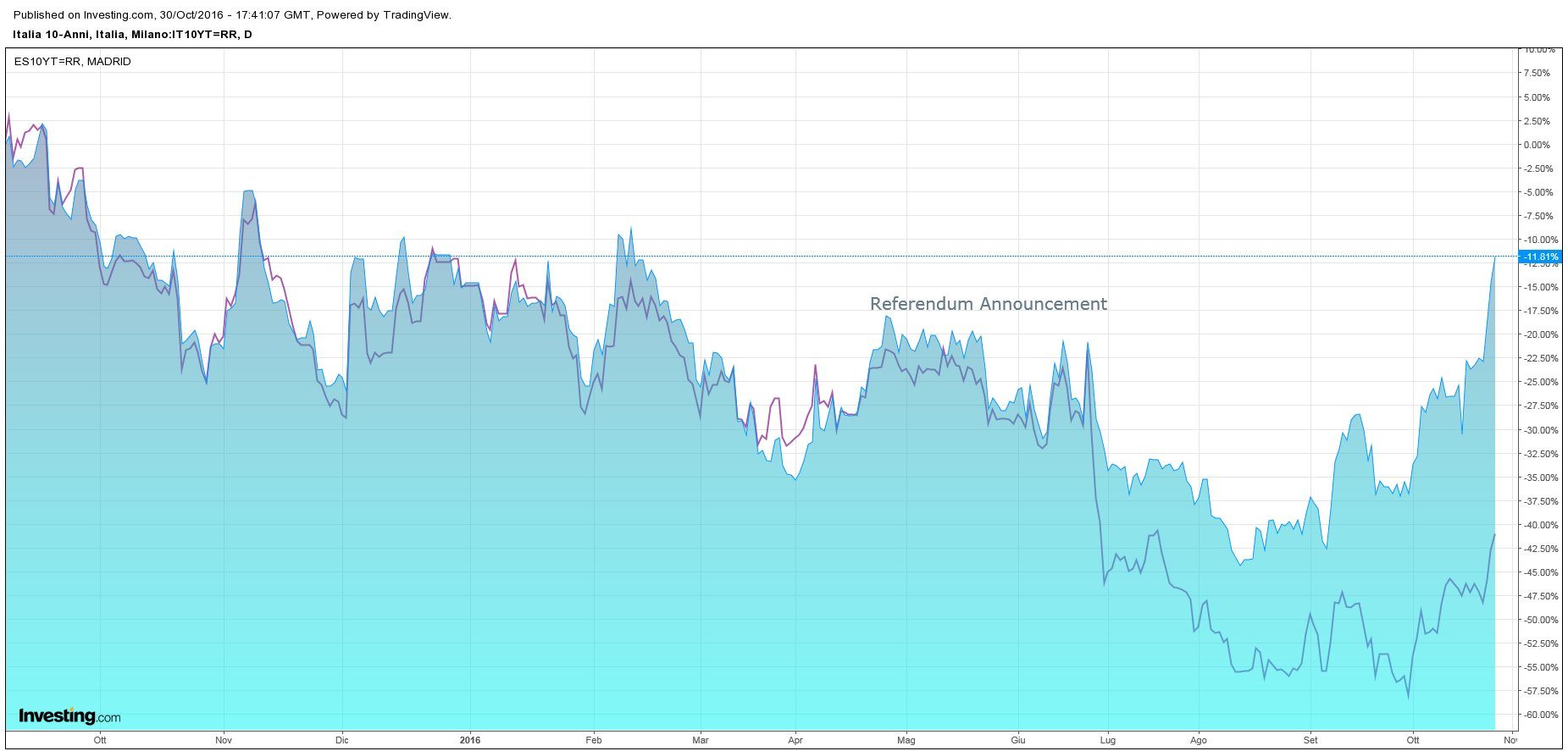
Italian

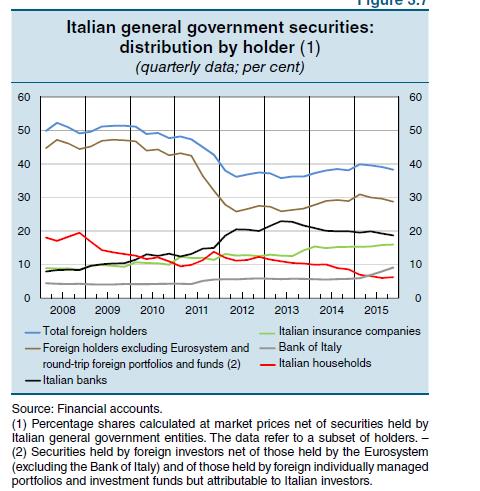
The credit spread widening of Italian government bonds has also negative implication for Italy's fragile banking system, still trying to deal with the non-performing loans (NPLs) issue, estimated to total 360 billion euros ($400.7 billion).  As indicated by the most recent Financial Stability Report (Bank of Italy), since 2008 total foreign holders of Italian BTP’s strongly declined while holdings of Italian banks, insurance companies and the Bank of Italy increased. 
 

Comparing the FTSE Italia All Share banks, the main index on the Italian banking sector, and the 10Y BTP's yield we main find a clear negative correlation, with some time lag. In addition expectations of a limited extension of the ECB quantitative easing program and the uncertain political scenario in Italy are likely to put addtional pressure on yield. In conclusion, the Italian banking industry is going through an intense reshaping of its business model, in some case with a clear need of capital injections. The recent sell-off in the government bonds space, Italian included, is unlikely that will provide some relief.
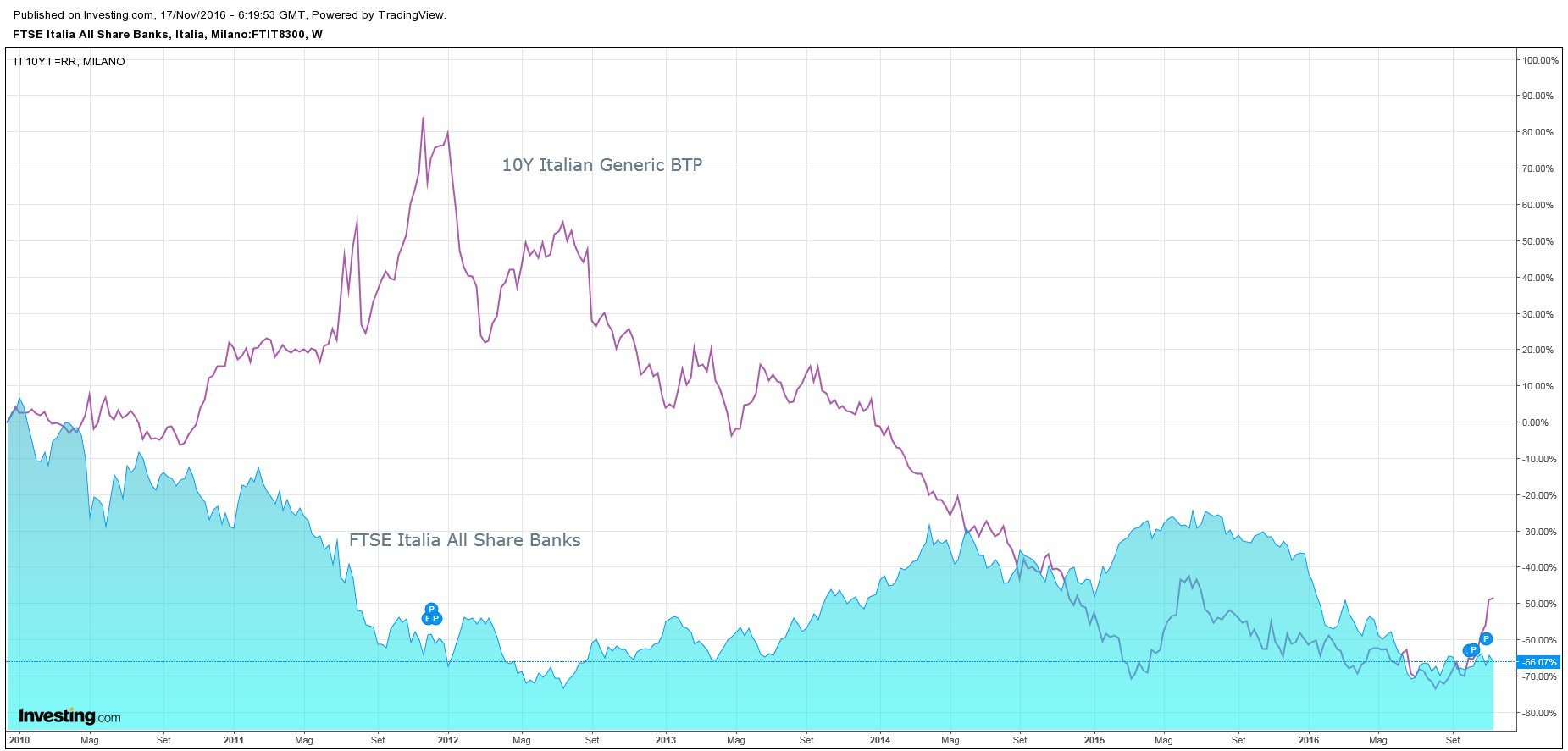
FTSE


Author

Edoardo Fusco Femiano, CFTe

Edoardo Fusco Femiano, CFTe

Independent Analyst

Edoardo is an independent trader and investment advisor with more than 10 years of experience in Portfolio Management, FX and Equity Trading, Investment Research and Risk Management within primary financial institutions (Vatican B


More from Edoardo Fusco Femiano, CFTe
Share:

Editor's Picks

EUR/USD struggles near 1.1850, with all eyes on US CPI data

EUR/USD holds losses while keeping its range near 1.1850 in European trading on Friday. A broadly cautious market environment paired with a steady US Dollar undermines the pair ahead of the critical US CPI data. Meanwhile, the Eurozone Q4 GDP second estimate has little to no impact on the Euro. 

GBP/USD recovers above 1.3600, awaits US CPI for fresh impetus

GBP/USD recovers some ground above 1.3600 in the European session on Friday, though it lacks bullish conviction. The US Dollar remains supported amid a softer risk tone and ahead of the US consumer inflation figures due later in the NA session on Friday. 

Gold remains below $5,000 as US inflation report looms

Gold retreats from the vicinity of the $5,000 psychological mark, though sticks to its modest intraday gains in the European session. Traders now look forward to the release of the US consumer inflation figures for more cues about the Fed policy path. The outlook will play a key role in influencing the near-term US Dollar price dynamics and provide some meaningful impetus to the non-yielding bullion.

US CPI data set to show modest inflation cooling as markets price in a more hawkish Fed

The US Bureau of Labor Statistics will publish January’s Consumer Price Index data on Friday, delayed by the brief and partial United States government shutdown. The report is expected to show that inflationary pressures eased modestly but also remained above the Federal Reserve’s 2% target.

A tale of two labour markets: Headline strength masks underlying weakness

Undoubtedly, yesterday’s delayed US January jobs report delivered a strong headline – one that surpassed most estimates. However, optimism quickly faded amid sobering benchmark revisions.

Solana Price Forecast: Mixed market sentiment caps recovery

Solana (SOL) is trading at $79 as of Friday, following a correction of over 9% so far this week. On-chain and derivatives data indicates mixed sentiment among traders, further limiting the chances of a price recovery.