ISM Services PMI Preview: Strong figure set to catapult US Dollar to new highs
- Economists expect the US ISM Services PMI to have declined from 55.2 to 54.4 points in February.
- Robust data from the labor market, manufacturing sector and others point to a better outcome.
- After a period of consolidation, the US Dollar has room for further gains.
- The reaction in stock markets depends on the components of the report.

Consolidation or extension? That is the question for many forex traders when they see prices nearing the limits – and also for the leading indicator for America's largest sector. The Institute for Supply Management (ISM) publishes its Purchasing Managers' Index (PMI) for the services sector, and markets are watching.
ISM Services PMI could stay on the rise
The ISM Services PMI used to work solely as a hint toward the Nonfarm Payrolls (NFP) report, focusing on its Employment component. Yet when inflation began picking up, the Federal Reserve (Fed) and markets shifted their attention toward the Prices Paid component, which reflects inflation.
The headline remains highly important, as the central bank wants a cooler economy. ISM's snapshot report for the sector is roughly 70% of the world's largest economy, therefore, it is critical for markets.
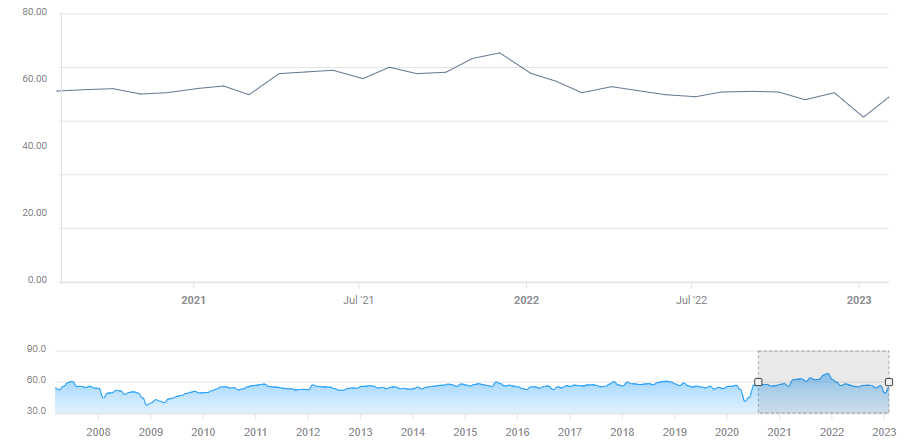
For February, economists expect the ISM Services PMI to fall to 54.4 from 55.2 points recorded in January, a consolidation of the bounce this indicator had experienced after a sharp fall in December. I expect an extension of the gains, rather than stability. Here's why.
ISM Services PMI:
Source: FXStreet
The main reason to have a bullish bias on this report is the heating US economy. Nonfarm Payrolls showed a leap of 517,000 jobs in January, Retail Sales figures topped all estimates, and Durable Goods Orders showed an increase in long-term investment.
Higher demand from China and stable energy prices have also left more money in Americans' pockets for services such as restaurants, hotels, hairdressers, and others. The post-pandemic recovery triggered a growing demand for services and a drop in the consumption of goods.
More importantly, inflation remains elevated, with the Core Consumer Price Index (Core CPI) advancing by 0.4% in January, the highest in several months. Despite the drop in goods consumption mentioned above, the parallel ISM Manufacturing PMI surprised with an increase in its Prices Paid component.
All in all, there are good reasons to expect an increase in the headline ISM Services PMI – and also in its Prices Paid component.
ISM Services PMI set to boost US Dollar, stocks depend on components
Any beat on the headline would show the US economy is heating and that the Fed needs to raise rates further. That is positive for the US Dollar – and so is an increase in the Prices Paid component.
The picture is more complicated for stock markets. On the one hand, higher inflation and elevated rates are undoubtedly adverse for equities, especially tech ones. On the other hand, a strong economy means higher company profits.
Stock investors will be eyeing the headline ISM Services PMI, and also the New Orders component, which is a forward-looking one. Any increase in this indicator would balance an unwelcome rise in the Prices Paid one.
Final thoughts
The US economy is doing well and the ISM Services PMI is set to reflect this strength. The US Dollar has been consolidating its gains and a robust figure may fuel the next leg of the rally.
Author

Yohay Elam
FXStreet
Yohay is in Forex since 2008 when he founded Forex Crunch, a blog crafted in his free time that turned into a fully-fledged currency website later sold to Finixio.