ISM Manufacturing PMI Preview: shutdown, what shutdown?

- ISM Manufacturing PMI expected to be stable at moderate expansion
- Sentiment plunge in December as shutdown fears proves transitory
The Institute for Supply Management will release its February manufacturing purchasing managers’' index at 10:00 am EST, 15:00 GMT on Friday March 1st
Forecast
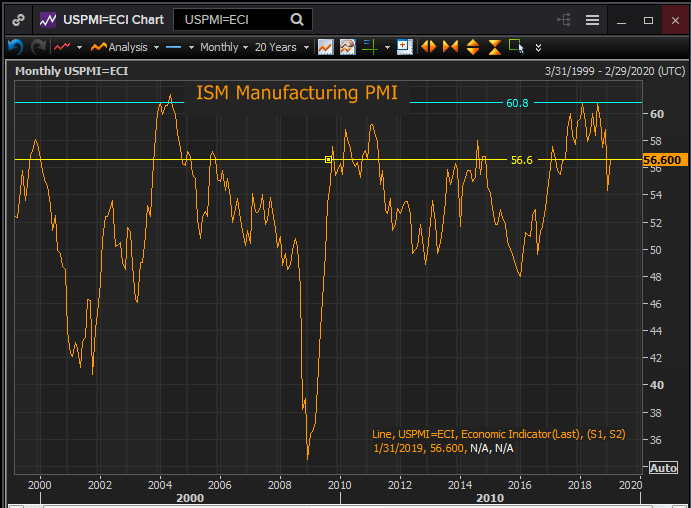
The manufacturing PMI index is expected to decline slightly to 55.5 from 56.6 in January. The prices paid index is predicted to rise to 51.5 from 49.5. The employment index was at 55.5 in January and 56.0 in December. New orders were at 58.2 in January, a recovery from December's steep fall to 51.3.
US Manufacturing: These are the good times
To paraphrase Federal Reserve Chairman Powell, These are the good times for the manufacturing sector. Mr. Powell’s original comment referred to the entire US economy. But no sector has fared better over the past two years than US factories, written off for a generation as a dying breed by analysts and politicians alike.
The manufacturing PMI index reached 60.8 in August last year. That was the highest since May 2004. The 12-month moving average that month was 59.24 the best since November 2004.
Reuters
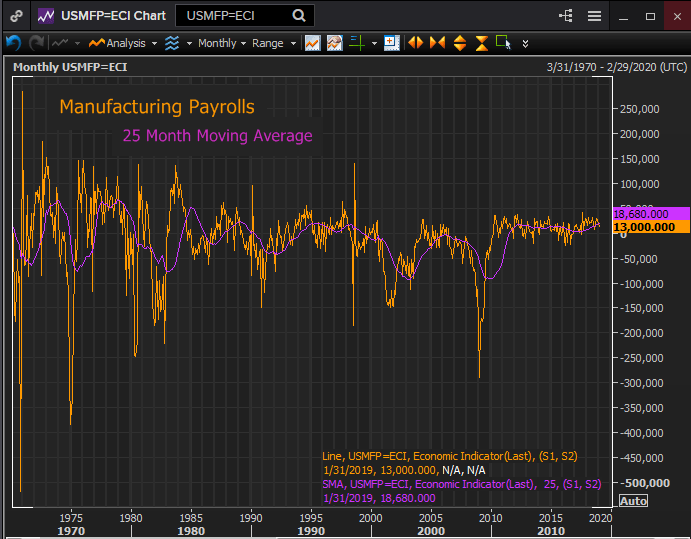
Since the turn of the year in 2017 the US economy has added 467,000 manufacturing jobs. To get a sense of the turnaround that was the best 25 month period since April 2012 when factories had hired 463,000 workers. The difference is that the 25 months prior to February 2010 US manufacturing had lost 2.272 million factory jobs. Barely a fifth were rehired.
Reuters
The much discussed and covered partial government of late December to January 25th has had little effect on the US economy. Consumer sentiment from the Conference Board has recovered into February from a two month drop and the University of Michigan is expected to do the same when the February results are released March 1st.
American firms hired 304,000 new workers in January, a remarkable figure for an expansion four months from the longest on record. The 4.0% unemployment rate has succeeded in bringing people back into the labor force and raising the participation rate to 63.2%, its highest since September 2013.
The ISM Index is nationwide survey of more than 300 purchasing and supply executive conducted monthly by the Institute for Supply Management. Index reading above 50 indicate expansion in that sector.
Author

Joseph Trevisani
FXStreet
Joseph Trevisani began his thirty-year career in the financial markets at Credit Suisse in New York and Singapore where he worked for 12 years as an interbank currency trader and trading desk manager.

















