Is the global Oil market heading for a $50.00 price floor?


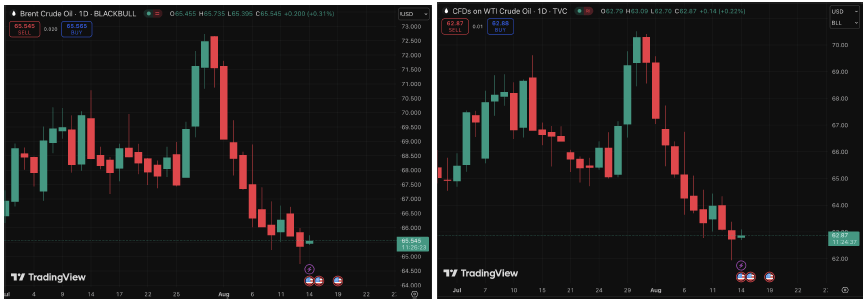
The International Energy Agency (IEA) has warned that the oil market could be heading into a deep surplus over the next two years, with supply growth far outstripping demand. Brent crude prices have already slipped below $66 a barrel, and U.S.
West Texas Intermediate (WTI) is trading close to $62, the weakest level in more than two months. Surging production in the U.S., an accelerated output recovery from OPEC+, and softer consumption forecasts are creating a supply-heavy environment that could push prices towards the $50 mark unless geopolitical events disrupt flows.
Key takeaways
- US oil output hits records: 21 million barrels per day in 2025 despite a drop in active rigs, thanks to advances in shale drilling and well effi ciency.
- OPEC+ ramps up supply: Cuts are being rolled back faster than expected, with additional growth from Brazil, Canada, and Guyana.
- Weak demand outlook: The IEA sees demand growth of just 0.68 million bpd in 2025 and 0.70 million bpd in 2026, less than half OPEC’s forecast.
- Glut warning: The IEA projects a surplus of almost 3 million bpd in 2026 - bigger than the pandemic-era oversupply.
- Possible offsets: Sanctions on Russia and Iran, along with Chinese stockpiling, could temporarily tighten the market.
- Price forecasts: Goldman Sachs expects Brent to average $64 in Q4 2025 and $56 in 2026.
Output growth is dominating market dynamics
The IEA’s August 2025 report lifted its supply growth forecast to +2.5 million bpd this year and +1.9 million bpd in 2026.
This is being fuelled by:
- OPEC+ members are increasing production more quickly after deciding to reverse recent output cuts ahead of schedule.
- Non-OPEC producers led by the U.S., Canada, Brazil, and Guyana are steadily adding barrels.
In the U.S., output growth has been driven by a more effi cient shale sector. Producers are drilling faster, extending well reach, and completing previously drilled wells (DUCs) to bring new supply online without signifi cant extra investment.
Demand growth is losing momentum
The IEA has trimmed its demand outlook slightly, citing weak economic sentiment across major markets and an ongoing shift to renewable energy.
It now expects global oil demand to expand by 680,000 bpd in 2025 and 700,000 bpd in 2026 - both 20,000 bpd lower than prior estimates.
OPEC’s own projection for 2025 demand growth stands at 1.29 million bpd, reflecting a more optimistic view based on expected fuel use in developing economies.
A 2026 oversupply risk
If current trends continue, the IEA sees the oil market facing a 3 million bpd surplus in 2026 - a level that would eclipse the glut seen during the 2020 price collapse.
Even with global refi ning runs expected to hit a record 85.6 million bpd in August, the excess crude may not be absorbed. Brent’s recent slide under $66 suggests the market is already pricing in this imbalance.
Source: TradingView
Geopolitical factors may provide support
Potential supply disruptions could slow or reverse the downward trend:
- Sanctions on Russia and Iran could remove substantial volumes from the global supply.
- Chinese stockpiling has already absorbed excess crude earlier in 2025.
- US–Russia–Ukraine talks could lead to new restrictions on Russian exports, triggering short-term price volatility.
While these risks may lift prices in the short term, the underlying oversupply trend remains strong.
Price scenarios and market outlook
Analysts suggest that if the projected surplus materialises, Brent could trade between $50 and $55 in 2026.
Unexpected production cuts or demand shocks could keep prices above $60, but the balance of risk is tilted towards lower levels.
Oil price technical analysis
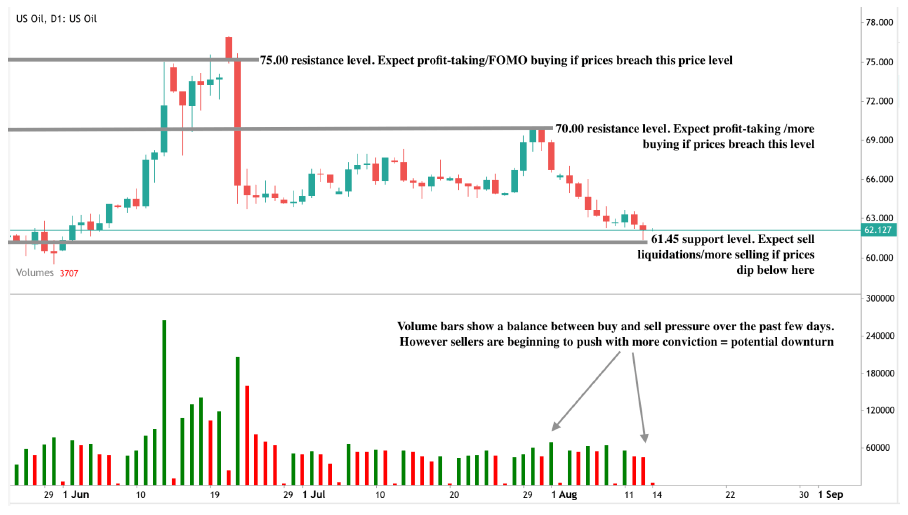
Currently, WTI is trading close to a key support level at $61.45. A bounce from this zone could push prices toward resistance at $70.00 and $75.00, but strong selling pressure is evident in current volumes. Without renewed buying momentum, prices risk breaking lower in the near term.
Source: Deriv MT5
Frequently asked questions
Why could oil prices fall to $50?
Because supply growth - driven by both OPEC+ and non-OPEC producers - is running far ahead of demand, it risks a large surplus.
Who is leading the production increases?
The U.S., Brazil, Canada, and Guyana are key non-OPEC contributors, alongside higher OPEC+ output.
What might stop the decline?
Sanctions on major producers, Chinese reserve building, or a stronger-than-expected demand rebound could keep prices higher.
Does strong refining activity help?
Refi ning runs are at record highs but are unlikely to offset the size of the projected crude surplus.
Investment implications
The market outlook suggests that oil prices could face sustained downward pressure over the medium term.
- Short-term opportunities exist for tactical buys near $61.45 support if geopolitical news sparks rallies.
- Medium-term positioning should factor in capped upside, with $70–$75 likely serving as a ceiling unless supply is sharply curtailed.
- Low-cost producers and effi cient shale operators may remain profi table even at lower prices,
Author
Prakash Bhudia
Deriv
Prakash Bhudia, HOD – Product & Growth at Deriv, provides strategic leadership across crucial trading functions, including operations, risk management, and main marketing channels.