|

Is Silver Poised to Continue Recovering?

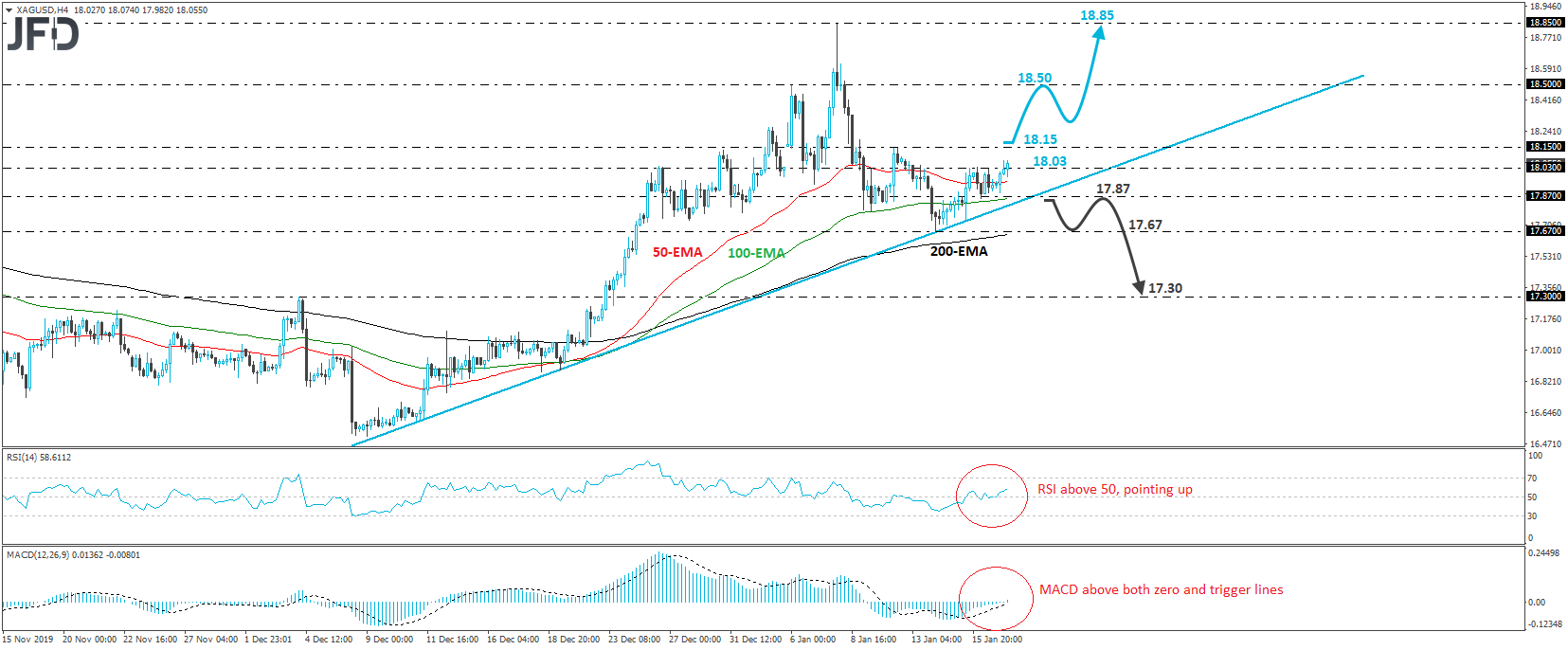
XAG/USD has been in a recovery mode since Tuesday, when it hit the upside support line drawn from the low of December 11th. Today, the metal poked its nose above the 18.03 barrier, marked by Wednesday’s and Thursday’s highs, which combined with the fact that it continues to trade above the aforementioned upside line, suggests that further recovery may be in the works.

However, in order to get more confident on that front, we would like to see a decisive break above the 18.15 zone, defined as a resistance by the high of January 10th. This could wake up more bulls, who could drive the battle higher and conquer the 18.50 zone, marked by the high of January 6th. They could take a break after hitting that zone, thereby allowing the price to pull back. Nonetheless, as long as the white metal would stay above the upside line, we would see decent chances for the bulls to recharge and aim for another test near 18.50. If they manage to bypass that zone this time around, we could see extensions towards the peak of January 8th, at around 18.85.

Taking a look at our short-term oscillators, we see that the RSI rebounded from near its 50 line and now looks to be heading toward 70, while the MACD, already above its trigger line, has just turned positive. These indicators suggest that silver has started picking up upside speed and support the notion for some more advances.

On the downside, we would like to see a clear dip below the 17.87 barrier before we start examining whether the bears have gained the upper hand. Such a dip may also bring the rate below the pre-mentioned upside line and could initially aim for the 17.67 area, defined by the low of January 14th. Another break, below 17.67, may carry larger bearish extensions, perhaps setting the stage for declines towards the 17.30 area, marked as a support by the inside swing high of December 4th.
Chart

JFDBANK.com - One-stop Multi-asset Experience for Trading and Investment Services


Author

More from JFD Team
Share:

Editor's Picks

AUD/USD sticks to positive bias above 0.7100; lacks bullish conviction

AUD/USD trades with a positive bias for the second straight day, holding above 0.7100 in the Asian session on Friday as softer US bond yields keep US Dollar bulls on the back foot. Furthermore, hawkish RBA Governor Bullock's comments boost rate hike bets and support the Aussie. However, the Fed's hawkish outlook, along with geopolitical uncertainties, limits USD losses and caps the pair.

USD/JPY approaches 158.00 as Japanese Yen resumes decline

USD/JPY is resuming its upside in the European session on Friday, refreshing two-week highs and nearing 158.00. The Japanese Yen extends losses, despite the Bank of Japan's (BoJ) expected rate hike to 1.25% and hawkish Governor Ueda's comments, as two surprise dissents against the rate hike weigh on it.

Gold: Upside remains capped by $4,400

Gold adds to the optimism seen in the second half of the week, trading with decent gains around the $4,370 region per troy ounce on Friday. The yellow metal’s advance finds traction in declining crude oil prices, and manages to offset the continuation of the move higher in the US Dollar and rising US Treasury yields across the curve.

Why altcoin season isn't coming back — and what stole its capital
If, after two years of being frozen in ice, Katara and Sokka woke you up to the crypto market, it would seem like 100 years have passed. With Bitcoin soaring to record highs just over a year ago, everyone expected a routine altcoin season, where investors take profits from the top crypto to chase higher returns in altcoins.
BoJ Recap: Not as hawkish as expected

The BoJ raised its short-term interest-rate target to 1.25% from 1.00% in a 7-2 vote, marking another step in the normalisation of monetary policy and widely matching what everyone has been expecting for weeks. Governor Kazuo Ueda said the policy phase had changed.

BoJ Recap: Not as hawkish as expected

The Bank of Japan (BoJ) raised its short-term interest-rate target to 1.25% from 1.00% in a 7-2 vote, marking another step in the normalisation of monetary policy and widely matching what everyone has been expecting for weeks.














