|

Is EUR/JPY ready for an uptrend? Bullish double bottom detected

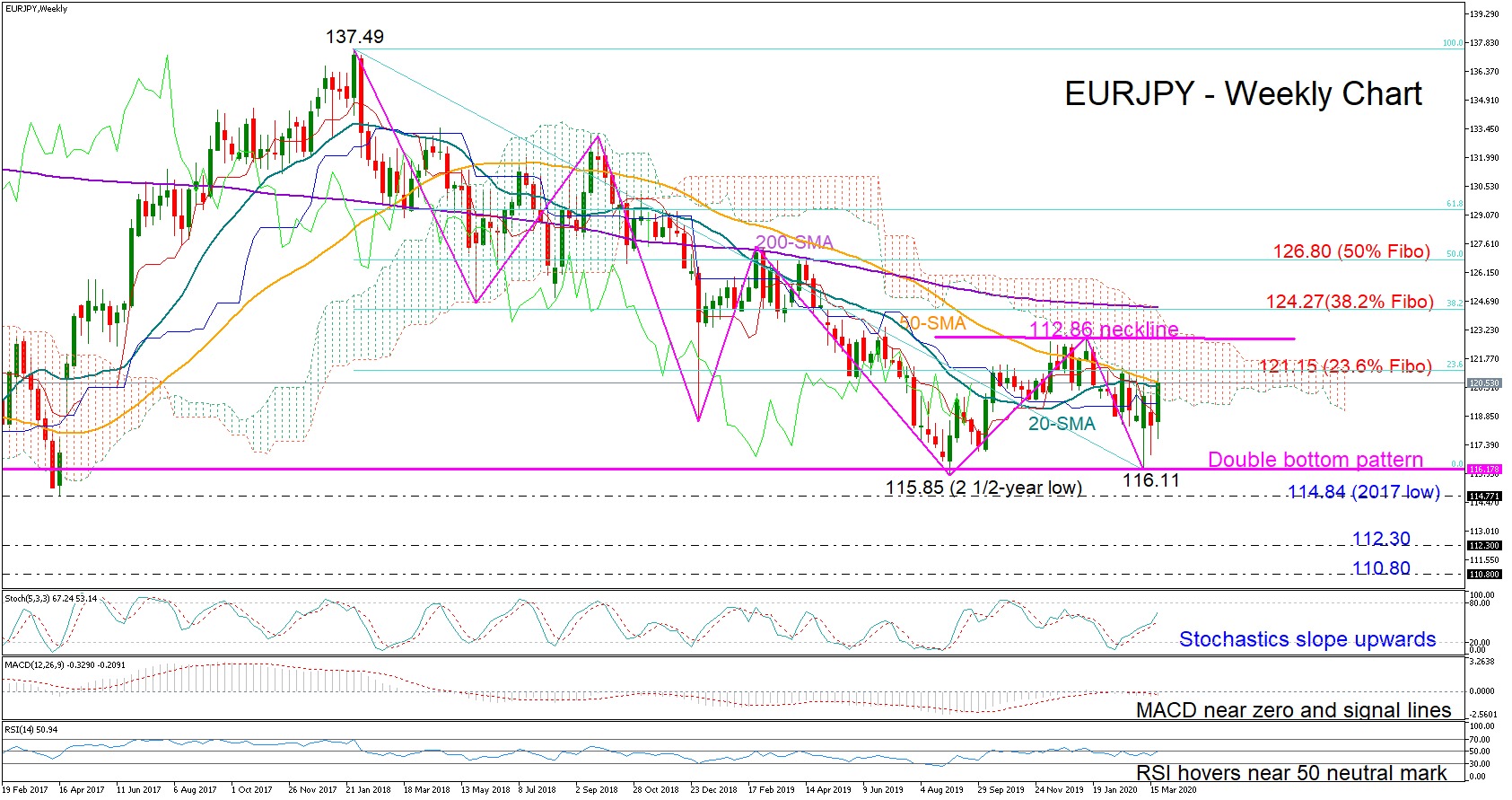
EURJPY managed to hold above its recent low of 116.11 this week even though the 121.00 resistance area added some pressure.
EURJPY

The positive performance in the market, however, is not the only good news. More importantly, the pair seems to be forming a double bottom pattern around 116.00 in the weekly chart which could be a bullish signal that the sell-off that started from the 2018 peak of 137.49 may have reached a bottom and it is time for the pair to change direction. A bullish cross between the 50- and the 20-weekly simple moving averages (SMAs) could further encourage a change in direction – if completed in the coming sessions.

In technical indicators, the strengthening fast Stochastics are backing any potential improvement but the RSI and the MACD continue to lack direction near their neutral levels, keeping some caution in the market for now.

To convince traders over a trend reversal, the bulls need to dominate above the 122.86 neckline. Such a move would validate the double bottom formation and send the price towards the 200-weekly SMA, hitting the 38.2% Fibonacci of 124.27 of the 137.49-115.85 downleg too. Above the latter, the pair could gain fresh momentum outside the Ichimoku cloud to meet the 50% Fibonacci of 126.80.

On the flip side, if the 23.6% Fibonacci of 121.15 rejects any correction towards the neckline, the focus will shift back to the 116.00 bottom. Should the bears pierce that floor, and more worryingly close below the 2017 trough of 114.84, the door would open for the 2016 support zone of 112.30-110.80.

Summarizing, a positive double bottom pattern has been detected in the EURJPY weekly chart, though a confirmation of a trend reversal could only come above the 122.86 neckline. 

Author

Christina Parthenidou

Christina joined the XM investment research department in May 2017. She holds a master degree in Economics and Business from the Erasmus University Rotterdam with a specialization in International economics.


More from Christina Parthenidou
Share:

Editor's Picks

EUR/USD flirts with daily highs, retargets 1.1900

EUR/USD regains upside traction, returning to the 1.1880 zone and refocusing its attention to the key 1.1900 barrier. The pair’s slight gains comes against the backdrop of a humble decline in the US Dollar as investors continue to assess the latest US CPI readings and the potential Fed’s rate path.

GBP/USD remains well bid around 1.3650

GBP/USD maintains its upside momentum in place, hovering around daily highs near 1.3650 and setting aside part of the recent three-day drop. Cable’s improved sentiment comes on the back of the Greenback’s  irresolute price action, while recent hawkish comments from the BoE’s Pill also collaborate with the uptick.

Gold clings to gains just above $5,000/oz

Gold is reclaiming part of the ground lost on Wednesday’s marked decline, as bargain-hunters keep piling up and lifting prices past the key $5,000 per troy ounce. The precious metal’s move higher is also underpinned by the slight pullback in the US Dollar and declining US Treasury yields across the curve.

Crypto Today: Bitcoin, Ethereum, XRP in choppy price action, weighed down by falling institutional interest 

Bitcoin's upside remains largely constrained amid weak technicals and declining institutional interest. Ethereum trades sideways above $1,900 support with the upside capped below $2,000 amid ETF outflows.

Week ahead – Data blitz, Fed Minutes and RBNZ decision in the spotlight

US GDP and PCE inflation are main highlights, plus the Fed minutes. UK and Japan have busy calendars too with focus on CPI. Flash PMIs for February will also be doing the rounds. RBNZ meets, is unlikely to follow RBA’s hawkish path.

Ripple Price Forecast: XRP potential bottom could be in sight

Ripple edges up above the intraday low of $1.35 at the time of writing on Friday amid mixed price actions across the crypto market. The remittance token failed to hold support at $1.40 the previous day, reflecting risk-off sentiment amid a decline in retail and institutional sentiment.













