Is China a Financial Risk to the Global Economy?

Executive Summary
China's importance in the global economy has clearly risen significantly over the past few decades. As it has grown from an emerging economy of modest size to the world's second largest economy, China has become one of the most dominant players in global trade flows. Although the country's financial interactions with the rest of the world have also grown meaningfully, China does not have the same heft in the global financial system as it does in the global economic system. China is fairly open in terms of trade flows, but its use of capital controls has restrained its financial integration with the rest of the world.
Because foreigners have limited amounts of direct financial exposure to China, a financial meltdown, should one occur, would likely not be as consequential for the global economy as the financial crisis that emanated in the United States beginning in 2007. But the indirect effects would not be inconsequential. A financial meltdown in China would probably cause a painful economic downturn in that country, which would impart a significant shock to global growth via the exports that China takes in from the rest of the world.
How Much Financial Heft Does China Have in the Global Economy?
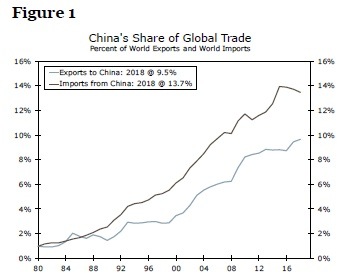
A few decades ago, when China was an emerging economy of only very modest size, it had very little economic and financial interaction with the rest of the world. In 1988, China took in less than 2% of the world's exports and only 2% of the world's imports were supplied by China (Figure 1). Thirty years later, China's absorption of the rest of the world's exports has grown to 10% and it supplies around 14% of the goods that the rest of the world imports. In other words, China has become a significant player in global trade flows in a relatively short period of time.
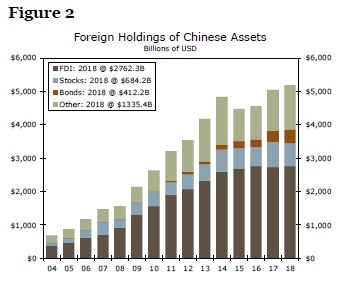
China also has become a more important player in the global financial system. Foreign holdings of Chinese assets have grown from less than $700 billion in 2004 (earliest available data) to more than $5 trillion in 2018 (Figure 2). Foreign direct investment (FDI) accounts for nearly $2.8 trillion of the current total, but foreigners' portfolio investment holdings include $700 billion of Chinese equities and more than $400 billion of Chinese bonds. On the other side of the ledger, China's ownership of foreign assets has mushroomed as well. Chinese holdings of foreign assets shot up from less than $1 trillion in 2004 to more than $7 trillion last year.
Author

Wells Fargo Research Team
Wells Fargo

















