Inflation in France and Germany: An unusual gap

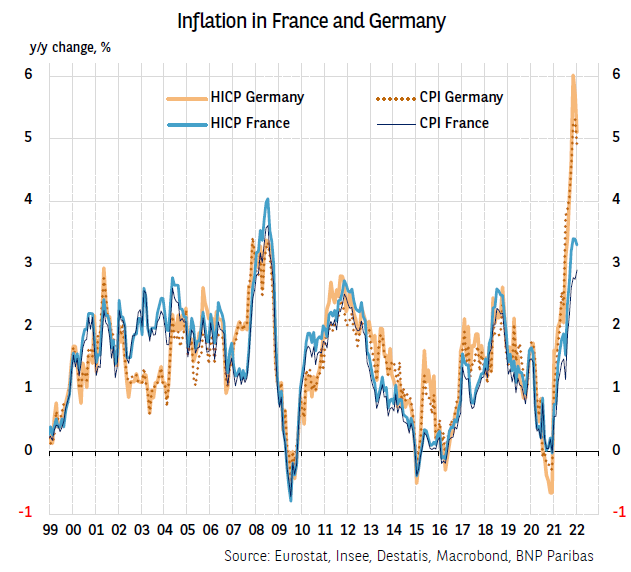
Usually close, French and German inflations, measured on a comparable basis by Eurostat’s harmonized index of consumer prices (HICP), have diverged sharply since the beginning of 2021, with inflation on the other side of the Rhine largely exceeding that in France. In November 2021, the gap reached +2.6 percentage points compared with an average of +0.2 pp since 1991. This difference is, for a part, due to a VAT effect: the decrease in the German rates in the second half of 2020 initially pulled down German inflation but the return to their previous level reverted that trend in 2021.
In January 2022, with the end of this VAT effect, German inflation fell back quite significantly (to 5.1% y/y according to Eurostat’s flash estimate, from 5.7% in December) but is still very high. French inflation is about two points lower (3.3% in January after 3.4% in December). And its more contained nature should be reinforced in February with the effects of the tariff shield put in place to limit the rise in electricity and gas prices.
Other interesting points behind these inflation differences, through the prism of the main HICP items: at the end of 2021, French inflation was more energy-led than German inflation (the energy component explaining half of French inflation versus 34% in Germany). French inflation was also slightly more “tertiary” (services contributing 28% versus 25%), while it was a bit more industrial and food-related on the other side of the Rhine (contribution of 24% and 16%, respectively) than on this side (16% and 8%)1.
Another difference exists, due to the weightings resulting from the accounting conventions specific to each country: that between the national measure of inflation and the harmonized one. The main difference in weighting concerns the health item in France (11% in the CPI, 4% in the HICP) and the housing component in Germany (32% in the CPI, 22% in the HICP2). This difference has fluctuated quite a bit since 1992, being, on average, slightly negative in France (national inflation 0.1 percentage point lower than harmonized inflation) and registering zero in Germany. Over the last months, however, this gap has widened to -0.8 points in Germany in November and -0.6 points in France (before narrowing, in January, to -0.2 and -0.4 points, respectively). The readability of the inflation figures is somewhat reduced by these differences. In any case, it is not possible to tell which measure is more accurate than the other.
Author
BNP Paribas Team
BNP Paribas
BNP Paribas Economic Research Department is a worldwide function, part of Corporate and Investment Banking, at the service of both the Bank and its customers.