India's retail inflation eases to 7.04% in May, but remains above RBI comfort level

Key highlights
- BOJ maintains ultra-low rates, warns against sharp yen falls.
- Fed says commitment to restoring price stability ‘unconditional’.
- UK economy contracts sharply by 0.3% in April as slowdown looms.
- India’s exports rise 20.55% to $38.94 bn in May; trade deficit at record $24.29 bn.
- Euro area CPI rises at record pace in June, energy and food prices pace gains.
- Venezuelan oil exports to Europe set to resume after two years -document, sources.
USD/INR weekly performance & outlook
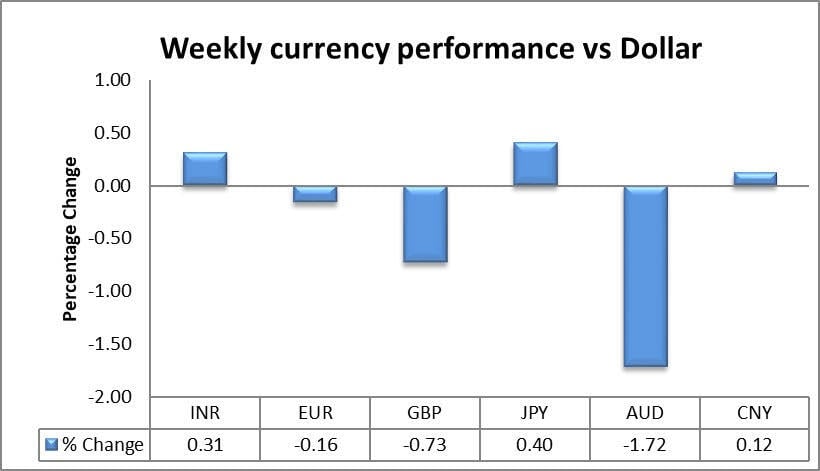
The USD/INR pair made a gap up opening at 78.0350 and traded within the range of 77.96 and 78.27. The pair closed the week at 78.07 levels. The Indian rupee traded range bound as RBI continued to offer Dollars to prevent the runaway Rupee depreciation. Global risk sentiment has deteriorated further as more central banks are turning increasingly hawkish. While the Fed had turned hawkish and began hiking much earlier, and effects of Fed tightening are now likely to hurt economic activity in the US, some of the other central banks have only recently joined the bandwagon. The Indian rupee remained resilient this week as the RBI’s intervention supported the domestic currency. However, the momentum remains bearish following FII outflows, risk-aversion sentiments and higher crude oil prices. The dollar is expected to remain in demand following the flight to safety in a rising interest rate scenario. Federal Reserve Chairman Jerome Powell reiterated the central bank’s commitment to bringing down inflation.
Fed hikes rates by 75 basis points, the biggest increase since 1994
EUR/USD
The EURUSD pair has started to edge lower after having tested 1.0600 on Thursday. The risk-positive market environment helps the shared currency stay resilient for the time being but the dollar could continue to gather strength and weigh on the pair in case US Treasury bond yields gain traction. ECB’s Visco said that he expects the ECB to continue to hike the policy rate in a gradual and sustained way after September. Further, ECB's Lagarde stated that the goal of anti-fragmentation tool is not to close spreads, but to normalize spreads. Euro area consumer prices rose at a record clip last, revised data confirmed, pushed higher energy and food prices in particular. According to Eurostat, the rate of increase in the headline Eurozone CPI accelerated from an annual pace of 7.4% in April to 8.1% for May.
BoE hikes interest rate to 1.25% to fight inflation; fifth rate hike in row
GBP/USD
The GBPUSD pair has staged a downward correction after having gained more than 150 pips on Thursday. As widely expected, the Bank of England announced on Thursday that it hiked its policy rate by 25 basis points to 1.25%. BoE updated its projections about CPI and expects inflation to peak at 10% in Q4 of 2022. The MPC estimates inflation to tame around the 2% target in two years as external factors dilute. Concerning UK’s growth, the bank expects a contraction in Q2, by -0.3%, weaker than anticipated in its May report. Forward guidance on path of rate hikes was missing in the statement, however, BoE emphasized that the the scale, pace and timing will reflect Committee’s assessment of the economic outlook and inflationary pressures. Meanwhile, yet another negative GDP print for the UK economy in April fanned recession fears. Wednesday holds the crucial UK inflation data publication, which will be a big market driver for the pound, as it will affect the BOE rate hike expectations.
ECB prepares new tool to tackle rising borrowing costs in weaker economies
Dollar Index
The US Dollar has pushed back firmly to end the week in a strong position against other major currencies. Hawkish commentary continues to extend the risk aversion already seen in the market even following the recent strong rate hike from the Fed. This comes after the Dollar gave up some ground on both Wednesday and Thursday even if other currencies like the Euro and Pound failed to take advantage of the momentary weakness. Their chance evaporated on Friday as rising Treasury Yields combined with fearful commentary from analysts pushed the US Dollar Index higher. The US Federal Reserve on June 15 announced a three-quarter of a percentage point or a 75 bps hike in its target interest rate, in what is being seen as a move to curb the spiralling inflation. The central bank, while announcing the rate hike, said it is "strongly committed" to returning inflation to two percent. Federal Reserve Chairman Jerome Powell in the recent speech, reiterated the central bank’s commitment to bringing down inflation, saying it’s essential for the global financial system.
Domestic and global equities
Domestic equities
A cautious mood in most global markets amid growing worries about recession dented the sentiment on Dalal Street. During the week, both the domestic benchmark Sensex and Nifty 50 declined by around 5%. Mostly all major indices closed with a major cut including the Nifty Bank, consumer durable and IT stocks. Sensex ended volatile session of the week at 51,360, while the Nifty 50 closed the week at 15,293. After having closed this week on a negative note, Indian domestic equity benchmark indices are likely to trade with a downside bias next week as the aggressive monetary policy stance by the US Fed potentially triggered the fear of a recession.
Global equities
World stocks closed out their steepest weekly slide since the pandemic meltdown of March 2020, as investors worried that tighter monetary policy by inflation-fighting central banks could damage economic growth. Investors were shaken this week after the US Federal Reserve unleashed its biggest hike in borrowing costs for almost 30 years to tackle red-hot consumer prices. The moves caused a global sell-off on Thursday. US and European markets tried to stage a rebound on Friday, but some indices were back in the red later in the day. The relatively quiet trading capped a brutal, tumultuous week for Wall Street. The S&P 500 lost 5.8% for its 10th drop in the last 11 weeks. That’s its worst week since March 2020, when stocks were in free-fall as the global economy suddenly shut down at the onset of the pandemic.
Domestic and global bonds

Domestic bonds
Bond market brace for a sharp hike in policy rate by major central banks to fight inflation in the coming months which led to shooting of the bond yields across the economies. The crude oil prices too remained elevated including the persistent selling of the FII from the EM. The higher US yields, multiple year high inflation print, economic slowdown in major economies have brought in the risk off mood in the market. India’s trade deficit widened to record $24.29 billion in May which was historic high, this also kept the bond market under pressure. The only silver lining the domestic bond market witnessed during the week was the slight fall in the domestic CPI print to 7.04% while still remaining above the RBI comfort zone. India 10-year benchmark traded between 7.572% and 7.617% to close the week at 7.546%.
Global bonds
The sharp investor retreat from government bonds in recent days reflects deepening gloom over the outlook for markets in the wake of surprisingly hot inflation report. Yields on Treasury’s largely reflect investors’ expectations for short-term rates over the life of a bond, and they in turn set a floor on borrowing costs across the economy. The yield on the benchmark 10-year U.S. Treasury note rose this week to settle at 3.23% during the weekly close, however, its touched its multiple year’s highest level of 3.498% on Tuesday. Rising yields usually drags down stock prices, increasing the opportunity cost in foregoing bonds for equities and delivering a particularly heavy blow to relatively unprofitable companies valued for their longer-term earnings potential.
Monthly FPI net investments

Marking the biggest annual outflow, foreign investors have sold Indian stocks worth over Rs 2 lakh crore in calendar year 2022 so far. FPIs have been selling Indian equities relentlessly since the last nine months. The strengthening of the dollar and rising bond yields in the US are the major triggers for FPI selling. Since the Fed and other central banks like the Bank of England and the Swiss central bank have raised rates, there are synchronized rate hikes globally, with rising yields. Domestic flows have, however, been robust and have absorbed some of the outflow. With rising US yield and strengthening of dollar, the FII outflows are expected to continue and may intensify with further aggressive tightening of the monetary policies by major central banks globally.

Macro-economic calendar

Author
Abhishek Goenka
IFA Global
Mr. Abhishek Goenka is the Founder and CEO of IFA Global. He pilots the IFA Global strategic direction with a focus on relentlessly improving the existing offerings while constantly searching for the next generation of business excellence.