|

If this is recession, somebody forgot to tell the consumer

Summary

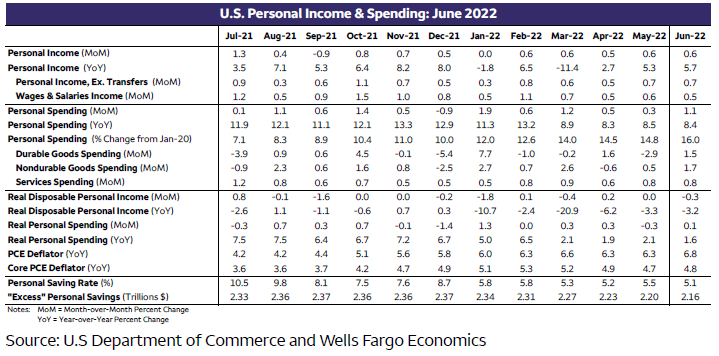
The 0.1% increase in real personal spending in June shows that even after adjusting for the highest inflation in 40+ years, consumers are still increasing spending, if only incrementally. But it is taking a toll, as consumers have not had to take their saving rate this low since 2009.

A different kind of financial crisis as saving rate craters

Like a dazed boxer still on his feet, the U.S. consumer is still in the fight with a consensus-beating increase in both income, which was up 0.6%, and spending, up 1.1%. After adjusting for inflation, real personal spending notched an incremental gain of 0.1%, and last month's real decrease of -0.4% got a slight bump up to -0.3% (chart). To some extent, these details were heralded by yesterday's Q2 GDP report, in which consumer spending was one of the few things still in expansion territory.
Chart

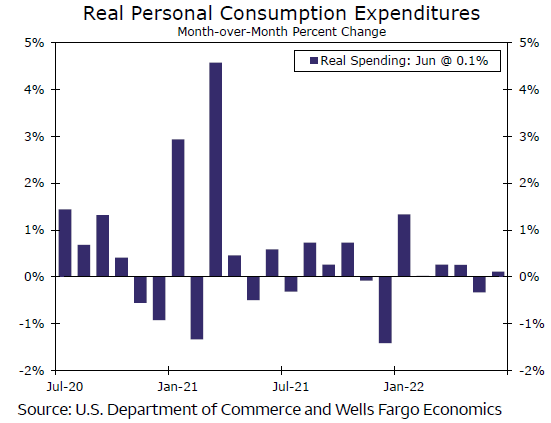
The consumer is reaching deep to find the means to go on spending in the face of the highest inflation in 40+ years. On trend, income is not keeping up with inflation, so in order to keep on spending, households are putting off saving. In fact, the saving rate at 5.1% is lower than it was during the financial crisis in 2009 (chart). Just as inflation is eroding purchasing power, wage growth isn't providing as much of a boost to income as it did recently. Wages and salaries advanced 0.46% in June, and while that's still above the average monthly growth rate that prevailed pre-pandemic (0.35%), it marks the slowest pace of wage growth in about a year and a half. Wage growth is moderating with the three-month annualized pace slowing to a still-strong 6.2% during the month (chart). Overall, real disposable personal income is now 5.8% below the level implied by its pre-pandemic trend.
fxsoriginal

Download The Full Economic Indicator

Author

More from Wells Fargo Research Team
Share:

Markets move fast. We move first.

Orange Juice Newsletter brings you expert driven insights - not headlines. Every day on your inbox.

By subscribing you agree to our Terms and conditions.

Editor's Picks

EUR/USD trims losses and returns to the 1.1750 area

The US Dollar resumed its decline in the American afternoon, helping EUR/USD trim early losses. The pair trades around 1.1750 as market participants gear up for the European Central Bank monetary policy decision and the United States Consumer Price Index.

GBP/USD consolidates above mid-1.3300s as traders await BoE and US CPI report

The GBP/USD pair struggles to capitalize on the overnight bounce from the 1.3310 area, or a one-week low, and oscillates in a narrow band during the Asian session on Thursday. Spot prices currently trade around the 1.3370 region, down less than 0.10% for the day, as traders opt to wait on the sidelines ahead of the key central bank event risk and US consumer inflation data.

Gold declines on profit-taking, USD strength ahead of US CPI release

Gold price edges lower below $4,350 during the Asian trading hours on Thursday. The precious metal retreats from seven-week highs amid some profit-taking and a rebound in the US Dollar (USD). The potential downside for the yellow metal might be limited after the recent US jobs data reinforce market expectations of further interest rate cuts by the US Federal Reserve and drag the USD lower. 

Top Crypto Losers: Pump.fun, SPX6900, Bittensor slide further with double-digit losses

Pump.fun, SPX6900, and Bittensor are leading the losses in the cryptocurrency market over the last 24 hours amid total liquidations of over $500 million. The retail segment alleges institutional manipulation amid an early-morning Bitcoin sell-off routine in the US market.

Monetary policy: Three central banks, three decisions, the same caution

While the Fed eased its monetary policy on 10 December for the third consecutive FOMC meeting, without making any guarantees about future action, the BoE, the ECB and the BoJ are holding their respective meetings this week. 

Crypto Today: Bitcoin, Ethereum, XRP slide further as risk-off sentiment deepens

Bitcoin faces extended pressure as institutional investors reduce their risk exposure. Ethereum’s upside capped at $3,000, weighed down by ETF outflows and bearish signals. XRP slides toward November’s support at $1.82 despite mild ETF inflows.