IBEX 35 could drop despite new economic stimulus

After the approval by the United States legislators of the largest economic aid package in the history of the United States, doubts are arising about whether the European Union will follow the same path.
The European summit in which a rescue plan for the eurozone economy was discussed by issuing additional and solidary debt or "coronabonds" had its members divided.
On one side of the trench are the Netherlands and Germany that have a low level of debt. Whereas, in the other are Spain, Italy, and France, which demand the issuance of European common debt instruments.
This debt issue, proposed by the European periphery countries, would oblige the "most solvent" countries, such as the Netherlands and Germany, to stand in support with the "least solvent" which already show large debt to gdp ratios.
However, despite the ECB's stimulus launched recently to purchase debt for 750,000 million euros and a possible agreement leading to the approval of the "coronabonds," the Ibex 35's structure suggests further declines.
Ibex 35, in its 2-week chart in log scale, shows a downward sequence that the Spanish index developed since November 2007 when it reached its all-time high located at 16,040.4 pts.
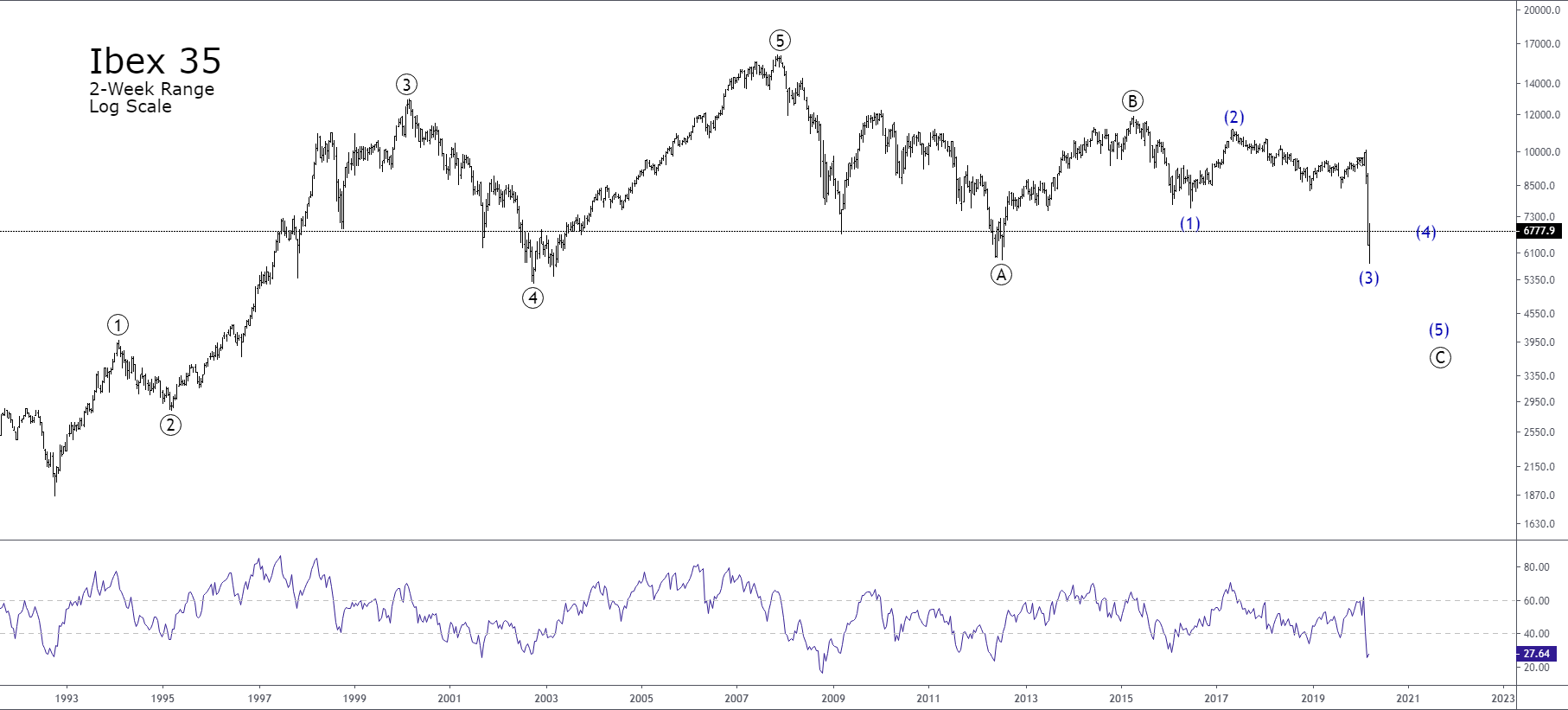
The corrective sequence of Primary degree labeled in black reflects that the price develops a wave ((C)), which still is incomplete. At the same time, we observe that within its internal structure, the Spanish index advances in a wave (3) of Intermediate degree identified in blue, which suggests more drops in the mid-term.
The following log-scale 2-day chart, shows the Spanish index recovering after the fall drew by increasing concerns by the SARS-CoV-2 virus pandemic and its potential economic impact, that drove it to pierce the psychological support of 6,000 pts, down to a short-term 5,814.5 pts bottom.
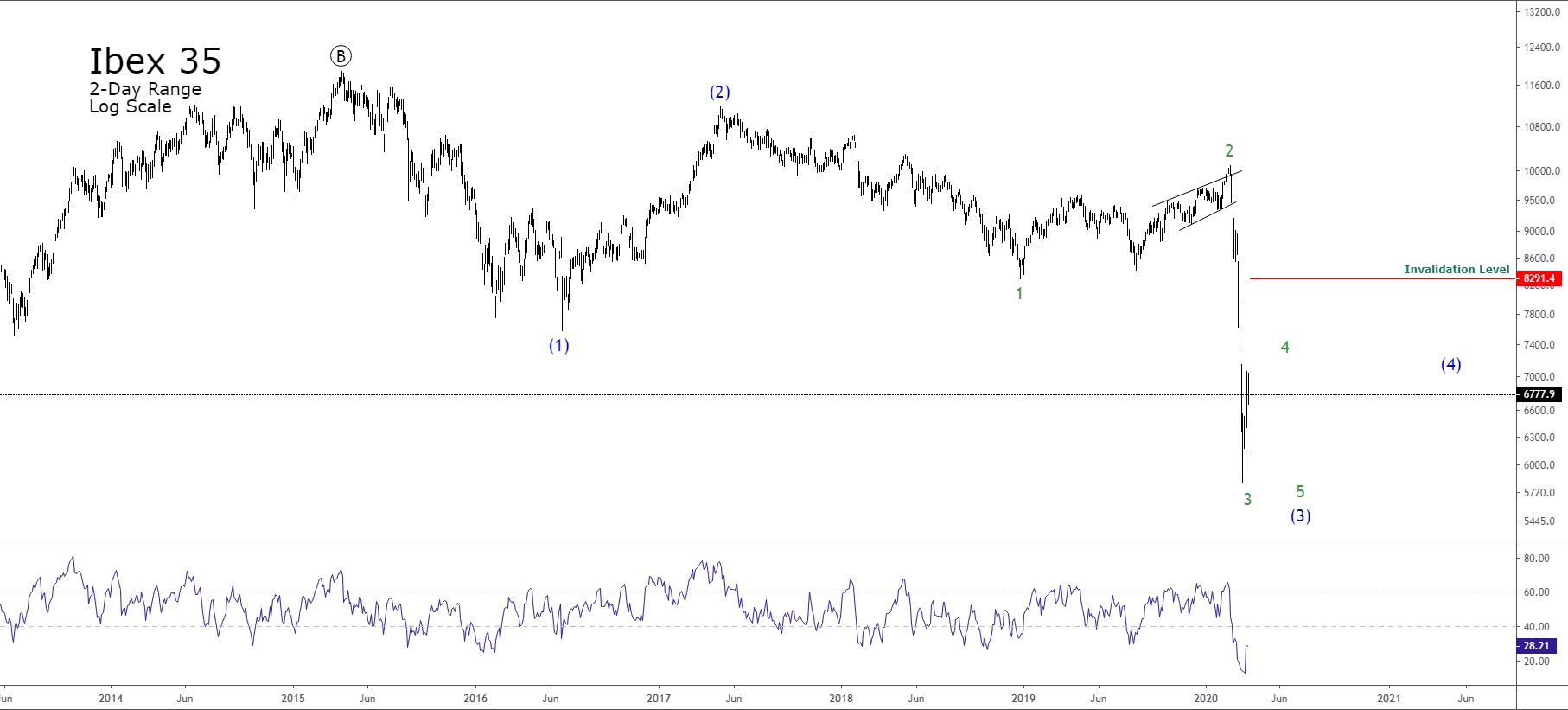
This progression which corresponds to wave 4 of Minor degree labeled in green, which belongs to the third wave of Intermediate degree identified in blue, suggests a temporary recovery in the Spanish stock market. However, in the mid-term, it is possible that the Spanish benchmark will plunge to new lows revisiting the zone of 5,000 pts.
The following 4-hour chart shows the Ibex 35, making a bullish recovery. This first move could correspond to a wave ((1)) or ((a)) of Minute degree labeled in black. As long as the pullback remains above 5,814.6 pts, there is a chance that the Ibex 35 will rebound and develop a wave ((iii)) or ((c)).
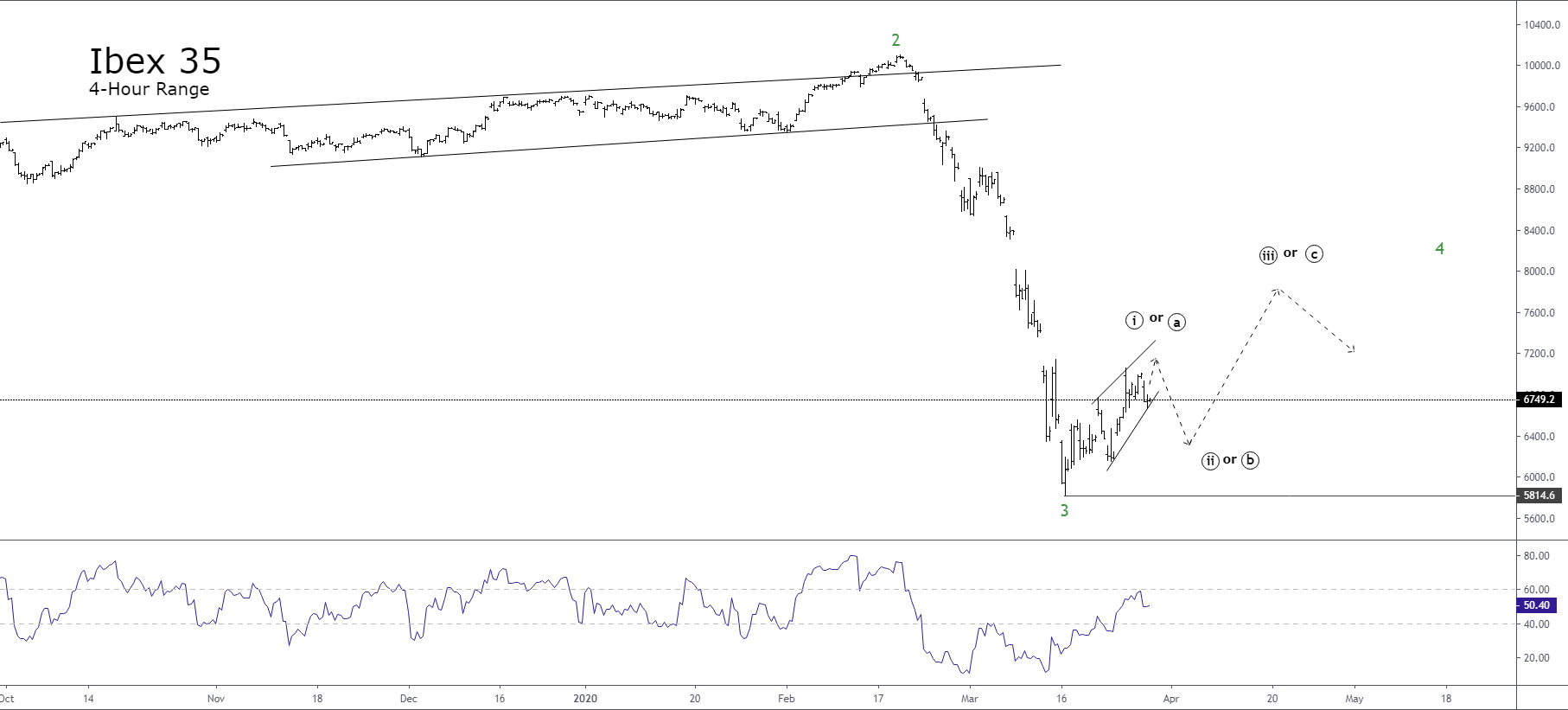
In conclusion, considering that the long-term structure corresponds to an incomplete bearish wave ((C)), our preferred position is bearish. However, in the short term, our bias remains on the bullish side until price remains above 5,814.6 pts.
Author

EagleFX Team
EagleFX
EagleFX Team is an international group of market analysts with skills in fundamental and technical analysis, applying several methods to assess the state and likelihood of price movements on Forex, Commodities, Indices, Metals and

















