Hungarian wage growth remains elevated


Wage growth came in as expected in July. It seems likely that it will remain stable at this level in the near future. However, households still prefer to save rather than spend due to weak consumer confidence.
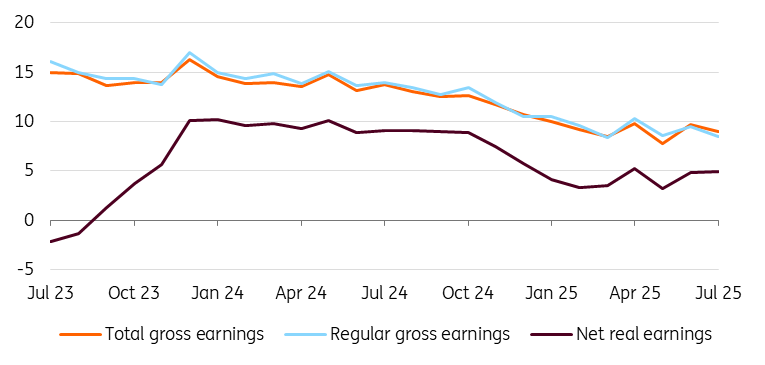
According to the latest report by the Hungarian Central Statistical Office (HCSO), the growth rate of gross average earnings slowed slightly compared to the previous month but remained strong. In July 2025, average wages increased by 9% year-on-year, which is roughly in line with market expectations. Essentially, the trend observed in the first half of the year continued into the second one: wage growth of around 9%, which is insufficient for substantial economic improvement.
As a reminder, July's retail data was a negative surprise, as we saw a monthly contraction. This indicates that strong wage growth alone is necessary but not sufficient for sustained dynamic growth in retail trade, consumption, and the overall economy.
Nominal and real wage growth (% YoY)
Source: HCSO, ING
So, what could the problem be? In our view, the key lies in consumer confidence, which remains subdued compared to its pre-crisis peak, while households are adjusting to a slowdown in wage growth – from around 20% to high single digits.
Additionally, inflation is uncomfortably high. While government measures can statistically moderate the pace of price increases, households continue to perceive inflation as too high. Therefore, even though the purchasing power of wages grew by 4.9% YoY in July, consumers are saving a larger portion of their marginal income than historically would. Consequently, while rapid wage growth improves the financial situation of households, it does not help the real economy grow as much as these figures suggest.
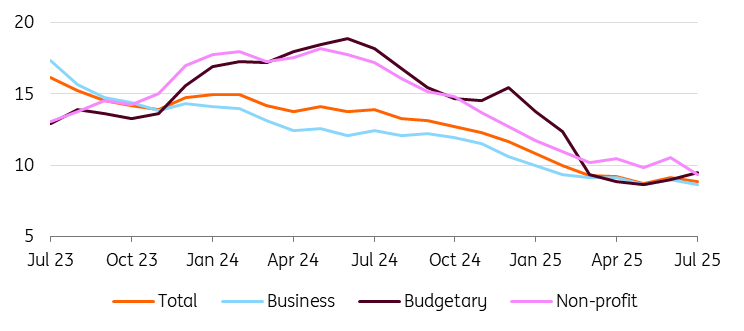
A closer look at the facts and individual sectors reveals that wage trends are broadly consistent across all major areas. Average wage growth slowed to 8.7% in the corporate sector. Earnings in agriculture continue to rise at a low double-digit rate due to an increase in seasonal work.
A similar situation appeared in the energy and water management sectors. In July, wage growth in the manufacturing industry was close to the national average, and employee numbers remained stable, but at a multi-year low level. In the public sector, wage adjustments in education are pushing up the average wage growth, as is the case in the nonprofit sector.
Wage dynamics (3-month moving average, % YoY)
Source: HCSO, ING
We expect average annual wage growth of between 8-9% for the economy as a whole in 2025, which is a slight upward revision of our forecast. However, weak and declining business confidence indices pose a downside risk, which may be joined by labour cost rationalisation.
Despite this situation, some sectors continue to face labour shortages primarily due to a shrinking labour market supply, which is putting upward pressure on wages. Over the next year, the most important issue will be the possible revision of the minimum wage agreement by the government (set to rise by 13% from January 2026). As usual, the vast majority of companies will likely align their wage calculations with it, which could increase the already high tension in the labour market.
Read the original analysis: Hungarian wage growth remains elevated
Author
ING Global Economics Team
ING Economic and Financial Analysis
From Trump to trade, FX to Brexit, ING’s global economists have it covered. Go to ING.com/THINK to stay a step ahead.

















