How to trade interest-rate decisions with smart money concepts


What exactly are interest rates?
Interest rates are the “price of money.”
- Policy Rate (Fed Funds, ECB Deposit, BoE Bank Rate, etc.): the benchmark every other dollar, euro, or pound in the system references.
- Why traders/investors care: Higher rates attract capital (carry flows), boost the currency, and reshape expectations for growth and inflation.
Think of them as the central bank’s thermostat: too cold (slow growth) > turn the dial down, too hot (run-away inflation) > adjust it higher.
Hawkish vs dovish-in plain english
Stance | Core Message | Typical Market Reaction* |
|---|---|---|
Hawkish | “Inflation is too high-we’re ready to tighten.” | Bond yields ↑, domestic currency ↑ |
Dovish | “Growth is fragile-we’ll keep policy easy.” | Bond yields ↓, domestic currency ↓ |
Immediate knee-jerk moves often sweep obvious stops before the true direction unfolds. This is where SMC edges in.
Why it matters for traders
- Volatility Spike: Scheduled to the minute - liquidity is thin, spreads widen, algo headline-scrapers fire first.
- Macro Re-pricing: A single sentence can re-anchor rate expectations for months affecting the money flow trajectory of big players.
- Liquidity Pools: Large funds rebalance, hedge, or exit-perfect fuel for a classic sweep-and-reverse and/or even repositioning for continuation.
Why rate decisions create A+ SMC setups
- Scheduled Liquidity Vacuum: Banks pull quotes minutes before release-spreads can triple.
- Algo Whipsaw: Millisecond headline bots grab the text feed first, running stops either side.
- Position Unwinding: Leveraged funds square ahead of uncertainty, leaving large resting orders at obvious highs/lows.
- Macro Re-Pricing: A single phrase reshapes the forward curve-fuel for a multi-day trend.
Scenario blueprint
Surprise Outcome | USD Bias | Expected SMC Setup |
|---|---|---|
Hawkish Hike / Hawkish Hold (dot-plot shifts higher, CPI still hot) | Dollar strength | Liquidity runs above prior highs → bearish MSS on EUR/USD, GBP/USD, Gold |
Dovish Cut / Dovish Hold (forward guidance softens, growth fears) | Dollar weakness | Liquidity runs below recent lows → bullish MSS on EUR/USD, risk-on rallies in Nasdaq/silver |
Split Signal (rate unchanged but hawkish dot-plot) | Knee-jerk both ways | Double sweep likely-wait for second break of structure before entry |
How to trade it with smart money concepts
1. Pre-event mapping of key levels
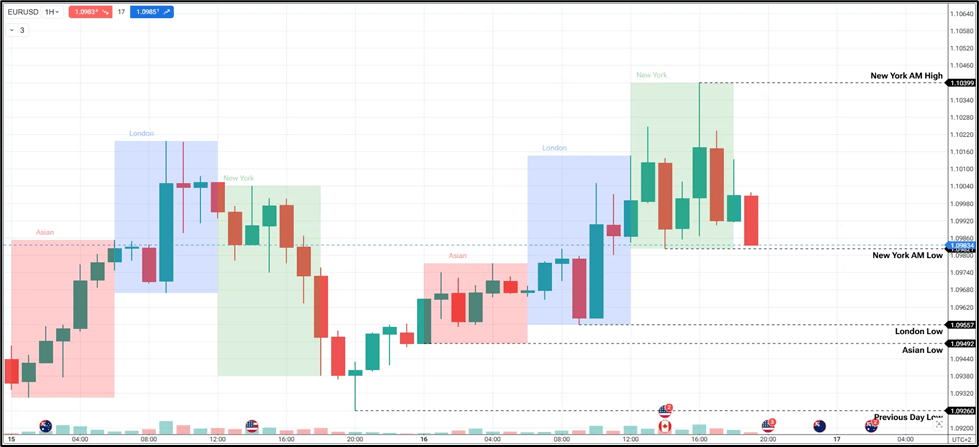
Prior to the release, start marking out key levels. This key liquidity levels are obvious levels where, logically, stop orders are found.
- Plot HTF liquidity levels: previous week’s high/low, previous day’s high/low, equal highs/lows, unfilled FVGs on H4/D1.
- Mark kill-zones: 30 m before announcement and the first 5 m after.
Note: Focus only on levels that have not yet been tested after the release.
Determine Fed rate result
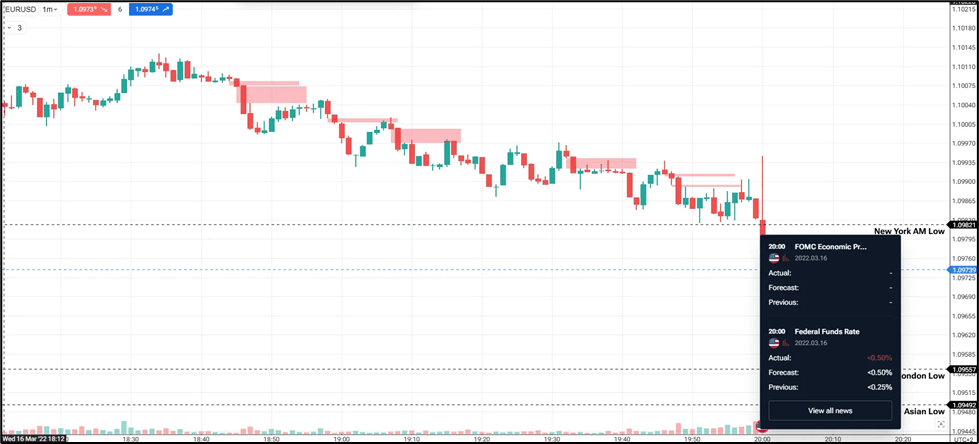
Once you’ve mapped the liquidity “battle-lines,” the next task is to decode the actual policy outcome versus what the market discounted.
- Check the headline figure: Hike / Cut / Hold - note the size (e.g., +25 bp, –25 bp, or unchanged).
- Classify the stance:
- Hawkish – favour USD longs / risk-off pairs.
- Dovish – favour USD shorts / risk-on pairs.
- Mixed – prep for double-sweep scenario; stay nimble until a clear Market Structure Shift prints.
Wait for a Sweep of Key Levels after 15-30 mins at the FOMC Press Conference at the Lower Timeframe
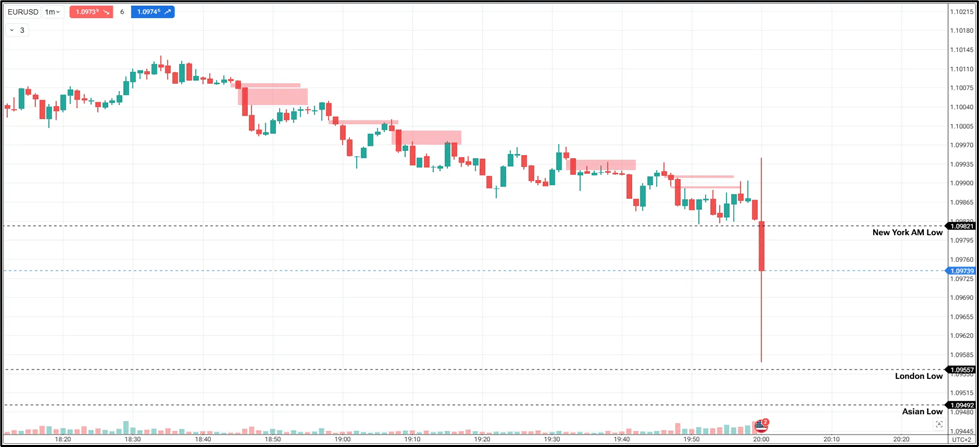
After the headline drops, the market’s first task is to clear out every resting stop. Always let that flush finish before even thinking about an entry.
- Hawkish Surprise (rate hike / hawkish hold):
- Expect an initial spike against USD strength (e.g., EUR/USD shoots higher) as buy-stops above the pre-event range get cleared.
- The reversal leg that follows usually breaks back below the sweep high. Watch for this to become the displacement candle that kicks off the true bearish move.
- Dovish Surprise (rate cut / dovish hold):
- Look for a knee-jerk dump with USD strength (e.g., EUR/USD flushes lower) as sell-stops under the range are harvested.
- A fast snap-back above the sweep low often marks the start of the bullish displacement.
- Mixed / In-Line Result:
- Be prepared for a double sweep. Price may run tops and bottoms before choosing direction.
- Stand aside until a clear Market Structure Shift (MSS) confirms the real intent.
In this case, Hawkish Surprise materialized after a rate hike has been released.
Look for imbalances and market structure shifts
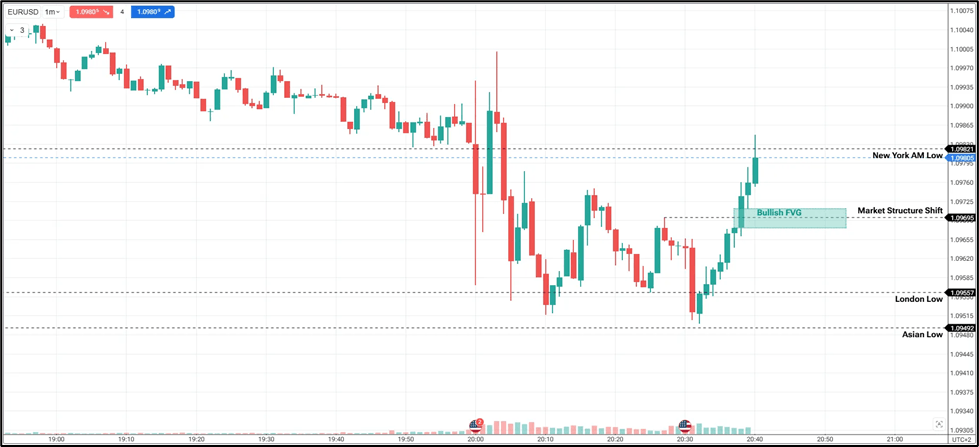
Signs that institutions are getting involved: Volume Imbalances & Structures Shifting
- Look for an impulsive opposite move that breaks structure (M1-M5) and leaves an imbalance.
- The candle that breaks the sweep’s origin creates your Market Structure Shift (MSS) confirmation.
Emphasis: Look for these confirmations once key levels have been tapped.
Set orders at the volume imbalances (FVGs) as institutions rebalances

You can either set a limit order, waiting for institutions to rebalance at the volume imbalances Fair Value Gaps or create a market order as price trades at the FVG to account for spread.
- Draw the immediate FVG in the displacement leg.
- Wait for price to retrace 50–100 % into that gap.
- Enter with stop just beyond the sweep extreme.
Set targets
Target the next external range liquidity (session high/low, HTF FVG boundary) or 2–3 R static if volatility is collapsing.
- 2R - 3R static target or;
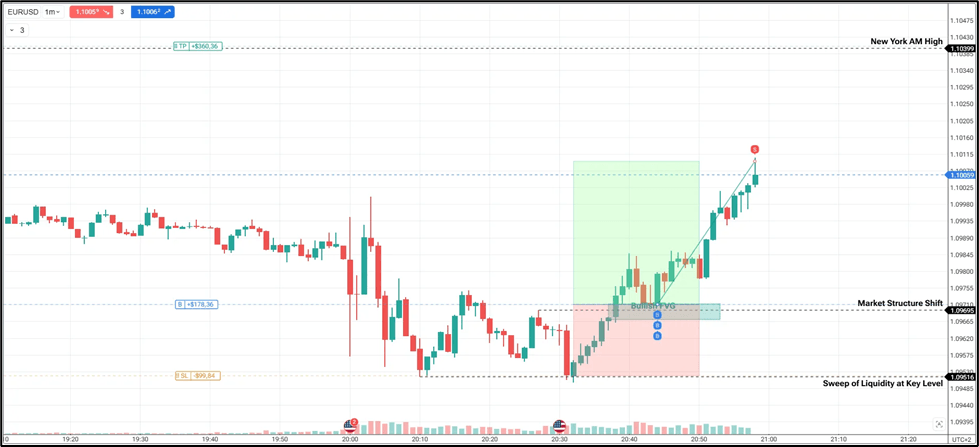
- Next key level or;
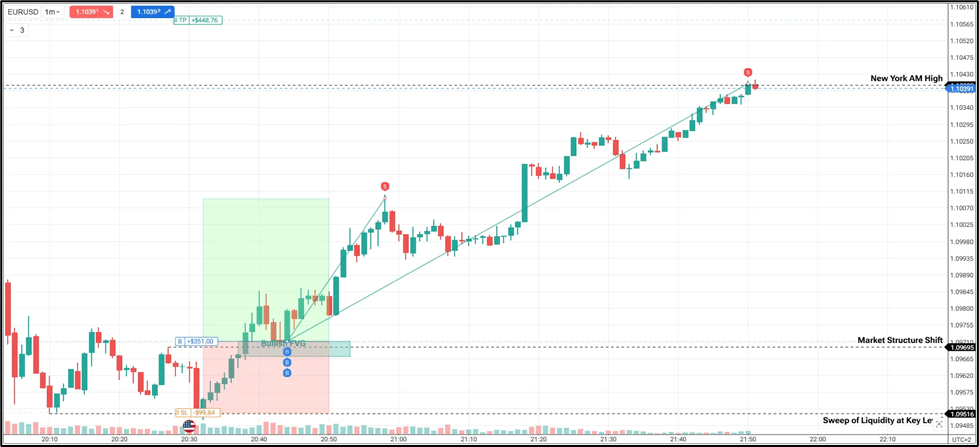
- Using trend indicators to follow trend (e.g., moving average crossover)
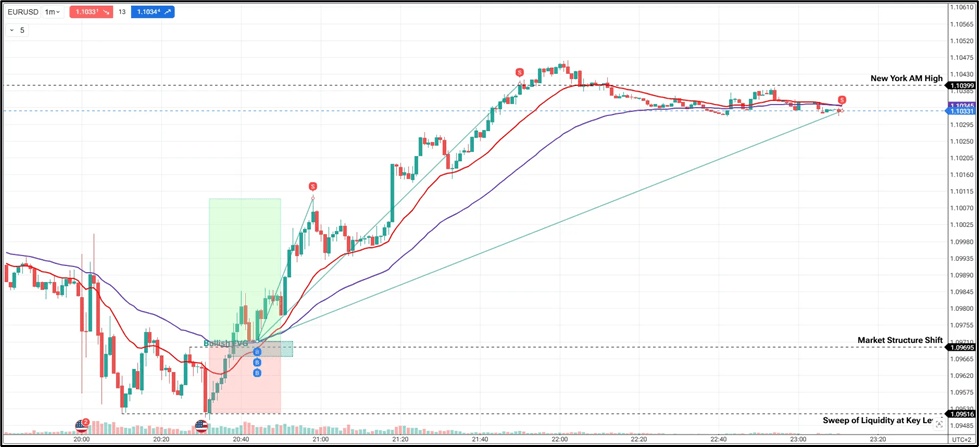
Interest-rate decisions are scheduled earthquakes. Most traders get buried under the debris of the first tremor. With this approach, mapping liquidity, waiting for the crowd’s misdirection, and entering at institutional footprints, you’ll stand where the aftershock turns into profit. You’ll be able to play the game with confirmation and lessening risks of getting whipsawed before the actual move starts. Trade the red-carpet side door, not the paparazzi stampede.
Author
Jasper Osita
Independent Analyst
Jasper has been in the markets since 2019 trading currencies, indices and commodities like Gold. His approach in the market is heavily accompanied by technical analysis, trading Smart Money Concepts (SMC) with fundamentals in mind.