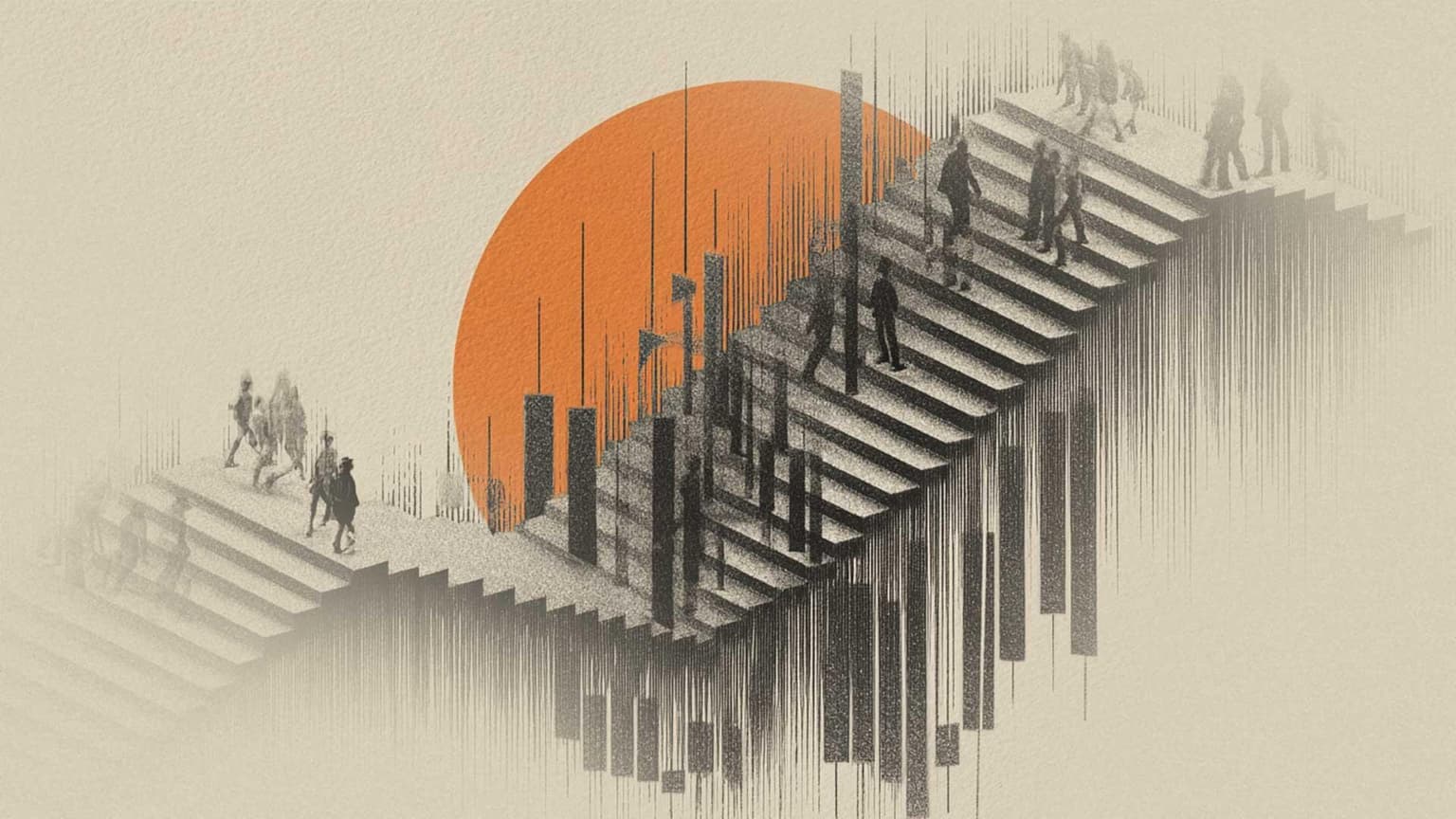
How the Federal Reserve drives the boom-bust cycle

The Federal Reserve was sold as a way to "provide the nation with a safer, more flexible, and more stable monetary and financial system."
That's not what the central bank does.
In fact, the Fed destabilizes the monetary system by constantly interjecting itself into it, tinkering with interest rates, and creating money out of thin air to support government borrowing and spending. This leads to a broader destabilization of the economy manifested in booms and busts.
When most people talk about the economy, they tend to focus on government policies such as taxation and regulation. For instance, Republicans blame President Biden for inflation. Meanwhile, Democrats blame “deregulation” for the 2008 financial crisis. While government policies certainly have an impact on the trajectory of the economy, this partisan analysis ignores the biggest player on the stage — the Federal Reserve.
You can't grasp the economic big-picture without understanding how the Fed's monetary policy drives the boom-bust cycle.
The effects of other government policies happen within the Fed’s monetary framework. Money-printing and interest rate manipulations fuel booms and the inevitable attempt to return to “normalcy” precipitates busts.
In simplest terms, easy money blows up bubbles. Bubbles pop and set off a crisis.
Rinse. Wash. Repeat.
The boom
When the economy slows or enters into a recession, central banks like the Federal Reserve drive interest rates down and launch quantitative easing (QE) programs to “stimulate” the economy.
Low interest rates encourage borrowing and spending. This flood of cheap money suddenly available allows consumers to easily borrow money and consume more — thus the stimulus. It also incentivizes corporations and government entities to borrow and spend. Coupled with quantitative easing, a central bank can pump billions of dollars of new money into the economy through these artificially low interest rates.
Quantitative easing compounds this effect.
QE is a fancy term for printing lots of money. Of course, the Fed doesn’t have a printing press in the basement of the Eccles Building running off dollar bills, but it generates the same practical effect. The Federal Reserve digitally creates money out of thin air and uses the new dollars to buy securities and government bonds, thereby putting “cash” directly into circulation. QE not only boosts the amount of money in the economy, it also has a secondary function. As the Federal Reserve buys U.S. Treasury bonds, it monetizes government debt. In effect, it creates artificial demand for Treasury bonds. This allows the government to borrow and spend more than it otherwise could.
The central bank can also buy financial instruments like mortgage-backed securities as it did during QE1 in 2008 and during the pandemic. This effectively serves as a bank bailout. Big banks get to remove these worthless assets from their balance sheets and shift them to the Fed’s. Theoretically, this makes the banks more solvent and encourages them to lend more money to ease the credit crunch that occurs when banks become financially shaky.
This monetary policy results in a temporary boom. All of that new money has to go somewhere. It could result in rising consumer prices (a symptom of inflation), but generally, it pumps up the price of assets such as real estate and stock markets, creating a fake wealth effect. People feel wealthier because they see the value of their assets rapidly increasing. With plenty of debt-driven spending and rapidly increasing asset prices, the economy grows, sometimes at a staggeringly fast rate.
This process also creates inequality. The first receivers of this new money — generally bankers and politically connected individuals and institutions — get the most direct benefit from the newly minted dollars. Their decisions on where to spend the money create artificially high demand in the chosen industries or asset classes. Think of the housing market in the years leading up to ’08, or tech companies during the dot-com boom. This amplifies distortions in the capital structure. The first receivers also get to spend the new money before the inflationary effects take hold and prices rise. Those who receive the money later on down the line, say through pay raises, don’t get the same benefits as the first users. Price inflation eats up their gains.
Meanwhile, surging economic growth, shrinking unemployment, and rising stock markets driven by money creation give the illusion of a healthy economy. However, the monetary policy hides the economic rot at the foundation.
To sustain an economic expansion, you need capital goods — factories, machines, and natural resources. Capital goods are produced through savings and investment. When central banks juice consumption without a healthy underlying capital structure, it will eventually become impossible to maintain. You can print all the dollars you want, but you can’t print stuff. At some point, the credit-driven expansion will outstrip the available stock of capital. At that point, the house of cards begins to collapse.
Imagine you plan to build a giant brick wall. With interest rates low and credit readily available, you borrow all the money you need to complete the job. But two-thirds of the way through, a brick shortage develops. You may have plenty of money, but you’ve got no bricks. You can’t finish your project.
This scenario provides a simplified picture of what happens in the economy during a Fed-fueled economic expansion. Flush with cash, investors begin all kinds of projects they will never be able to complete. Eventually, the malinvestments become apparent. The boom teeters and then collapses into a bust.
The bust
Of course, the Fed helps this process along as well.
Once the apparent recovery takes hold, the Fed generally tries to tighten its monetary policy to keep price inflation under control. It ends QE programs and begins to nudge interest rates back up. When the recovery appears to be in full swing, the central bank may even shift to quantitative tightening — shrinking its balance sheet. During the boom, governments, consumers, and companies pile up enormous amounts of debt. Rising interest rates increase the cost of servicing that debt. They also discourage new borrowing. Easy money dries up. This speeds up the onset of the next recession and the cycle repeats itself.
To understand this, we can look back at the past three boom-bust cycles.
In October 1987, the stock markets crashed. The following year, inflation rose above 5 percent, prompting then-Fed Chairman Alan Greenspan to raise interest rates above nine percent in early 1989. This led to a mild recession in the early 1990s. Greenspan pushed rates below 3 percent in late 1992, then began to slowly nudge them upward in 1994. But the Fed never got rates anywhere near the pre-recession level. With the economy plugging along, rates peaked at 6 percent in 1995. From there, Greenspan held rates in the five-to-six percent range through 2001.
As the New York Times put it, “Greenspan makes a winning bet in the mid-1990s, resisting pressure to raise interest rates as unemployment declines. He argues that increased productivity, including the fruits of the computer revolution, have increased the pace of sustainable growth. Indeed, the Fed finds itself debating whether there is such a thing as not enough inflation, and a new Fed governor named Janet L. Yellen plays an important role in convincing Mr. Greenspan that a little inflation helped to lubricate economic growth.”
In December 1996, the dot-com boom was in full swing. Greenspan warned of “irrational exuberance” in the markets, even as he fed it with artificially low — for the time — interest rates.
Again from the NYT:
"The Fed decides that popping bubbles is not part of its job description, leading critics to charge that Mr. Greenspan’s monetary policies spawned an era of booms and busts, culminating in the 2008 financial crisis."
And then the dot-com bubble popped in the spring of 2001.
In response, Greenspan slashed rates, eventually dropping them all the way down to 1 percent in June 2003. This set the stage for the 2008 financial crisis.
The Fed began nudging rates higher in the summer of 2004. By February 2005, we were already seeing ripples of trouble in the over-inflated housing market, but the Federal Reserve continued nudging rates up. Of course, mortgage rates moved upward along with the federal funds rate. More homeowners began to default. In late 2007, the bottom fell out and in late 2008, the entire system imploded, kicking off the Great Recession.
By December 2008, Federal Reserve Chairman Ben Bernanke had dropped rates to .25 percent — effectively zero — and he launched the first of what would become three rounds of quantitative easing. The Fed held rates at that historically low level for seven years.
Janet Yellen nudged rates up for the first time in 2015, followed up with one hike in 2016. It wasn’t until 2017 that the central bank began to normalize in earnest, hiking rates seven times over the next two years. After the last hike in December 2018, the Fed funds rate stood at 2.5 percent. The Federal Reserve also began to unwind quantitative easing in 2018 by shedding assets from its balance sheet.
This set blew up a new bubble. By 2017, the economy was loaded up with government, corporate, and consumer debt. The stock markets were juiced to record levels. We also saw other asset bubbles in high-yield bonds, housing (again), and commercial real estate, along with a lot of other assets you don’t hear as much about — such as art and comic books.
In the fall of 2018, the impact of rate hikes and quantitative tightening began to ripple through the economy. The stock market tanked. It was the first sign that the cycle was about to turn from boom to bust. Federal Reserve Chair Jerome Powell rode to the rescue, signaling that interest rate normalization was over and announcing the end of quantitative tightening. It looked like we were lurching toward the next bust when the pandemic bailed the Fed out. The Fed cut rates three times in 2019, trying to keep the boom on life support.
Then, in an odd twist of fate, COVID-19 bailed the Fed out.
The government shutdowns in 2020 gave the central bank an excuse to put loose monetary policy on steroids. It quickly slashed rates to zero and launched a massive quantitative easing program that pumped nearly $5 trillion in newly printed money into the economy in less than two years.
The unprecedented intervention into the financial system reinflated the bubbles that were leaking air before the pandemic. After the initial crash, as the government shut things down, stock markets soared. Stimulus checks kept Americans spending, even though production crashed. In effect, pandemic policies created post-2008 boom 2.0.
But there was a dark side. With soo much new money flowing into the economy soo quickly, price inflation reared its ugly head, forcing the central bank to raise rates and begin shrinking its balance sheet much sooner than it wanted to.
The Fed still hasn't done enough to slay the price inflation dragon it released during the pandemic, but it has raised rates high enough to perpetuate the next bust.
It's just a matter of time.
When the economy crashes, the Fed will almost certainly do what it always does -- try to manufacture a new boom with more artificially low interest rates and money printing. That means more inflation.
Wash.
Rinse.
Repeat.
But at some point, the Fed will push things too far and it won't be able to undo the bust. What happens next isn't clear, but it won't be pretty
To receive free commentary and analysis on the gold and silver markets, click here to be added to the Money Metals news service.
Author
Mike Maharrey
Money Metals Exchange
Mike Maharrey is a journalist and market analyst for MoneyMetals.com with over a decade of experience in precious metals. He holds a BS in accounting from the University of Kentucky and a BA in journalism from the University of South Florida.