Household Debt Surpasses 2008 Peak


Household debt rose 1.2 percent in Q1 to $12.73 trillion, surpassing the $12.68 trillion mark set in Q3-2008. After accounting for population growth and inflation, however, households are not nearly as levered as 2008.
Aggregate Household Debt Returns to 2008 Levels
Household debt rose by $149 billion in Q1-2017, bringing the aggregate level of debt to an all-time high (top chart). Although the return to this level of debt has grabbed headlines, there are a few important considerations when comparing household borrowing today relative to a decade ago.
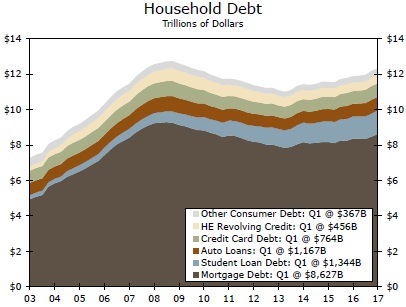
First, the composition of debt has changed significantly. There has been a shift away from mortgage lending and towards autos and education-related debt. As a share of total debt, student loans have more than doubled from a 4.8 percent share in Q3-2008 to a 10.6 percent share today. Auto lending has seen a similar, albeit more moderate, trend. Mortgage debt, however, remains $670 billion below its 2008 peak.
Second, although household debt has surpassed its previous peak, this ignores a series of other factors, such as population growth, inflation and growth in real output. As illustrated by the dark line in the middle chart, nominal debt per capita still remains short of its 2008 level. After adjusting for inflation, blue line, it is even clearer that the average household's debt portfolio is smaller relative to a decade ago. When viewed through this lens, the recent growth in household debt looks much more modest.
Loan Quality Fairly Stable on Trend
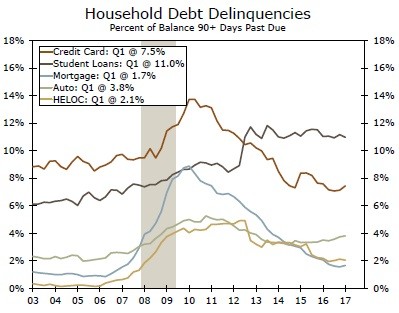
In terms of loan quality, household debt delinquencies remained roughly flat in Q1, although there were some differences between categories of loans. Auto loan delinquencies ticked modestly higher and have risen very gradually over the past few quarters (bottom chart). Credit standards on autos have tightened from already relatively constricted levels; the median credit score for a newly originated auto loan was 706 in Q1, a 6 point increase from Q4 and well above the 686 reading in Q3-2007 on the eve of the Great Recession.
Mortgage debt drove most of the growth in Q1. As we have highlighted in other reports, a mild winter weather likely pulled forward some housing activity that would typically take place in the spring. This in turn helped spur a strong first quarter for the housing market, with real residential construction expenditures rising at a 13.7 percent annualized rate. Auto loans and student loans grew $10 billion and $34 billion, respectively, while credit card balances declined by $15 billion.
On balance, the recent growth in household debt is a broad sign of strength rather than consumer weakness. Student loans remain a long-term secular challenge, and other areas, such as autos, warrant close monitoring as new data become available. That said, household leverage remains lower than it was in the 2000s credit bubble while the personal saving rate is higher. Despite the Q1 weakness, we expect real consumer spending to rebound in Q2 amid an ever-tightening labor market and healthy consumer confidence.
Author
Wells Fargo Research Team
Wells Fargo

















