Home Affordability: Canada vs. US


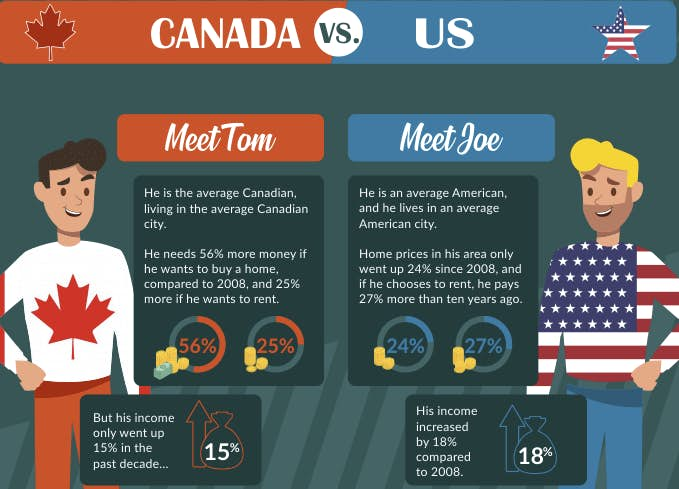
Homes are unaffordable in the US, but the situation is far worse in Canada.
Point2homes has an interesting set of charts on Home Affordability In Canada vs the US.
Key Findings
- The average Canadian has to dish out a whopping 56% more to buy a home, or 25% more to rent one compared to ten years ago, but the median wage in Canada only went up 15%.
- The average home price in the U.S. increased at a much slower rate (24%), while the median income went up by 18%.
- Since 2008, the Canadian dollar lost approximately 25% of its power compared to the American dollar, going from almost perfect parity to a much lower exchange rate.
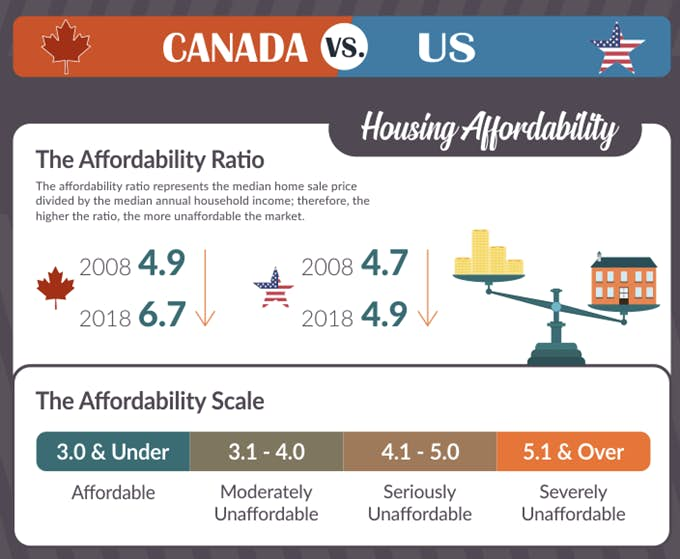
- The affordability crisis worsened in Canada, where the housing market went from “seriously unaffordable” to “severely unaffordable”, but the American housing market remained in the “seriously unaffordable” category.
Real Housing Prices
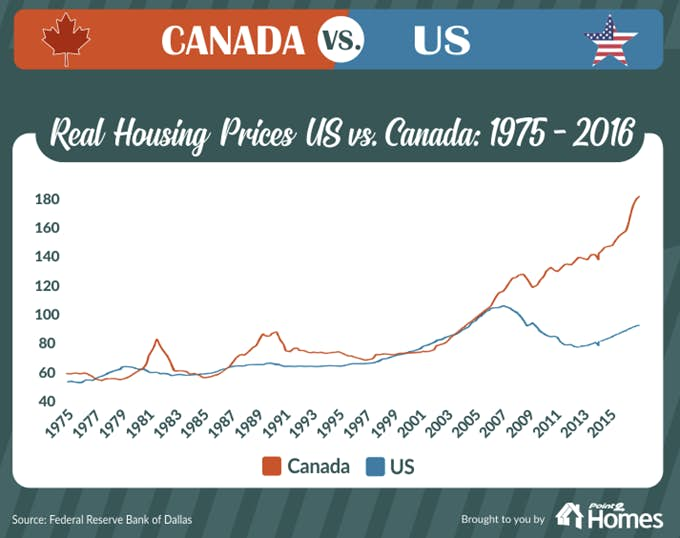
- Eight years into the new millennium, the U.S. marched head first into one of the worst economic crises in its history following the bursting of the housing bubble. Canada’s real estate bubble hasn’t yet popped and the country has not yet seen a major decline in home prices, but the Canadian economy experienced its own share of turbulence following the oil price crash from 2014 and the burst of China’s speculative bubble.
- And now, 10 years after the housing crisis that destabilized the U.S., some analysts claim that Canada faces a similar scenario if it stays the course: household debt currently exceeds 100% of GDP, according to data released by the Bank for International Settlements, the average home price went up 56% in ten years, while the median wage per household only increased 15% during the same period, and loose lending is on the rise.
- In the past six years, the Canadian dollar has lost 25% of its power compared to the American dollar, going from almost perfect parity to a much lower exchange rate. Therefore, in this study, the median wages, the average home prices, and average rents in both countries are expressed in the respective country’s currency, to avoid distortions and inaccuracies in percentage changes.
Canada vs US Rent
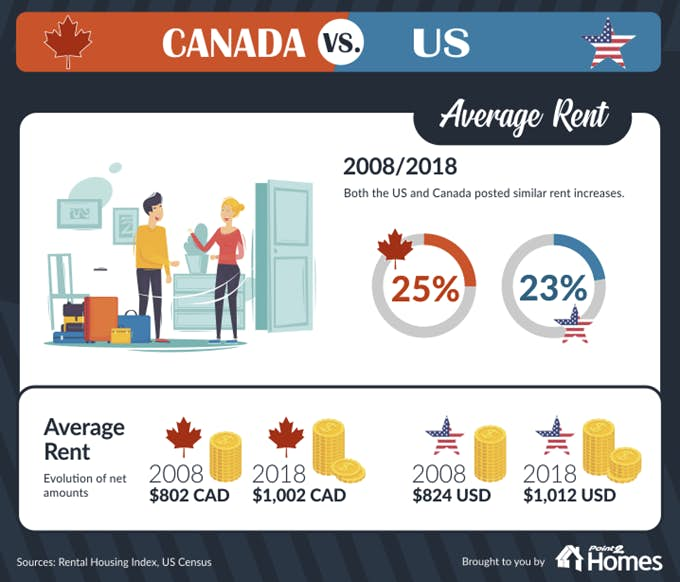
- The alternative to homeownership, renting has been on the rise in both Canada and the U.S. in the past decade. And so has the average rent in both countries. In Canada, the average amount went up 25% in ten years, and the U.S. had a similar trajectory, posting a 23% increase since 2008. However, all cities are not created equal.
- According to RENTCafé.com, average rents in New York and San Francisco are way ahead of all the other American urban centres: in Manhattan, renters pay $4,119 USD, and even in Brooklyn, they face average rents of $2,801 USD. Four other cities post average rents above $3,000 USD: San Francisco, CA ($3,590 USD), Boston, MA ($3,379 USD), San Mateo, CA ($3,234 USD), and Cambridge, MA ($3,112 USD).
- In Canada, it is Vancouver and especially Toronto that boast the highest rents, but they are well below the highest rental rates in the U.S. – in both cities, the average rent hovers around $2,000 CAD. And Vancouver doesn’t show any signs of slowing down: the provincial government agreed to a 4.5% maximum allowable rent increase for 2019, which is the largest rent increase since 2004 when the ceiling was set at 4.6%.
Unaffordability Nightmare
Mish Comments
Note that Point2homes compared median home price to median annual income. I criticized a US study recently for using averages rather than median values.
What struck me most was the lead claim the "average home price in the U.S. increased at 24%" since 2008. I thought that number was low. It turns out to be high.
The best judge of this is neither median nor average price but rather resales of the same home.
Case Shiller 20 City Composite
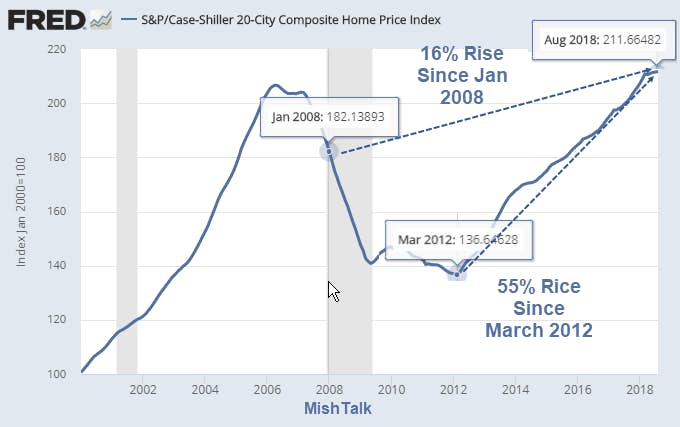
Since 2008, the price of the same house in the 20 major city study area rose only 16%. Since March of 2012, however, the price for the same home is up a whopping 55%.
Along with rising interest rates, that is having a severe impact on the US housing market.
Inflation Adjusted Case Shiller
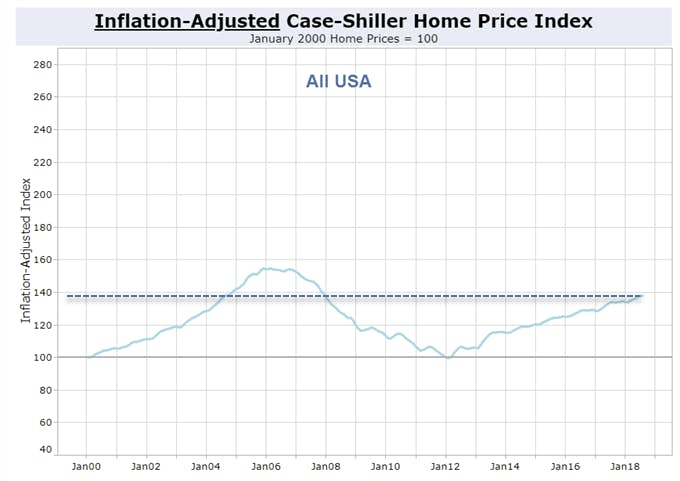
In real terms, US houses are more affordable now than in 2008 but they are not affordable. In Canada, the bubble never corrected at all.
In the US, real median household incomes have been stagnant. Real home prices haven't.
Lower mortgage payments of existing homeowners do not make homes more affordable. The Fed blew another housing bubble. Once again, the size of the bubble varies city to city.
The Canadian bubble dwarfs the US. It will weigh on Canada for at least another decade.
Related Articles
- Housing Least Affordable in a Decade
- California Ground Zero in Upcoming Real Estate Bust
- Thud! Sept New Home Sales Plunge 5.5% from Dramatically Revised Lower August
- Housing Continues to Weaken: Starts Decline 5.3%, Permits Down 0.6%
Check out the link number one for more charts and studies about housing affordability in the US.
Author
Mike “Mish” Shedlock's
Sitka Pacific Capital Management,Llc

















