
|

Here we go again

The selloff that started after Samsung announced jaw-droppingly good—and better-than-expected—results continued through the following European and US sessions. ASML in Europe lost more than 7%, while VanEck’s semiconductor ETF in the US fell nearly 3.8%, slipping below its 50-DMA for the first time since April. The tech-heavy Nasdaq 100 led losses among the major US indices—it lost 1.77% and closed a touch below its own 50-DMA, also for the first time since April. Its brand-new member, SpaceX, tanked 6.83% on its first day in the index. The stock went straight down and closed below its post-IPO opening price of $150 per share.

Yesterday also marked the end of the quiet period for SpaceX, allowing Wall Street analysts to reveal what they think about the company. And it blew my mind to see that opinions ranged from bullish to extremely bullish. Goldman Sachs and Citi analysts set price targets of around $200 per share (more than a one-third increase from yesterday’s closing price), Deutsche Bank expects the stock to rise to $255 per share (+70% from yesterday’s close), and Morgan Stanley to $300 per share—that would represent a 100% gain from yesterday’s closing price.
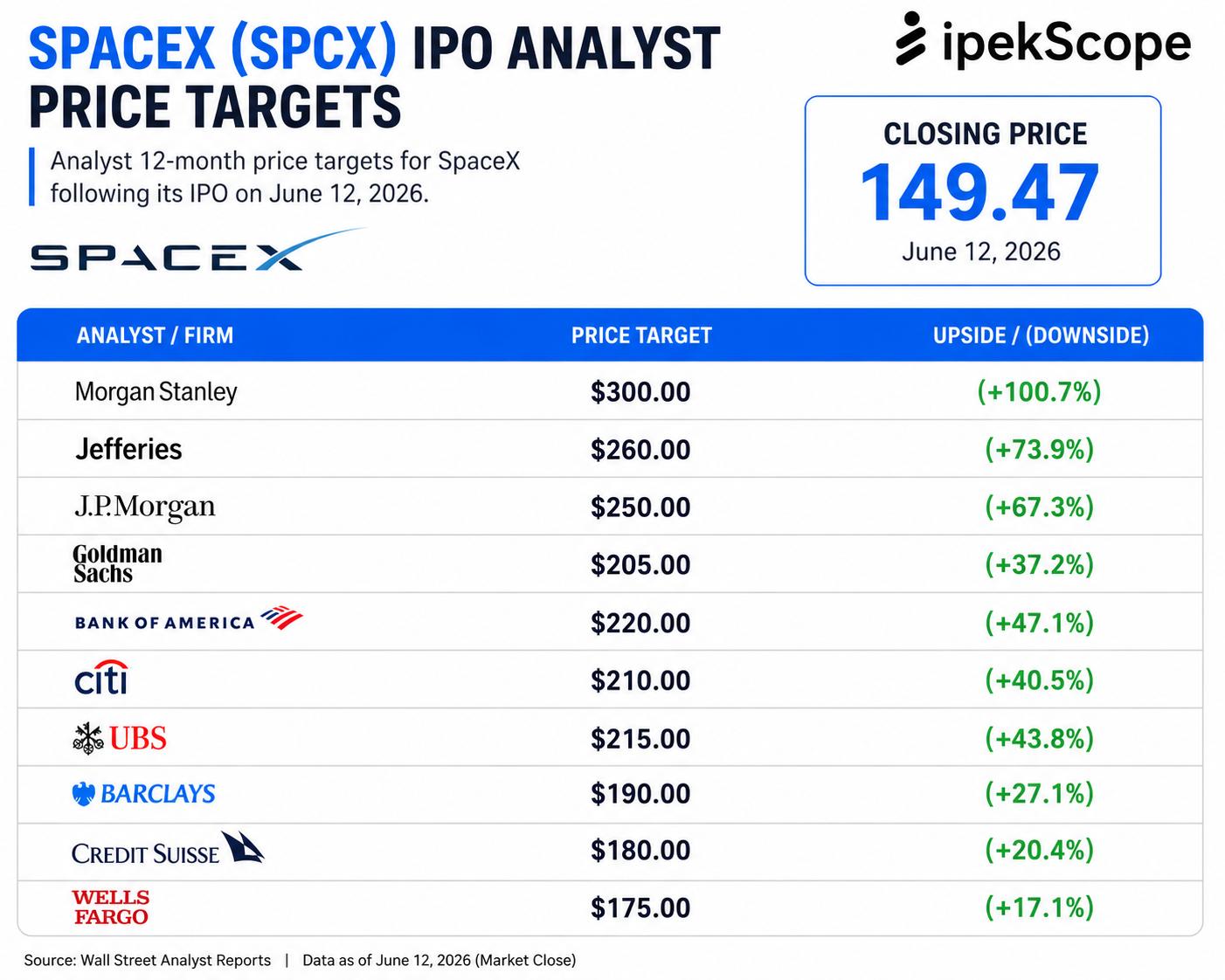
Chart

Morgan Stanley analysts say they "believe SpaceX can convert energy into intelligence at scale with optionality to monetize through a range of consumer and enterprise solutions for the next era of AI," while also acknowledging that there is "still considerable uncertainty about the company's prospects." That part is actually more interesting than their average price target: Morgan Stanley sees a valuation range of $75 to $600 per share.


Read the full article here.

Author

Ipek Ozkardeskaya

Ipek Ozkardeskaya began her financial career in 2010 in the structured products desk of the Swiss Banque Cantonale Vaudoise. She worked in HSBC Private Bank in Geneva in relation to high and ultra-high-net-worth clients.


More from Ipek Ozkardeskaya
Share:

Editor's Picks

GBP/USD: Sustenance above 20-day EMA backs further upside above 1.3400

The GBP/USD pair trades almost flat at around 1.3355 during the European trading session. The Cable consolidates as investors await the Federal Open Market Committee minutes of the June policy meeting, which will be published at 18:00 GMT. At press time trades marginally lower to near 101.05.

EUR/USD gains as the Dollar moves sideways amid market caution

EUR/USD maintains its position after registering modest losses in the previous day, trading around 1.1410 during the Asian hours. Traders’ attention is focused on Wednesday's release of the US Federal Reserve Meeting Minutes, the first under newly appointed Chairman Kevin Warsh, for crucial clues regarding the future path of US interest rates.

Gold regains $4,100 despite Iran risks, ahead of Fed Minutes

Gold is fading in the tepid rebound above $4,100 early Wednesday, having reversed a part of the previous sell-off. Traders eagerly await the Minutes of the US Federal Reserve June monetary policy meeting, due later in the day, for fresh trading impetus.

Pi Network crashes to a record low amid broader market stress

Pi Network (PI) price edges toward $0.1000 extending losses for the fifth straight day. Retail sentiment remains bearish as Open Interest and the funding rate decline. The technical outlook for PI is bearish as selling pressure mounts, despite oversold conditions.

WTI holds above $72.00, near two-week high amid fresh US-Iran tensions

West Texas Intermediate (WTI) struggles to capitalize on the previous day's strong move up and enters a bullish consolidation phase near a two-week high, touched during the Asian session this Wednesday. The black liquid currently trades just above the $72.00 mark, with bulls awaiting a sustained strength beyond a technically significant 200-day SMA amid renewed US-Iran hostilities.

Bye, forward guidance: How to trade when central banks choose silence

Central banks have spent years telling markets what might come next. Now, traders face the possibility that they say a lot less. From the Federal Reserve to the European Central Bank and the Bank of England, policymakers are pushing back against forward guidance.