Good data, happy ECB


Over the past two weeks some key Eurozone economic data releases have been much better than expected, with the surprise indices having remained highly elevated. Such economic data included strong inflation, and modestly better-than-expected GDP data. However, those do present some risks to the consensus view that further monetary policy easing will be needed later this year and may instead lead the European Central Bank (ECB) down a wait-and-see path in 2021.
Inflation
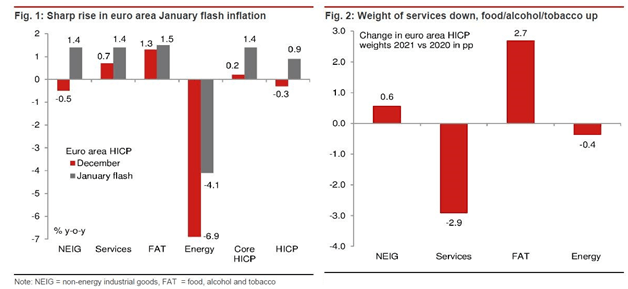
Eurozone Harmonised Index of Consumer Prices (HICP) inflation rose strongly in January, with all of the big four countries surprising with an uptick in the indicator. The most notable rise came from Germany, where inflation rose to 1.6% Year-on-Year (YoY) from -0.7%, but there were significant rises too in France (to 0.8% from zero), Italy (to 0.5% from -0.3%) and Spain (to 0.6% from -0.6%). Overall, Eurozone inflation in January rose to 0.9% from -0.3%, an upside surprise of 0.3pp, while core inflation rose to 1.4% from 0.2% in the previous month, an upside surprise of 0.5pp.
The particularly sharp rise in German inflation was due to some policy-specific factors such as the reversal of the VAT cut that had been in place since the middle of last year, and the implementation of the climate package. In addition to that, there appears to be an inflation that has boosted by a change in weights within the HICP basket. This was required by Eurostat, so most statistical institutes in Europe changed their HICP weights in January 2021 in response to changes in consumption patterns linked to the pandemic. As explained by ECB Executive Board member Schnabel in her recent interview with Deutschlandfunk, the significant shift in individual goods’ weights within the basket makes it “very difficult to compare inflation figures over time”.
Eurozone GDP
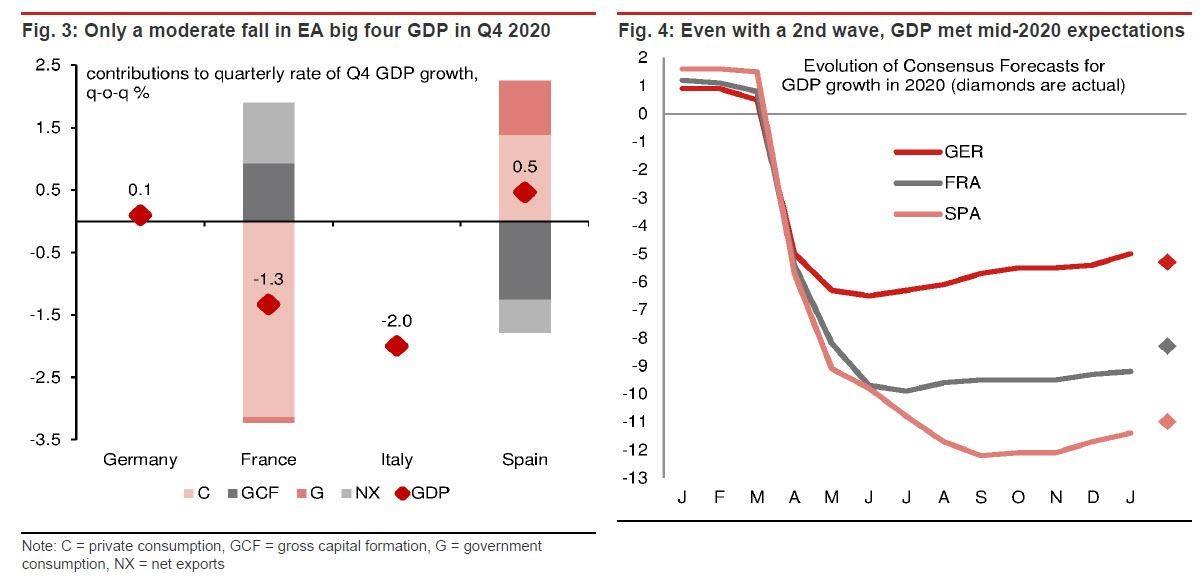
Eurozone GDP was also published this week and showed that the second COVID-19 wave had – in Q4 of 2020 at least – only a modest effect on output, falling by 0.7% when compared to Q3 of the same year. Activity in two of the eurozone big four economies surprised consensus on the upside. French GDP fell by only 1.3% Quarter-on-Quarter (QoQ), which was far less than what was expected, while in Spain output rose by 0.4% QoQ rather than the 1.4% fall expected. While, in Germany and Italy, GDP figures were broadly in line with consensus.
It’s very tempting to conclude that GDP has not fallen as much as it actually did, however, economists’ forecasts published in the middle of 2020 for the major euro area economies were actually fairly accurate.
It’s important to note that forecasts made in the middle of 2020 did not generally take into consideration the scale of the second wave of the virus, thus in some sense, GDP has surprised to the upside at the end of 2020 because output has grown as expected, but with far worse virus conditions than foreseen.
Monetary Policy Implications
The well-above-expectations rise in euro area January inflation and the limited decline in Q4 GDP potentially pose substantial risks to the ECB, which have been expecting to increase their Pandemic Emergency Purchase Programme (PEPP) envelope in the second half of 2021.
As mentioned earlier, ECB Executive Board member Schnabel said in an interview published on Sunday (with Deutschlandfunk) that the central bank is “expecting the inflation rate to pick up in the course of this year. We must be careful, however, not to mistake these short-term developments for a sustained increase in inflation. We are faced with very weak demand. And it does not look like this is going to fundamentally change. This is why we continue to be more worried about inflation being too low rather than too high.”
With that said, adding more monetary stimulus when inflation and GDP are both high, will be a hard sell for most ECB members. However, as I explained, much of the rise in inflation is seen to be temporary and related to one-off factors which were policy and weight changes. In an environment of rising inflation and increased uncertainty, the possibility of the ECB adopting a ‘wait-and-see’ approach throughout 2021 is very real.
Author
Alexander Douedari
Independent Analyst
Alexander Douedari is an Award Winning Hedge Fund Manager and Selfmade 7-Figure Trader. Now Mentor for Students all around the world.

















