Gold Weekly Forecast: Sellers take control after impressive US labor market data
- Gold made a sharp U-turn after climbing to a multi-week high.
- Near-term technical outlook points to a loss of bullish momentum.
- XAU/USD could come under bearish pressure if $2,030 is confirmed as resistance.

Gold gathered bullish momentum and climbed to its highest level since early January above $2,060 before erasing a majority of weekly gains on Friday. Comments from Federal Reserve (Fed) officials could impact the precious metal’s valuation next week in the absence of high-tier macroeconomic data releases.
Gold price declined sharply on Friday
Gold benefited from escalating geopolitical tensions and retreating US yields to start the week, gaining more than 0.5% on Monday. News of a drone strike on a US base near Jordan's border with Syria killing three and injuring more than 20 troops revived fears over a deepening crisis in the Middle East.
Ahead of the Federal Reserve’s (Fed) policy announcements, Gold remained relatively calm on Tuesday but managed to close in positive territory. On Wednesday, the Fed left the policy rate unchanged at 5.25%-5.5% as expected. The Fed made significant changes to the policy statement and dropped the section about how policymakers will take into account a range of economic indicators in determining the extent of any additional policy firming that may be appropriate. Instead, the US central bank said that they will continue to monitor “the implications of incoming information for the economic outlook” to assess the appropriate stance of policy.
The initial reaction to the Fed’s tone caused the US Dollar to come under bearish pressure and helped XAU/USD edge higher. In the post-meeting press conference, however, "based on the meeting today, I don't think likely we will have a rate cut in March," Fed Chairman Jerome Powell responded when asked about the possibility of a rate reduction at the next meeting. Following this remark, Wall Street’s main indexes fell sharply and helped the USD gather strength, capping the pair’s upside in the late American session. Powell also acknowledged that they could cut rates sooner if they saw an unexpected weakening in the labor market.
Following the choppy market action seen in the Fed aftermath, US Treasury bond yields turned south in the American session on Thursday and fuelled a fresh leg higher in Gold. The benchmark 10-year US Treasury bond yield lost more than 2% and dropped to its lowest level since late December below 3.9% after uninspiring employment-related data releases, while XAU/USD rose above $2,060. There were 224,000 first-time applications for unemployment benefits in the week ending January 27, higher than the market expectation of 212,000, the US Department of Labor reported. Additionally, the ISM Manufacturing PMI improved to 49.1 in January from 47.1 in December but the Employment component declined to 47.1 from 47.5.
On Friday, Gold turned south and erased the majority of its weekly gains following the January jobs report. Nonfarm Payrolls in the US rose by 353,000, surpassing the market expectation of 180,000 by a wide margin. November's increase of 216,000 got revised higher to 333,000. Additionally, annual wage inflation, as measured by the change in the Average Hourly Earnings, rose to 4.5%. The benchmark 10-year US Treasury bond yield recovered toward 4% on upbeat data and XAU/USD declined below $2,030.
Gold price could react to Fedspeak next week
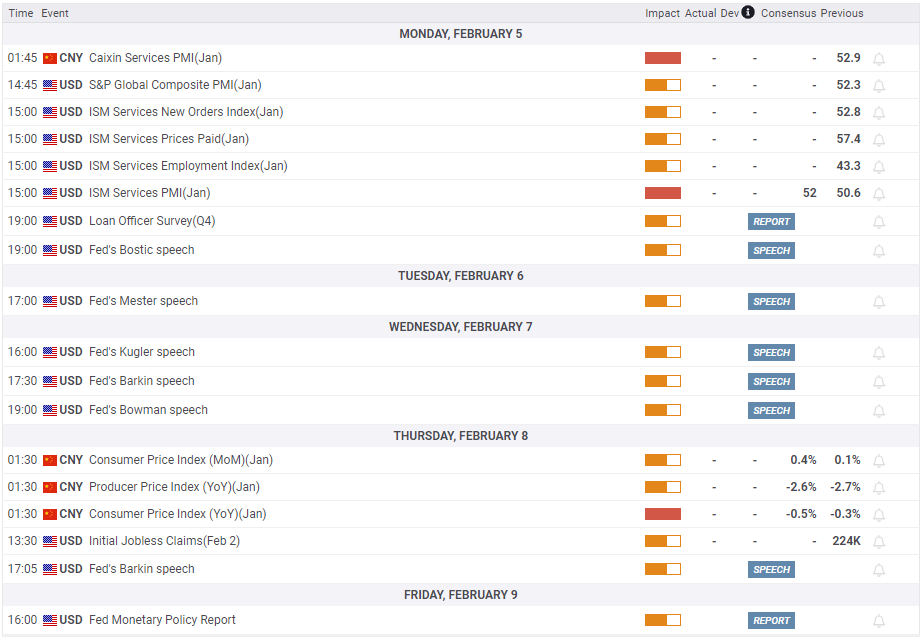
The ISM will release the January Services PMI report on Monday. Unless there is a significant divergence in the headline PMI reading, which is forecast to edge higher to 52.0 from 50.6 in December, investors are likely to react to the labor component. The Employment Index declined sharply from 50.7 in November to 43.3 in December, showing a contraction in service sector payrolls. A further decline in this sub-index could weigh on the USD, while a recovery toward or above 50 could help the currency find demand. Nevertheless, the market reaction could remain short-lived in the aftermath of the January labor market figures.
The economic calendar will not feature any other high-tier data releases that could impact Gold’s valuation later in the week. Instead, market participants will focus on comments from Fed officials.
Despite Powell having essentially ruled out a rate cut in March, the CME FedWatch Tool shows that markets are still pricing in a 20% probability of a policy pivot at the next meeting. The market positioning suggests that the USD has some room on the upside in case Fed officials continue to push back against this expectation. On the other hand, XAU/USD could regain traction if policymakers leave the door open to a rate cut next month. That, however, seems increasingly unlikely after the impressive jobs report.
Gold technical outlook
The Relative Strength Index (RSI) indicator on the daily chart retreated to 50 after advancing to 60 before the NFP, highlighting a loss of bullish momentum. The 20-, and 50-day Simple Moving Averages form a pivot point for XAU/USD at around $2,030.
On the upside, $2,060 (static level) aligns as first resistance before $2,080 (static level) and $2,100 (psychological level). If Gold falls below $2,030 and confirms this level as resistance, technical sellers could take action. In this scenario, $2,020 (Fibonacci 23.6% retracement of the latest uptrend) could be seen as first support before $2,000 (psychological level, static level).

Gold FAQs
Why do people invest in Gold?
Gold has played a key role in human’s history as it has been widely used as a store of value and medium of exchange. Currently, apart from its shine and usage for jewelry, the precious metal is widely seen as a safe-haven asset, meaning that it is considered a good investment during turbulent times. Gold is also widely seen as a hedge against inflation and against depreciating currencies as it doesn’t rely on any specific issuer or government.
Who buys the most Gold?
Central banks are the biggest Gold holders. In their aim to support their currencies in turbulent times, central banks tend to diversify their reserves and buy Gold to improve the perceived strength of the economy and the currency. High Gold reserves can be a source of trust for a country’s solvency. Central banks added 1,136 tonnes of Gold worth around $70 billion to their reserves in 2022, according to data from the World Gold Council. This is the highest yearly purchase since records began. Central banks from emerging economies such as China, India and Turkey are quickly increasing their Gold reserves.
How is Gold correlated with other assets?
Gold has an inverse correlation with the US Dollar and US Treasuries, which are both major reserve and safe-haven assets. When the Dollar depreciates, Gold tends to rise, enabling investors and central banks to diversify their assets in turbulent times. Gold is also inversely correlated with risk assets. A rally in the stock market tends to weaken Gold price, while sell-offs in riskier markets tend to favor the precious metal.
What does the price of Gold depend on?
The price can move due to a wide range of factors. Geopolitical instability or fears of a deep recession can quickly make Gold price escalate due to its safe-haven status. As a yield-less asset, Gold tends to rise with lower interest rates, while higher cost of money usually weighs down on the yellow metal. Still, most moves depend on how the US Dollar (USD) behaves as the asset is priced in dollars (XAU/USD). A strong Dollar tends to keep the price of Gold controlled, whereas a weaker Dollar is likely to push Gold prices up.
Author

Eren Sengezer
FXStreet
As an economist at heart, Eren Sengezer specializes in the assessment of the short-term and long-term impacts of macroeconomic data, central bank policies and political developments on financial assets.

















