Gold Weekly Forecast: Sellers return on hawkish Fed bets and Middle East uncertainty
- Gold turned south after touching a three-week high above $4,770 and registered large weekly losses.
- Strong US inflation data caused markets to reassess the possibility of Fed policy-tightening.
- The technical outlook points to a bearish tilt in the near term.

Gold (XAU/USD) edged higher at the beginning of the week but made a sharp U-turn as the US Dollar (USD) gathered strength on hot inflation data, closing the week in the red by losing more than 3% of its value. In the absence of high-impact data releases, geopolitical headlines could drive the precious metal’s valuation in the near term.
Gold turns south as markets reassess prospects of tighter Fed policy
Gold declined in the Asian session on Monday after United States (US) President Donald Trump rejected Iran’s proposal to end the war. In the second half of the day, the USD struggled to find demand as the Nasdaq Composite and the S&P 500 indexes both hit new record highs following the opening bell.
Although Gold climbed to its highest level in three weeks above $4,770 in the first half of the day on Tuesday, it reversed its direction and registered small daily losses as the USD started to gather strength after hot inflation data.
The US Bureau of Labor Statistics (BLS) reported on Tuesday that the Consumer Price Index (CPI) rose 3.8% in April, up sharply from the 3.3% increase recorded in March. This print also came in above the expectation of 3.7%. On a monthly basis, the CPI rose 0.6%, following the March's increase of 0.9% and matching analysts' estimate. The core CPI, which excludes volatile food and energy prices, rose 0.4% and 2.8% on a monthly and yearly basis, respectively, both slightly higher than what analysts had expected.
Higher-than-expected consumer inflation was followed by another hot print a day after: On Wednesday, the BLS announced that annual producer inflation in the United States, as measured by the change in the Producer Price Index (PPI), jumped to 6% in April from 4.3% in March, compared to the market expectation of 4.9%. That’s the biggest increase since 2022, and it fueled market fears of another wave of upcoming inflation.
Following the CPI and PPI releases, the probability of the Fed raising the policy rate by at least 25 basis points by end-2026 rose to nearly 50% from about 20%, according to the CME FedWatch Tool. In turn, the benchmark 10-year US Treasury bond yield rose to its highest level in a year above 4.5%, causing XAU/USD to come under heavy bearish pressure.
In the meantime, news of India raising import tariffs on Gold and Silver from 6% to 15% and Prime Minister Narendra Modi urging citizens to voluntarily stop buying physical Gold to limit USD outflows and ease pressure on foreign exchange reserves further weighed on Gold prices in the second half of the week. After posting moderate losses for three consecutive days, XAU/USD extended its slide and dropped to a fresh 10-day low below $4,600 on Friday.
Commerzbank analysts explain that India’s decision to raise tariffs on Gold and Silver imports are intended to support the Indian Rupee (INR) by narrowing the trade deficit and curb the USD demand. “In Q1 2026, Gold and Silver imports, which account for 14% of total imports, surged 146% YoY as global Gold and Silver prices rose 60% and 161% YoY, respectively. Strong bullion demand from traders and households for investment and cultural purposes has intensified onshore USD demand and widened the trade deficit,” they add.
Similarly, ING commodities strategists Warren Patterson and Ewa Manthey argue that the tariff hike is likely to be a near-term headwind for physical Gold demand in India, “potentially tempering local buying and weighing on import flows."
FXStreet analyst Haresh Menghani, however, warns that higher Gold duties could backfire as these could incentivize Gold’s black market in the country: “The illicit trade would cause significant revenue loss to the government, feed the unaccounted money system (black money), and technically contribute to a higher trade deficit,” he says.
Gold traders await Fed Minutes, stay focused on Middle East
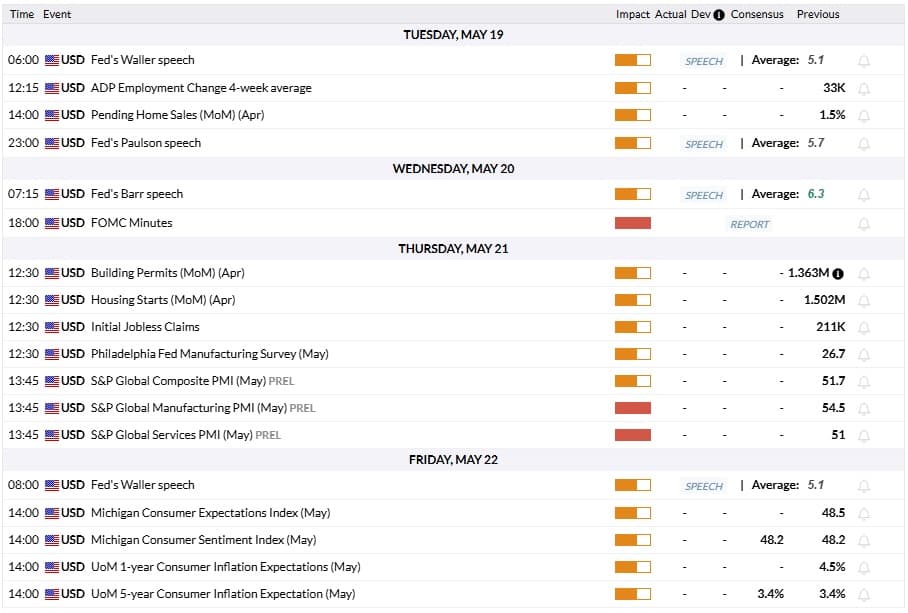
The US economic calendar will not offer any high-impact data releases in the first half of the week. On Wednesday, the Fed will publish the minutes of the April policy meeting. The publication will offer key details regarding the discussions surrounding the wording of the policy statement.
The readout could be particularly interesting as there were three hawkish dissenters: Cleveland Fed President Beth Hammack, Dallas Fed President Lorie Logan and Minneapolis Fed President Neel Kashkari voted against the inclusion of easing bias in the statement, citing heightened inflation risks and uncertain economic outlook.
In case the publication shows that more officials shared the same view even though they didn’t dissent, while voicing their openness to policy-tightening in case there are signs of high inflation becoming entrenched in the economy, investors could continue to price in a rate hike and support the USD. In this scenario, XAU/USD is likely to stay under bearish pressure.
Conversely, the USD could lose strength and help XAU/USD rebound if the minutes suggest that Fed officials remain optimistic about inflation coming back down quickly once the Middle East crisis is over.
On Thursday, S&P Global will publish the preliminary Manufacturing and Services Purchasing Managers’ Index (PMI) data for May. If headline prints remain in the expansion territory above 50 but the survey highlights an acceleration in input inflation in the private sector, the USD is likely to hold its ground.
Meanwhile, investors will keep a close eye on headlines coming out of the Middle East. Following his summit with Chinese President Xi Jinping, US President Trump said China is interested in helping broker progress on Iran, including the reopening of the Strait of Hormuz. Unless there is a significant decline in crude Oil prices, with the US and Iran finding a middle ground to open the strait, global inflation fears are likely to make it difficult for Gold to stage a decisive rebound.
Gold technical analysis: Short-term bearish tilt emerges
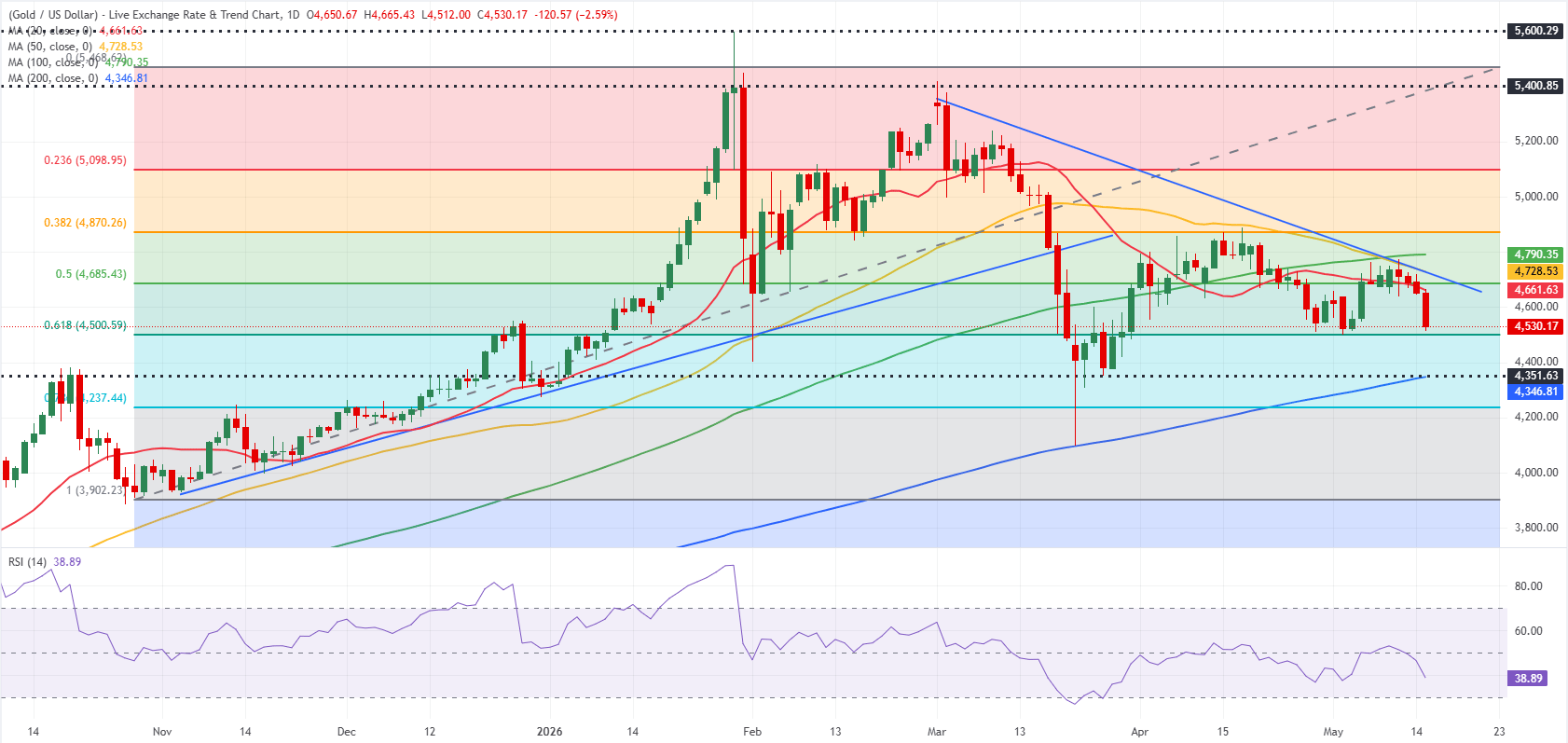
The Relative Strength Index (RSI) indicator on the daily chart dropped to 40 and Gold closed the last two days below the 20-day, 50-day and 100-day Simple Moving Averages (SMA), reflecting a buildup in bearish momentum.
On the downside, the Fibonacci 61.8% retracement level of the November-February uptrend aligns as the next critical support level at $4,500 ahead of $4,350 (200-day SMA). A daily close below the latter could trigger another leg lower toward $4,240 (Fibonacci 78.6% retracement).
Looking north, the first resistance level could be seen at $4,685 (Fibonacci 50% retracement, descending trend line) before $4,790 (100-day SMA) and $4,870 (Fibonacci 38.2% retracement).
Gold FAQs
Gold has played a key role in human’s history as it has been widely used as a store of value and medium of exchange. Currently, apart from its shine and usage for jewelry, the precious metal is widely seen as a safe-haven asset, meaning that it is considered a good investment during turbulent times. Gold is also widely seen as a hedge against inflation and against depreciating currencies as it doesn’t rely on any specific issuer or government.
Central banks are the biggest Gold holders. In their aim to support their currencies in turbulent times, central banks tend to diversify their reserves and buy Gold to improve the perceived strength of the economy and the currency. High Gold reserves can be a source of trust for a country’s solvency. Central banks added 1,136 tonnes of Gold worth around $70 billion to their reserves in 2022, according to data from the World Gold Council. This is the highest yearly purchase since records began. Central banks from emerging economies such as China, India and Turkey are quickly increasing their Gold reserves.
Gold has an inverse correlation with the US Dollar and US Treasuries, which are both major reserve and safe-haven assets. When the Dollar depreciates, Gold tends to rise, enabling investors and central banks to diversify their assets in turbulent times. Gold is also inversely correlated with risk assets. A rally in the stock market tends to weaken Gold price, while sell-offs in riskier markets tend to favor the precious metal.
The price can move due to a wide range of factors. Geopolitical instability or fears of a deep recession can quickly make Gold price escalate due to its safe-haven status. As a yield-less asset, Gold tends to rise with lower interest rates, while higher cost of money usually weighs down on the yellow metal. Still, most moves depend on how the US Dollar (USD) behaves as the asset is priced in dollars (XAU/USD). A strong Dollar tends to keep the price of Gold controlled, whereas a weaker Dollar is likely to push Gold prices up.
Author

Eren Sengezer
FXStreet
As an economist at heart, Eren Sengezer specializes in the assessment of the short-term and long-term impacts of macroeconomic data, central bank policies and political developments on financial assets.

















