|

United States Producer Price Index soars in April amid Iran war

United States Producer Price Index soars in April amid Iran war

The United States (US) Producer Price Index jumped to 6% on a yearly basis in April, following the 4.3% posted in March and largely surpassing the expected 4.9%. On a monthly basis, the PPI rose 1.4%, doubling the March reading of 0.7%, and much higher than the anticipated 0.5%.

Wholesale inflation hit its highest since December 2022, not really a surprise considering what’s going on in the Middle East. The energy supply disruption triggered by the Iran war is the main source of higher inflationary pressures around the globe and what’s twisting central bankers’ hands.

The figures came a day after the Consumer Price Index (CPI) rose by 3.8% in the same period, nearly doubling the Federal Reserve’s (Fed) goal of 2%, spurring speculation that the central bank will have no choice but to hike interest rates.

Market reaction
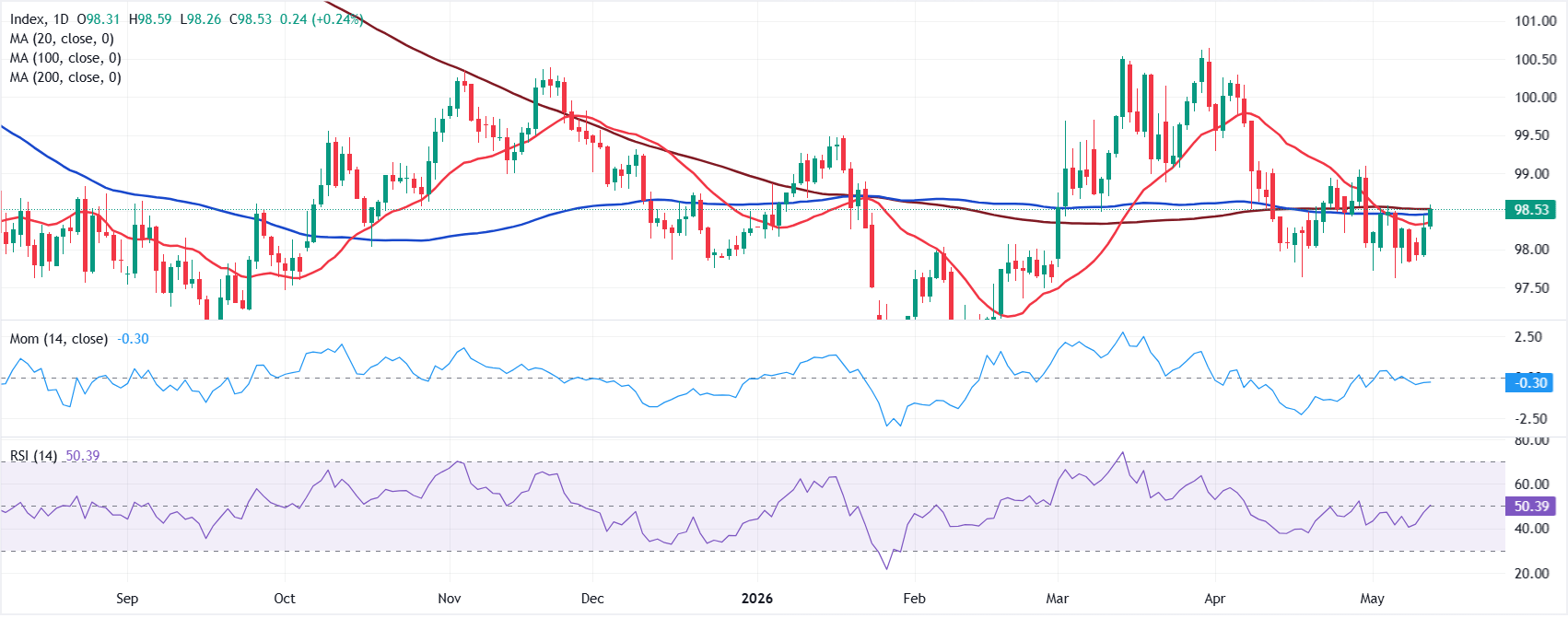
The US Dollar Index (DXY) retains the positive momentum across the FX board amid a combination of risk aversion and mounting speculation of upcoming US rate hikes, holding near fresh weekly highs in the 98.60 region. Recent peaks at around 99.10 turn into a critical resistance area ahead of additional gains.

Author

FXStreet Team

Composed of a group of economic journalists and FX experts, the FXStreet content team produces and oversees all content published on FXStreet. It provides a purely journalistic approach to the Forex market.


More from FXStreet Team
Share:

Editor's Picks

AUD/USD remains depressed below 0.6750 after RBA minutes

AUD/USD treads water below 0.6750 in Asia on Tuesday, struggling near ten-month lows. The pair fails to find any inspiration from RBA Governor Bullock’s hawkish remarks. Moreover, Minutes from the November RBA meeting also had little impact on the Australian Dollar amid a bullish US Dollar undertone, bolstered by firming Fed hike bets and geopolitical uncertainties.

USD/JPY holds steady around 156.50 as 'Yentervention' risks loom

USD/JPY is consolidating around mid-156.00s in the Asian session on Tuesday as traders stay on high alert amid speculation that authorities will step in to support the Japanese Yen. Meanwhile, the US Dollar holds its recent gains at a 19-month high, amid firming Fed rate-hike bets and geopolitical uncertainty. This, along with the wide US-Japan rate differential, acts as a tailwind for the pair.


Gold trims intraday recovery gains as Fed hike bets and Iran risks support USD

Gold struggles to capitalize on modest recovery gains and trades near the lowest level since October 2025, set the previous day, albeit retaining a mildly positive tone through the first half of the European session. The US Dollar pauses following the recent strong rally to a 19-month peak, offering some support to the commodity. However, firming US Federal Reserve rate-hike bets and geopolitical uncertainties limit USD losses, capping the non-yielding bullion.

Pi Network sinks to record low of $0.0551 as bears dominate

Pi Network extends its losing streak, hitting a new all-time low of $0.0551 on Tuesday as bearish pressure intensifies. Weakening derivatives metrics suggest bears remain in control. In addition, deteriorating technical indicators point to elevated downside risk, despite oversold conditions that could trigger a short-term relief bounce.

Make or break tonight: Nvidia reports Q3 earnings
The Nasdaq lost 2.5% yesterday following an interim final rule by the US Commerce Department on US export restrictions on AI chips (to China). The rule targets a loophole where Chinese firms rent computing power from data centers in unrestricted countries. Data center operators in Singapore, Malaysia, Thailand, Indonesia and Brazil must now request a US license to buy advanced AI chips.
Gold isn't being sold for thew reason most people think
Gold (XAU/USD) remains under heavy selling pressure on Monday, hitting its lowest level in 13 months. The precious metal is struggling to recover despite escalating geopolitical tensions in the Middle East, a backdrop that would normally encourage investors to seek protection in safe-haven assets. However, the main driver behind Gold's decline is not the geopolitical uncertainty itself.