Gold Weekly Forecast: Mideast stalemate keeps bullish potential in check
- Gold retreated after setting a fresh two-month high near $4,450.
- Easing Fed rate hike bets help the precious metal limit its losses.
- The technical outlook highlights buyer hesitancy in the short term.

After posting its largest one-week gain since January in the first week of August, Gold (XAU/USD) extended its rally and touched a fresh two-month peak near $4,450 as markets continued to scale back bets for a Federal Reserve (Fed) interest rate hike in September. With the crisis in the Middle East remaining unresolved, however, Gold corrected lower to end the week virtually unchanged. Investors will continue to pay close attention to comments from Fed officials and assess the developments surrounding the United States (US)-Iran conflict in search of the next directional clue.
Gold stretches higher following US inflation prints
Gold started the week on a bullish note as the negative impact of the disappointing US July employment data on the US Dollar (USD) lingered. After rising more than 1% on Monday, Gold stretched higher in the Asian session on Tuesday but lost its traction in the American session to close the day marginally lower.
US President Donald Trump claimed that the situation with Iran was “going fine” and that they had “total control” of the Strait of Hormuz. Nonetheless, markets largely ignored these comments and Gold struggled to preserve its bullish momentum as CNN reported that only eight vessels crossed the waterway on Tuesday, compared to an average of 120 before the war. Additionally, the US Energy Information Administration (EIA) revised its crude Oil price projections, noting that it now expects the barrel of West Texas Intermediate (WTI) to average $80.88 in 2026, compared to $76.26 in the previous forecast.
The US Bureau of Labor Statistics (BLS) reported on Wednesday that annual inflation, as measured by the change in the Consumer Price Index (CPI), declined to 3.4% in July from 3.5% in June. On a monthly basis, the CPI rose by 0.1% following the 0.4% decline recorded in the previous month, while the core CPI, which excludes volatile food and energy prices, increased by 0.2%. All these figures came in line with market expectations and failed to support the USD, helping Gold erase Tuesday’s losses.
The USD came under renewed bearish pressure on Thursday after the BLS announced that the annual producer inflation softened to 4.7% in July from 5.5% in June. Following these data releases, the CME Group FedWatch Tool’s probability of a 25 basis points (bps) Fed rate hike in September declined below 35% from about 45% a week earlier.
Analysts at MUFG note that the US Dollar “has continued to trade on a softer footing this week encouraged by the scaling back of Fed rate hike expectations.” They highlight that “the slowdown in private employment and wage growth in recent months alongside limited evidence of higher energy prices spilling over into core inflation since the US-Iran conflict started is providing more leeway for the Fed to leave rates on hold.”
After touching its highest level since early June at $4,450 during the early hours of the American session, Gold lost its traction and closed the day in the red. US Treasury Secretary Scott Bessent noted on Thursday that Washington is going to apply measures that have "never been seen" on Iran, and US Secretary of Defense Pete Hegseth said that the US can sustain its blockade against Iran “indefinitely,” reviving concerns over a prolonged conflict that could force Oil prices to remain elevated.
Heading into the weekend, disappointing Retail Sales data from the US fed weighed on the USD and allowed Gold to end the week in the upper half of its weekly range, near $4,400.
Gold investors await fresh US data and Fed signals
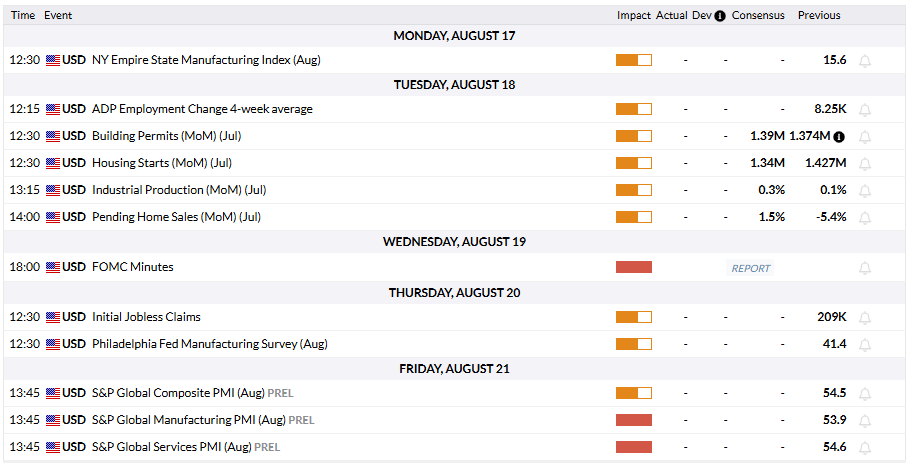
The US economic calendar will not feature any high-impact data releases in the first half of the week. On Wednesday, the Fed will publish the minutes of the July monetary policy meeting. In case the document highlights that policymakers, who voted for a policy hold, keep an open mind about a rate increase in September, the USD could gather strength with the immediate reaction and cause Gold to correct lower. Conversely, the USD could come under pressure and pave the way for a leg higher in Gold if the publication reveals that policymakers see a high bar for a rate hike. Still, the market reaction could remain limited considering that the meeting took place before the July employment report.
Cleveland Fed President Beth Hammack delivered a distinctly hawkish message earlier in the week, with an FXS Speechtracker score of 8.2/10, notably stronger relative to the historical average of 7.3/10. The repeated call to “raise rates right now,” framed against a stable labor market and broad-based inflation amid recent shocks, underscored a clear preference for tighter policy. Similarly, Chicago Fed President Austan Goolsbee called the labor market "stable, without being good" while stressing that "prices and affordability" and inflation are the biggest problems of the US economy, leaning toward prioritizing price stability over labor-market strength.
On Friday, S&P Global will publish the preliminary Manufacturing and Services Purchasing Managers’ Index (PMI) data for August. In case either of the headline PMIs unexpectedly drop into contraction territory below 50, the immediate reaction is likely to be USD-negative and help XAU/USD push higher. If headline PMIs remain close to July levels, underlying details of the survey, especially around input inflation, could drive Gold’s performance. Any highlights about companies planning to increase prices in anticipation of persistently high energy costs could revive inflation fears. Even if PMI surveys fail to shift Fed expectations in a significant way, the USD could hold its ground in this scenario and weigh on XAU/USD heading into the weekend.
Analysts at OCBC argue that the recent recovery in gold may be losing momentum, noting that “this lack of follow-through suggests the next leg higher may not be straightforward after the recent recovery.” They acknowledge that “the broader macro backdrop remains more constructive as markets pare back Fed hike expectations,” but caution that “risks of near-term consolidation or a moderate pullback cannot be ruled out.” In their view, “a more sustained move higher may require further easing in US yields and the USD, alongside stronger investment demand such as continued ETF accumulation.”
On a more constructive outlook, TD Securities experts expect Gold to “remain near the upper end of its current trading range, which has shifted meaningfully higher since July,” but caution that “it is still too early to call for a breakout toward $5,000/oz.” At the same time, they highlight that the balance of risks could turn more decisively bullish if price pressures remain contained, noting that “if no new inflation pressures materialize, Gold is off to the races and a 5-handle is a very real possibility.”
Gold technical analysis: Bulls retreat
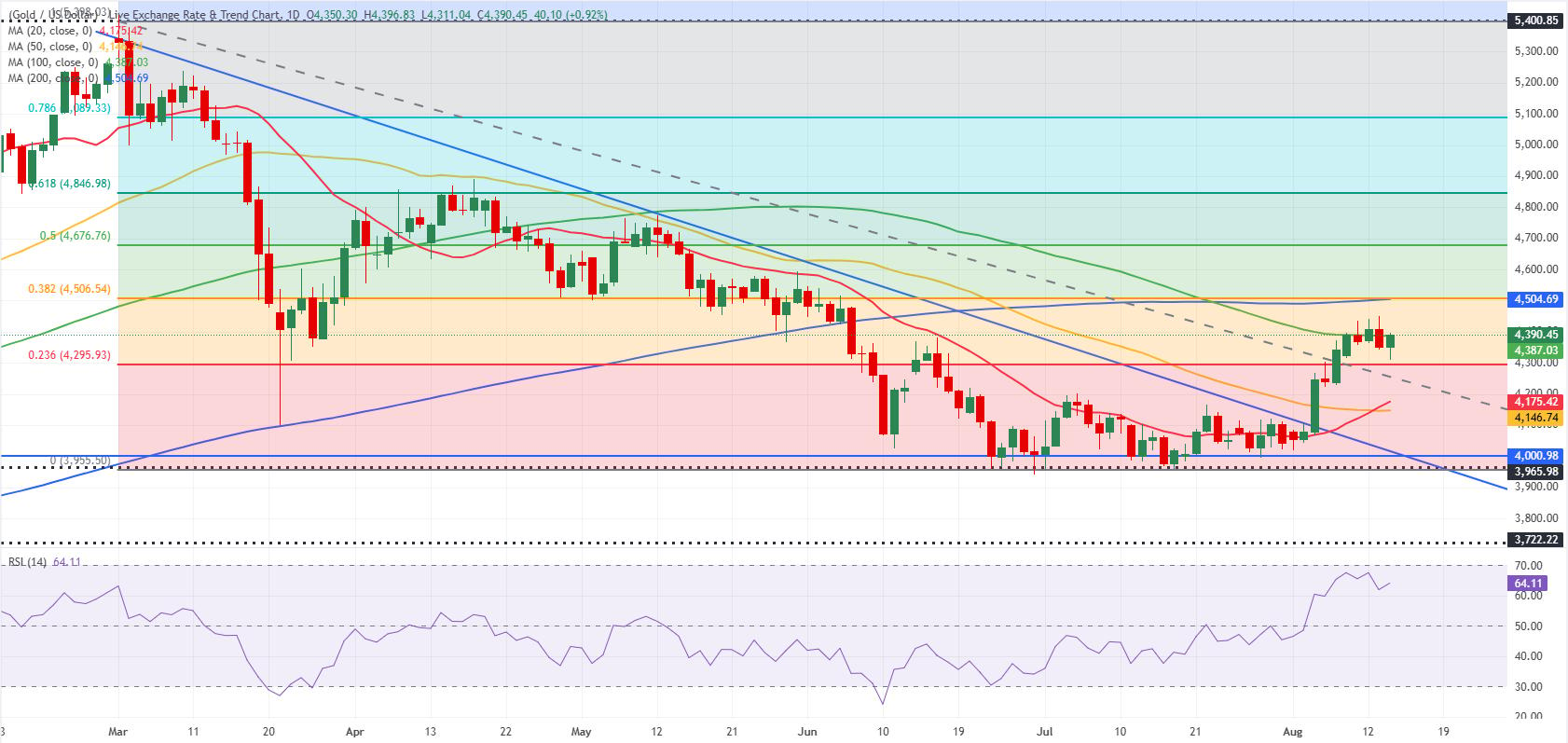
The Relative Strength Index (RSI) indicator on the daily chart holds above 60 but remains below the weekly highs, suggesting that the bullish bias remains intact but lacks momentum. Additionally, Gold failed to stabilize above the 100-day Simple Moving Average (SMA), currently located near $4,390, after climbing above this level several times this week, reflecting buyers’ hesitancy.
In case XAU/USD confirms $4,390-$4,400 (100-day SMA, static level) as support, $4,450 (static level) could be seen as an interim hurdle before the critical $4,500-$4,505 region, where the 200-day SMA and the Fibonacci 38.2% retracement of the March-August downtrend align. Once this resistance is cleared, $4,680 (Fibonacci 50% retracement) could be seen as the bullish target.
On the downside, the immediate support area could be spotted at $4,300-$4,295 (static level, Fibonacci 23.6% retracement) before $4,175-$4,150 (20-day SMA, 50-day SMA) and $4,000 (round level, static level).
Gold FAQs
Gold has played a key role in human’s history as it has been widely used as a store of value and medium of exchange. Currently, apart from its shine and usage for jewelry, the precious metal is widely seen as a safe-haven asset, meaning that it is considered a good investment during turbulent times. Gold is also widely seen as a hedge against inflation and against depreciating currencies as it doesn’t rely on any specific issuer or government.
Central banks are the biggest Gold holders. In their aim to support their currencies in turbulent times, central banks tend to diversify their reserves and buy Gold to improve the perceived strength of the economy and the currency. High Gold reserves can be a source of trust for a country’s solvency. Central banks added 1,136 tonnes of Gold worth around $70 billion to their reserves in 2022, according to data from the World Gold Council. This is the highest yearly purchase since records began. Central banks from emerging economies such as China, India and Turkey are quickly increasing their Gold reserves.
Gold has an inverse correlation with the US Dollar and US Treasuries, which are both major reserve and safe-haven assets. When the Dollar depreciates, Gold tends to rise, enabling investors and central banks to diversify their assets in turbulent times. Gold is also inversely correlated with risk assets. A rally in the stock market tends to weaken Gold price, while sell-offs in riskier markets tend to favor the precious metal.
The price can move due to a wide range of factors. Geopolitical instability or fears of a deep recession can quickly make Gold price escalate due to its safe-haven status. As a yield-less asset, Gold tends to rise with lower interest rates, while higher cost of money usually weighs down on the yellow metal. Still, most moves depend on how the US Dollar (USD) behaves as the asset is priced in dollars (XAU/USD). A strong Dollar tends to keep the price of Gold controlled, whereas a weaker Dollar is likely to push Gold prices up.
Author

Eren Sengezer
FXStreet
As an economist at heart, Eren Sengezer specializes in the assessment of the short-term and long-term impacts of macroeconomic data, central bank policies and political developments on financial assets.