Gold Weekly Forecast: Gold to extend downward correction on hawkish Fed
- Gold reversed its direction after rallying toward new all-time highs.
- Gold is likely to regather its strength in case geopolitical tensions escalate further.
- In case US T-bond yields continue to push higher, gold could fall toward $1,950 and $1,940.

Gold started the new week with a bullish gap and reclaimed $2,000 on Monday. With safe-haven flows continuing to dominate the financial markets, gold came in within a touching distance of all-time highs above $2,070 on Tuesday. Ahead of Thursday’s meeting between the foreign ministers of Russia and Ukraine, however, the positive shift witnessed in market sentiment weighed heavily on the yellow metal and dragged it back below $2,000. Although XAU/USD staged a rebound, rising US Treasury bond yields didn’t allow it to hold above $2,000 and the pair ended up closing the week virtually unchanged.
What happened last week?
Reports suggesting that the US was planning to ban Russian oil imports over the weekend caused markets to turn risk-averse at the beginning of the week. Additionally, Ukrainian President Volodymyr Zelenskyy called upon the west to ramp up sanctions against Russia in a video statement on Sunday.
The market mood continued to sour on Tuesday as the Russian and Ukrainian delegations failed to make any progress in reaching a truce or a ceasefire following the third round of negotiations. The S&P 500 Index lost nearly 3% in its biggest one day decline in a long time and gold surged to its highest level since August 2018 at $2,071.
On Wednesday, comments from Ukrainian officials revived optimism for a de-escalation of the conflict and caused the yellow metal to lose interest as a safe haven. The Ukrainian President's Deputy Chief of Staff, Ihor Zhovkva, said that Ukraine was ready for a diplomatic solution. Additionally, Ukrainian President Volodymyr Zelenskyy told the German newspaper Bild that the aim of Thursday’s talks was to end the war and noted that Ukraine was prepared to make certain compromises if Russia were to do the same. XAU/USD broke below $2,000 and lost 2.8% on a daily basis.
Nonetheless, the risk rally remained short-lived and gold managed to stage a rebound on Thursday. Following his meeting with Russian foreign minister Sergey Lavrov, Ukrainian foreign minister Dmytro Kuleba said that they were unable to make progress on a ceasefire. "We cannot stop the war if the country that started the aggression has no desire to do so,” Kuleba said. On the other hand, Lavrov reiterated that they wanted Ukraine to be neutral and said that he reminded Ukraine that Russia had already presented its proposals. In the second half of the day, the US Bureau of Labor Statistics reported that annual inflation in the US, as measured by the Consumer Price Index, jumped to a multi-decade high of 7.9% in February from 7.5% in January. The benchmark 10-year US Treasury bond yield climbed above 2% for the first time since mid-February after this data and made it difficult for XAU/USD to preserve its recovery momentum.
On Friday, gold continued to edge lower amid improving market mood after Russian President Vladimir Putin said there were positive shifts in talks with Ukraine.
Next week
The US Federal Reserve is widely expected to kick off its tightening cycle with a 25 basis points rate hike when the two-day FOMC policy meeting concludes on Wednesday, March 16.
Following the January meeting, FOMC policymakers largely dismissed the possibility of a 50 basis points rate hike in March. Although uncertainty on the economic outlook and inflation has been heightened by the Russia-Ukraine war, the Fed is unlikely to surprise the markets with a double-dose rate increase.
Having said that, FOMC Chairman Jerome Powell could open the door for more aggressive policy tightening moving forward by confirming another 25 bps rate hike at the next meeting. Crude oil prices are already up nearly 15% in March after rising 8% in February, suggesting that inflation is likely to continue to rise at an accelerated pace. The impressive February jobs report should allow policymakers to focus on controlling inflation rather than improving the labor market conditions.
According to the CME Group FedWatch Tool, markets are currently pricing in a 57.9% probability of one more 25 bps rate hike in May. US T-bond yields should continue to push higher on a hawkish policy outlook and weigh on gold.
On the flip side, a dovish surprise, which is the less likely scenario, could cause T-bond yields to turn south and trigger a leg higher in XAU/USD.
February Retail Sales will be featured on the US economic docket as well but market participants should pay little or no attention to this data.
On Thursday, the Bank of England (BOE) will announce its policy decisions as well. In case GBP/USD rises after the BOE event, the selling pressure surrounding the dollar could help XAU/USD edge higher and vice versa.
Meanwhile, investors will continue to pay close attention to geopolitical headlines. Gold has been one of the most sensitive assets to changes in risk mood and it is likely to continue to find demand if tensions continue to escalate.
Gold technical outlook
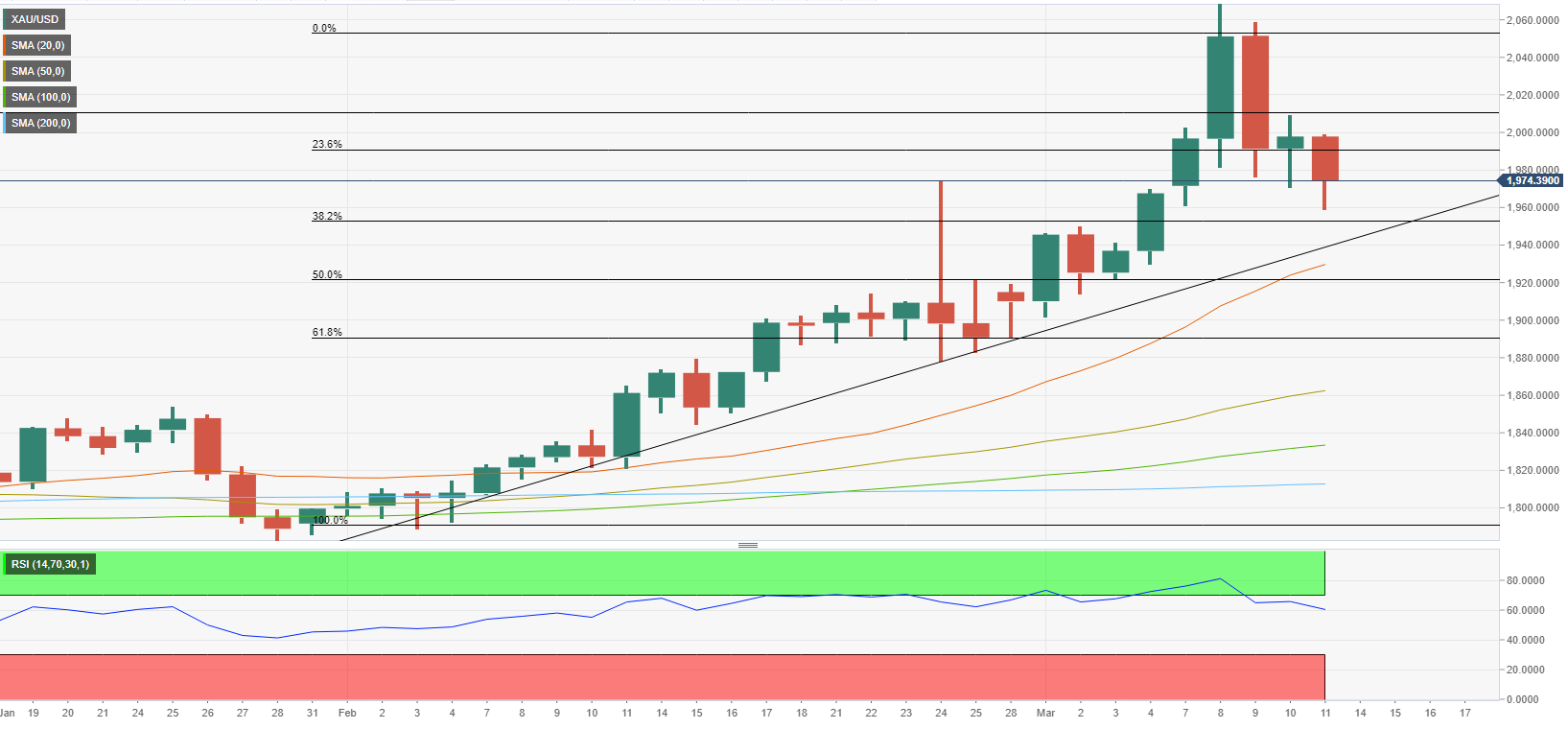
On the daily chart, the Relative Strength Index (RSI) indicator holds comfortably above 50, suggesting that the latest decline could still be considered as a technical correction of the sharp uptrend that started early February. Nevertheless, XAU/USD ended the week below the Fibonacci 23.6% retracement of this uptrend, opening the door for additional losses toward $1,950 (Fibonacci 38.2% retracement). With a daily close below that level, the pair could test the ascending trend line at $1,940.
On the upside, $1,990 (Fibonacci 23.6% retracement) aligns as first technical resistance before $2,000 (psychological level) and $2,010 (static level).
Gold sentiment poll
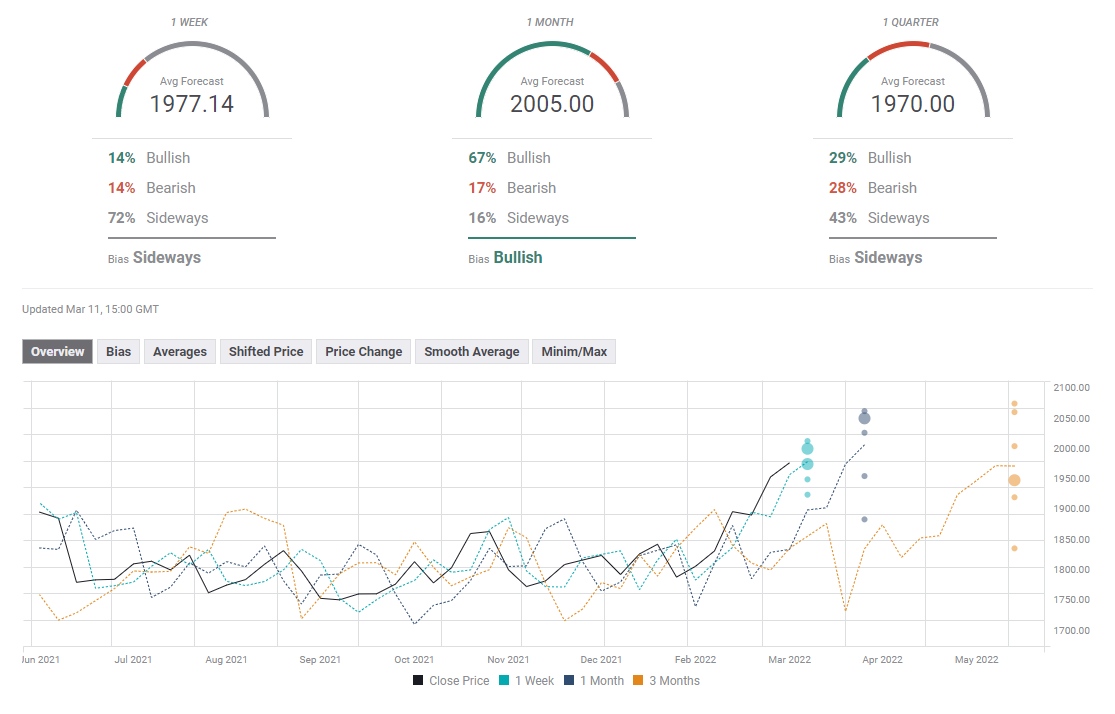
The FXStreet Forecast Poll shows that experts are expecting the yellow metal to trade sideways next week. There is, however, a noticeable bullish shift in the one-month outlook with the average price target sitting above $2,000.
Author

Eren Sengezer
FXStreet
As an economist at heart, Eren Sengezer specializes in the assessment of the short-term and long-term impacts of macroeconomic data, central bank policies and political developments on financial assets.