Gold Weekly Forecast: Correction in US T-bond yields could help XAU/USD recover toward $1,780
- XAU/USD fell sharply as USD capitalized on soaring T-bond yields.
- Gold's near-term outlook points to a possible upward correction.
- Key resistances for XAU/USD are located at $1,780 and $1,800.

The XAU/USD pair staged a decisive rebound and erased the majority of the previous week’s losses on Monday. Although the pair managed to close above $1,800, it failed to preserve its bullish momentum and spent the first half of the week fluctuating in a relatively tight range. With the USD gathering strength on Thursday, XAU/USD turned south and dropped nearly 2%. The buying pressure surrounding the greenback remained intact ahead of the weekend and gold plunged to its lowest level since June 2020 at $1,717 and lost more than 3% on a weekly basis.
What happened last week
In the absence of significant macroeconomic data releases at the start of the week, the risk-positive market mood made it difficult for the USD to find demand and allowed XAU/USD to stage a strong rebound.
On Tuesday, FOMC Chairman Jerome Powell downplayed concerns over an uncontrolled increase in inflation but noted that the rise in US Treasury bond yields was likely driven by expectations for higher inflation. Regarding the policy outlook, "we will keep our policy accommodative," Powell told the Senate Banking Committee and repeated that they have a significant ground to cover before getting even close to the Fed’s employment goal. These remarks helped US stock indexes to gain traction and limited USD’s gains against its rivals.
In his second day of the semi-annual testimony, Powell delivered identical remarks to the House Committee on Financial Services and failed to trigger meaningful market feedback.
On Thursday, the US Bureau of Economic Analysis revised the United States' Real Gross Domestic Product (GDP) growth to 4.1% in the fourth quarter in its second estimate from 4% as expected. Other data from the US showed that the weekly Initial Jobless Claims fell to 730,000 and came in much better than the market expectation of 838,000. The market reaction remained relatively muted to these figures but the volatility picked up in the late American session.
The lack of demand in the 7-year US Treasury note auction caused a sharp upsurge in the US T-bond yields. The US sold 7-year notes at 1.195%, compared to 0.754% in the previous auction and the benchmark 10-year yield rose more than 10% to touch its highest level in a year. This market development provided a boost to the USD in the second half of the week and weighed heavily on XAU/USD.
Friday's data from the US revealed that the Core Personal Consumption Expenditures (PCE) Price Index, the Fed's preferred gauge of inflation, in January remained unchanged at 1.5% on a yearly basis. Moreover, Personal Income and Personal Spending increased by 10% and 2.4%, respectively, but these reading were largely ignored by market participants. Reflecting the broad-based USD strength, the US Dollar Index jumped to its highest level in more than a week near 91.00 ahead of the weekend and XAU/USD remained under constant bearish pressure.
Next week
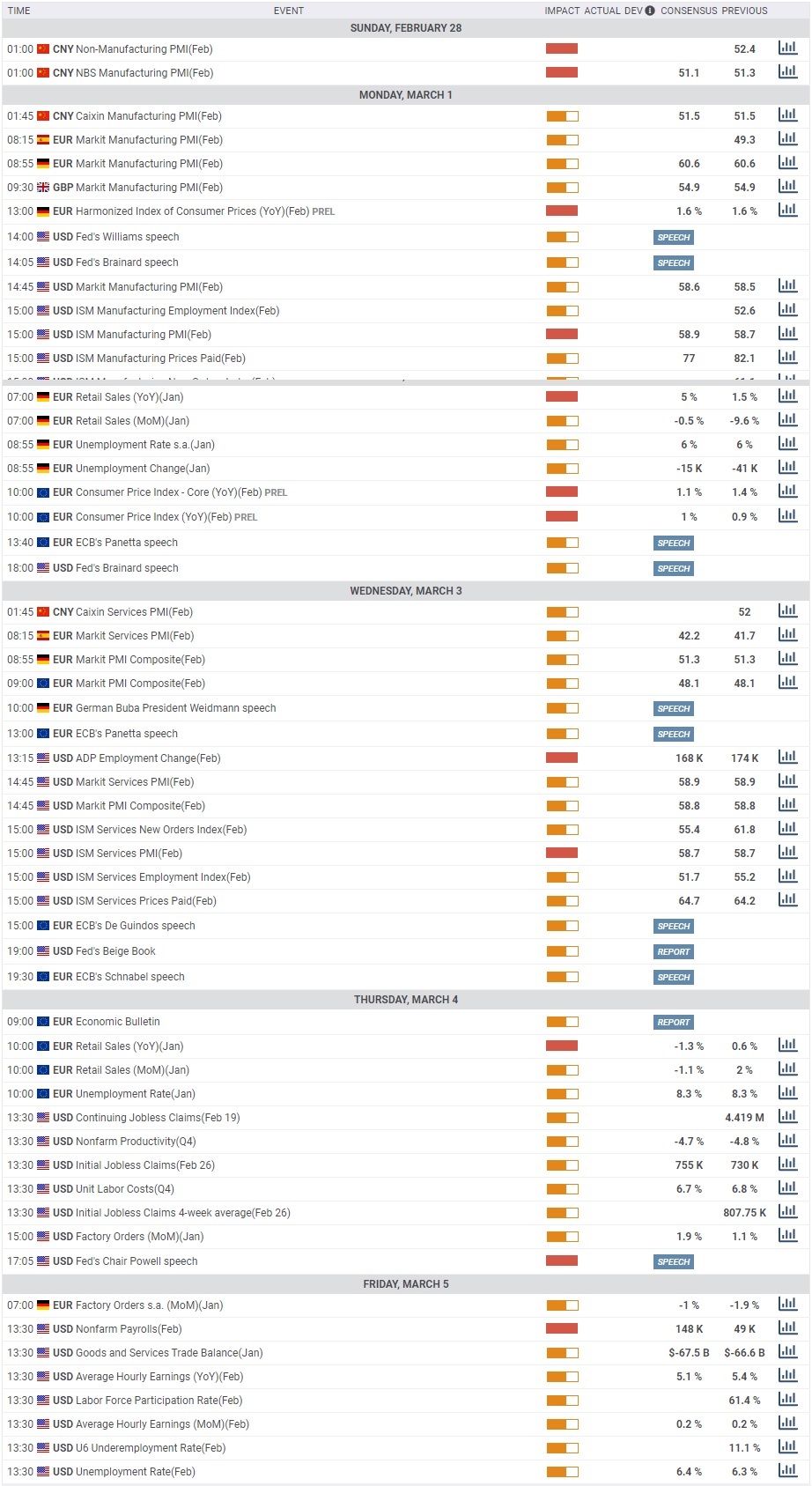
Non-Manufacturing PMI and NBC Manufacturing PMI data from China could impact the market sentiment at the start of the week. A positive start to the week in major global equity indexes could weigh on the USD and help XAU/USD stage a rebound. The US economic docket on Monday will feature the ISM Manufacturing PMI data as well.
The next significant data release from the US will be the ISM Services PMI on Wednesday. Additionally, the Federal Reserve's Beige Book will be looked upon for fresh clues regarding price pressures.
Later in the week, the US Bureau of Labor Statistics will release the February Nonfarm Payrolls report, which is expected to show an increase of 148K following January's weak +49,000 print.
Regardless of these data, investors are likely to remain focused on developments surrounding US Treasury bond yields. The 10-year US T-bond yield gained more than 35% in February alone and it's up nearly 50% since the beginning of the year but a significant hurdle is located around 1.5% level. A deep correction in yields could put the USD under heavy selling pressure and trigger a strong rebound in XAU/USD and vice versa.
Gold technical outlook
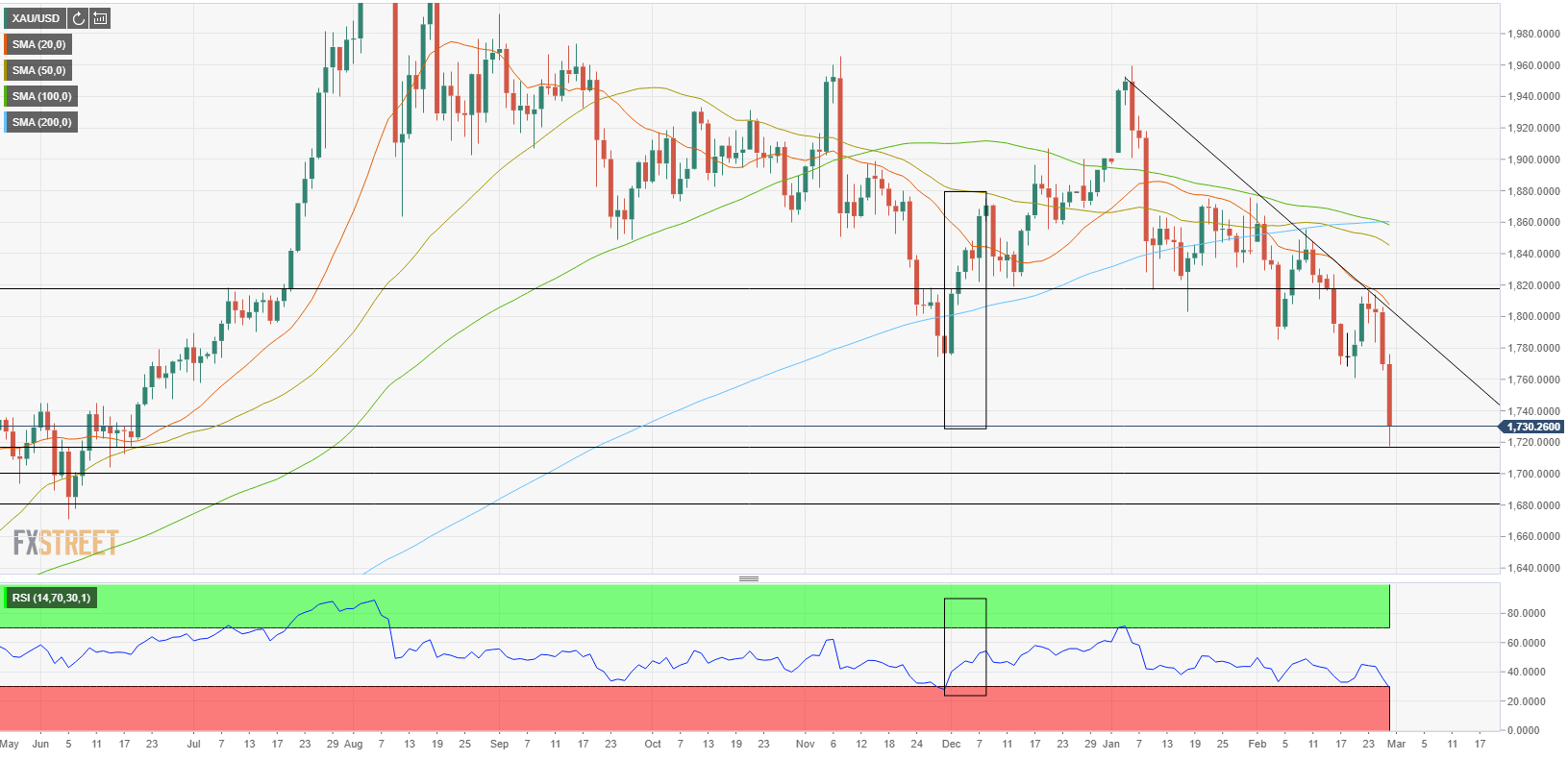
On the daily chart, the Relative Strength Index (RSI) indicator dropped into the oversold territory below 30 for the first time since early December. The last time the RSI become oversold, XAU/USD staged a recovery and gained nearly 5% in a three-day span. A similar correction could be in the books for gold in the near-term.
However, unless the pair manages to make a daily close above the descending trend line coming from January 6, currently located around $1,780, sellers could look to remain in control. Above $1,780, next resistance is located $1,800 (psychological level/20-day SMA) ahead of $1,820 (static level).
On the downside, the initial support could be seen at $1,717 (February 26 low) before $1,700 (psychological level). Below those levels, $1,680, which acted as strong support in April, May and June of 2020, is the next target.
Gold sentiment poll
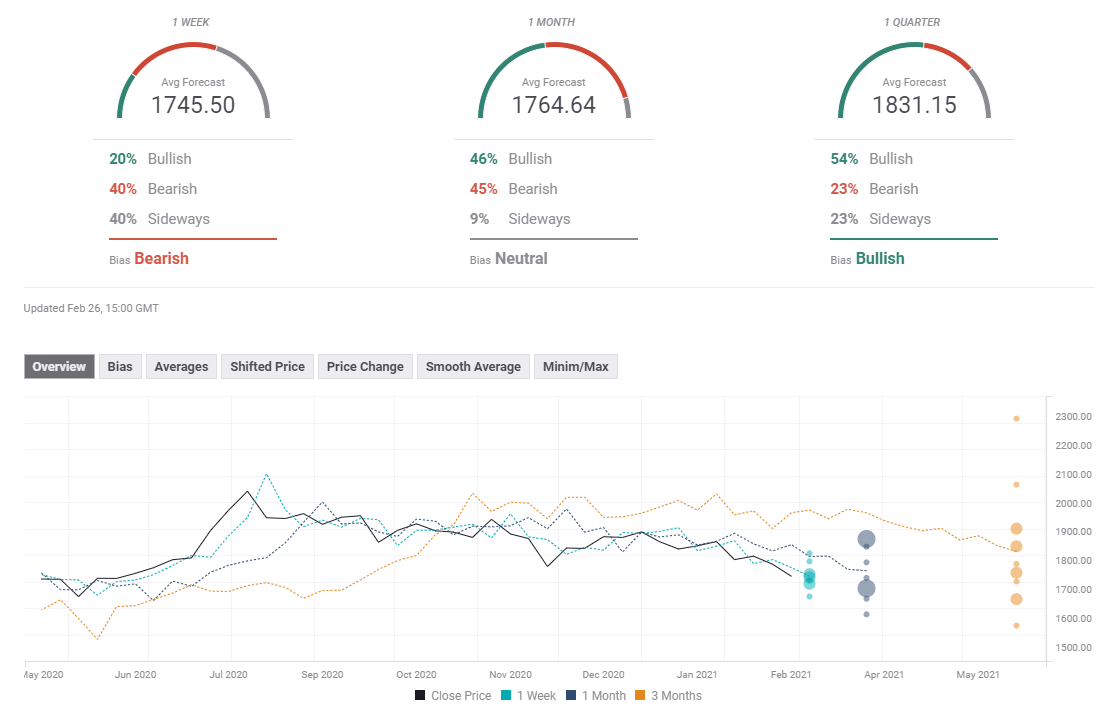
The FXStreet Forecast Poll shows that experts don't see gold extending its slide with an average target of $1,745 on a one-week view. The one-month view remains mixed with 46% of experts adopting a bullish outlook against 45% bearish.
Author

Eren Sengezer
FXStreet
As an economist at heart, Eren Sengezer specializes in the assessment of the short-term and long-term impacts of macroeconomic data, central bank policies and political developments on financial assets.