Gold Weekly Forecast: Bulls take a breather following three-week rally
- Gold corrected lower after reaching its highest level since mid-May near $4,700.
- US employment data for August could influence market pricing of the Fed policy outlook.
- The near-term technical outlook suggests that the bullish bias remains intact.

After rising nearly 14% in a three-week rally and reaching its highest level since mid-May near $4,700, Gold (XAU/USD) corrected lower to end the week in negative territory. August employment data from the United States (US) could trigger a directional move next week, while the technical picture highlights that the bullish stance persists in the near term.
Gold loses its bullish momentum as US Dollar stabilizes
Gold started the week on a firm footing and gained about 1% on Monday as the US’ “economic D-Day” on Iran underwhelmed, helping geopolitical tensions ease. The US Treasury Department announced new sanctions on 60 individuals, entities and vessels as part of its expanded effort to put economic pressure on Iran, but stopped short of imposing hefty penalties. Treasury Secretary Scott Bessent warned that if other countries do not sever business ties with Iran, they are under the risk of being forced out of the Dollar-based financial system. Bessent, however, declined to say which specific countries would be targeted or what type of penalties would be imposed.
The precious metal continued to climb higher but lost its traction on Tuesday after coming in within a touching distance of $4,700. While the overall market conditions remained mostly unchanged, the USD stabilized ahead of key data releases and limited XAU/USD’s upside.
The US Bureau of Economic Analysis reported on Wednesday that the Personal Consumption Expenditures (PCE) Price Index and the core PCE Price Index, the Federal Reserve’s (Fed) preferred gauge of inflation, rose by 3.7% and 3.3%, respectively, on a yearly basis in July, with both readings matching June’s increase.
The lack of progress in PCE inflation in July helped the USD stay resilient against its peers midweek. In turn, Gold corrected lower and lost more than 1% on the day. Other data from the US showed that Durable Goods Orders rose by 1.1% in July, compared to the market expectation of 0.7%, while Personal Income expanded by 0.4%.
Strategists at Deutsche Bank note that these latest US economic releases amounted to “a solid slate of data that’s hard to square with a view that Fed policy is restrictive.” They note that, although “pricing of a September Fed hike was pretty stable (up from 36% to 37%), there was greater repricing of Fed expectations further out with 42bps of hikes now being priced by next June (+3.7bps on the day).”
Meanwhile, Cleveland Fed President Beth Hammack, one of the dissenters who favored a hike at the last Fed’s meeting, delivered a hawkish message on Thursday, with an 8/10 FXS Speechtracker score. The emphasis that the “most recent inflation number was as expected” but that “now is time to act given persistence of inflation,” alongside the view that current policy is not providing restriction and that the neutral rate is on the higher side, underscored a push for tighter policy to re-anchor expectations. Repeated worries about an emerging “inflationary mindset,” public confidence in a return to 2%, and cost-of-living concerns signalled a readiness to endorse further rate hikes or at least resist cuts, a configuration typically supportive of the US Dollar.
Ahead of Fed Chair Kevin Warsh’s speech at the Jackson Hole Symposium and the US Bureau of Labor Statistics’ preliminary benchmark revision to Nonfarm Payrolls (NFP) on Friday, Gold remained indecisive and closed virtually unchanged above $4,600 on Thursday.
Fed Chair Warsh delivered a distinctly hawkish-leaning message at the Jackson Hole on Friday, with an FXS Speechtracker score of 7.4/10, compared to the 6.5/10 historical average and underscoring a stronger-than-usual emphasis on the inflation mandate.
The insistence that the Fed must be “confident underlying inflation is moving to objective, or “we have work to do,” alongside comments that it is “hard-pressed” to call financial conditions restrictive and that recent disinflation has not “meaningfully changed” underlying trends, pointed to a bias against rapid easing even as growth, consumer spending, and business investment remain solid.
Overall, the tone reinforced a firm 2% PCE target and highlighted that resilient activity and loose credit conditions could keep the Fed cautious about cutting rates too soon. Gold turned south on Fed Chair Warsh’s comments and dropped to a fresh weekly low near $4,550.
Gold investors await critical US employment data
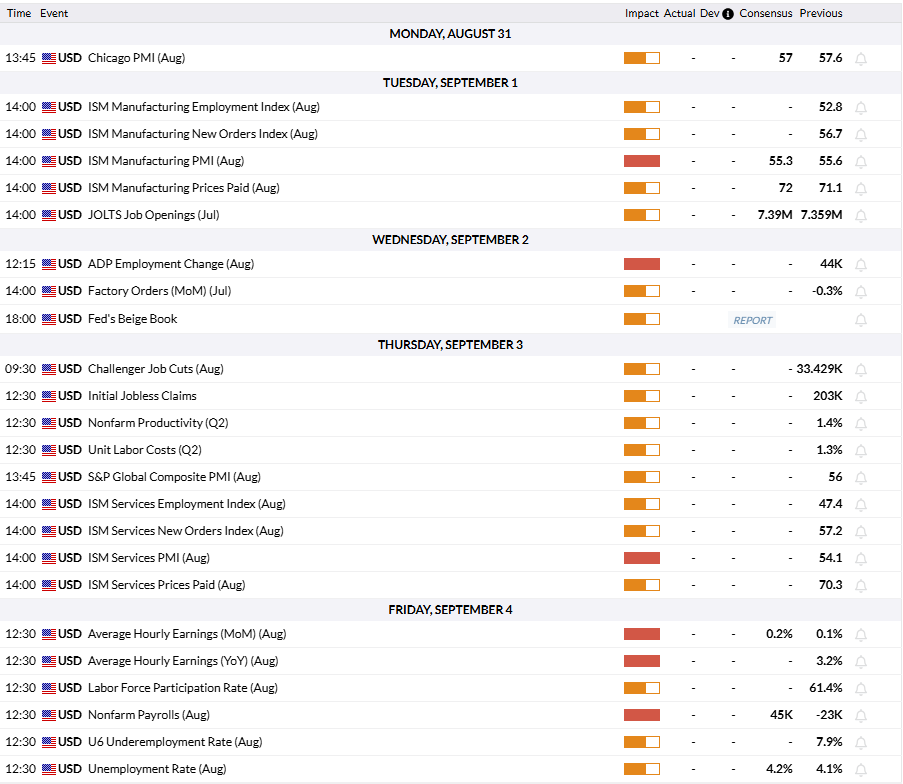
The US economic calendar will feature the Institute for Supply Management’s (ISM) Manufacturing Purchasing Managers’ Index (PMI) data for August on Tuesday. In case the headline PMI reading stays in the expansion territory above 50, and the input inflation component of the survey, the Prices Paid Index, comes in above July’s reading of 71.1, the USD could stay resilient against its rivals and cap XAU/USD’s upside. The ISM Services PMI report on Thursday could trigger a similar market reaction. Still, investors are likely to refrain from taking large positions ahead of Friday’s August employment report and limit the impact of PMI data on the yellow metal’s performance.
In July, Nonfarm Payrolls unexpectedly declined by 23K and missed the market expectation of 80K by a wide margin. As a result, investors scaled back bets for a Fed interest rate increase in September. However, the underlying details of the July employment report suggested that the labor market conditions were not as dire as it seemed initially because a majority of job losses were concentrated in government positions, especially in education due to seasonal variations in academic contracts and summer staffing shifts, and leisure and hospitality sector, which reflected the loss of jobs with the FIFA World Cup coming to an end.
A noticeable rebound in August, with an NFP print above 60K, could lead investors to second-guess a Fed policy hold in September and provide a boost to the USD heading into the weekend, causing XAU/USD to come under bearish pressure. Conversely, another disappointing NFP reading below 30K could point to a steady deterioration in labor market conditions. In this scenario, market participants could start pricing in a steady Fed policy for longer and open the door for a leg higher in XAU/USD.
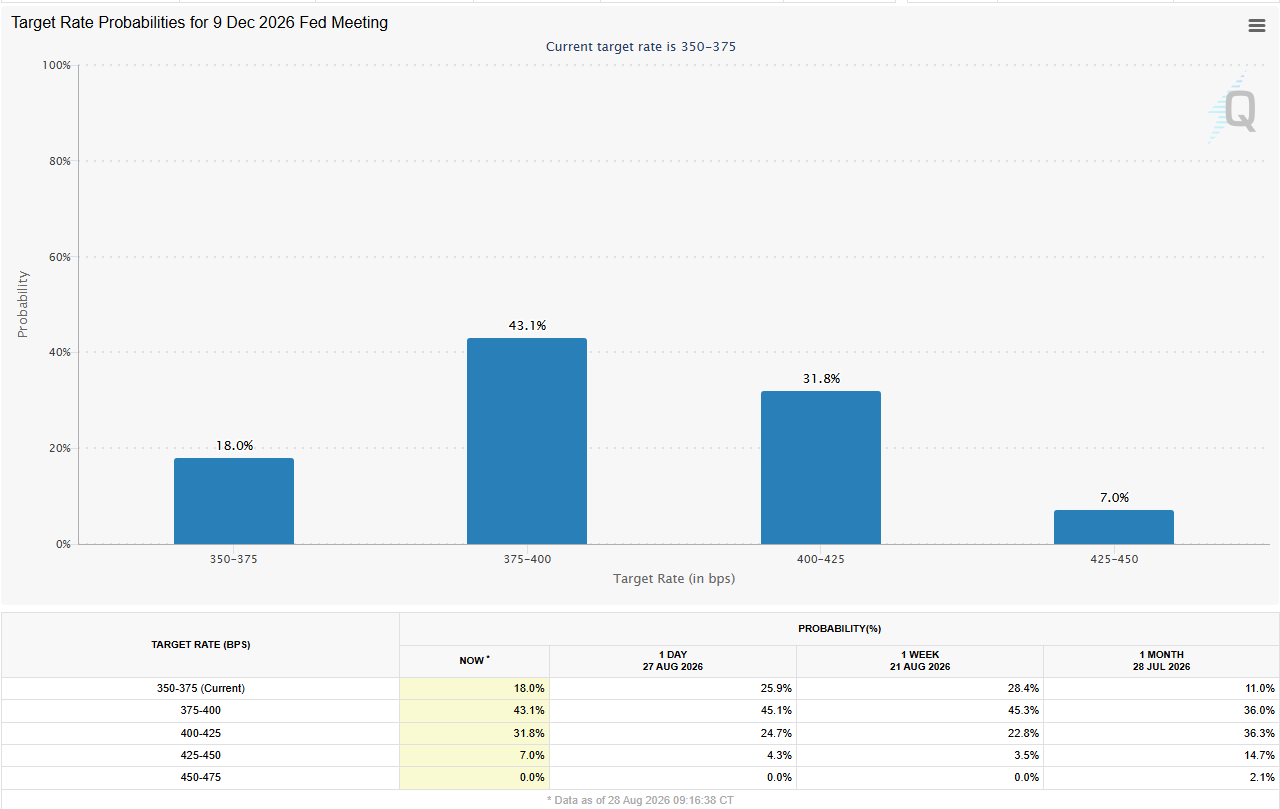
According to the CME FedWatch Tool, markets are still pricing in about a 80% probability that the Fed will raise the policy rate by at least 25 basis points (bps) by the end of 2026.
Meanwhile, investors will continue to keep a close eye on the situation in the Middle East. Iran and Oman have reportedly reached an agreement to establish a temporary shipping lane in the Strait of Hormuz. Still, Iran insists that the US must lift its naval blockade and return to its commitments under the Memorandum of Understanding before the waterway is fully opened. At the same time, mediators Qatar and Pakistan continue to ramp up their efforts to convince the US and Iran to find a diplomatic solution. In case Crude Oil prices decline sharply in the short term with sides agreeing to engage in direct negotiations, Gold is likely to gather bullish momentum.
Rabobank’s Bas van Geffen argues that Tehran’s current strategy may prove self-defeating over time. He notes that “Iran using this leverage now, may hurt the country in the future,” as the threat of closing the Strait of Hormuz is already “forcing exporting neighbours and importing countries around the globe to rethink their supply lines.” As these alternatives are developed, Rabobank expects that “Iran’s ability to take the global economy hostage will wane.”
Gold technical analysis: Latest decline appears as a technical correction
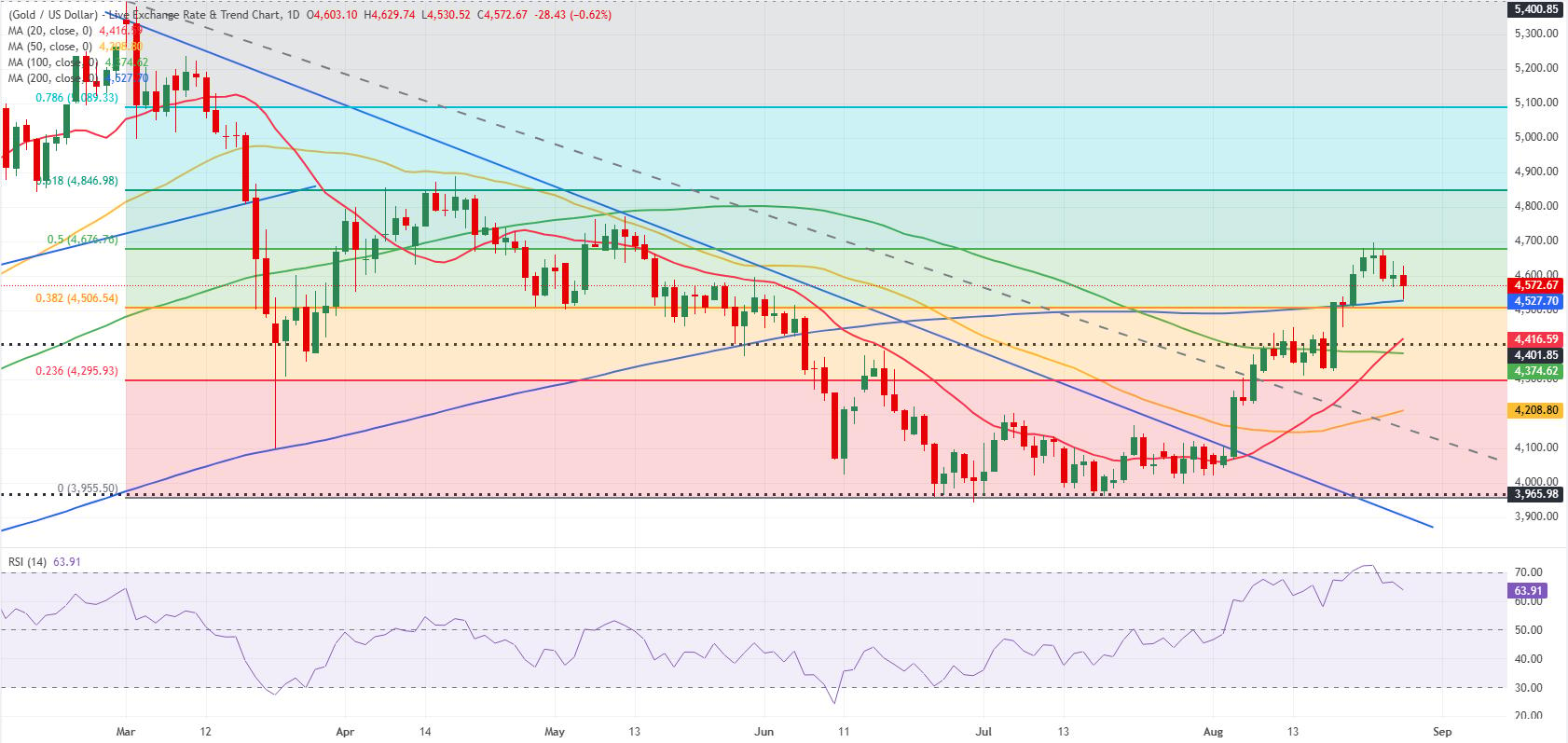
Gold turned south after approaching $4,700 midweek. With this decline, the Relative Strength Index (RSI) indicator retreated below 70 but managed to hold above 60, pointing to a technical correction rather than a bearish reversal. Additionally, XAU/USD continues to hold slightly above the 200-day Simple Moving Average (SMA), reaffirming the bullish stance.
On the upside, $4,675-$4,700 (Fibonacci 50% retracement of the March-August downtrend, round level) aligns as the initial resistance area ahead of $4,850 (Fibonacci 61.8% retracement) and $5,000 (psychological level).
Looking south, a strong support region could be spotted at $4,530-$4,500, where the 200-day SMA and the Fibonacci 38.2% retracement align. If Gold drops below this area and fails to reclaim it, technical sellers could take action. In this case, $4,400-$4,375 (static level, 100-day SMA) and $4,300-$4,295 (static level, Fibonacci 23.6% retracement) could be seen as next support zones.
Gold FAQs
Gold has played a key role in human’s history as it has been widely used as a store of value and medium of exchange. Currently, apart from its shine and usage for jewelry, the precious metal is widely seen as a safe-haven asset, meaning that it is considered a good investment during turbulent times. Gold is also widely seen as a hedge against inflation and against depreciating currencies as it doesn’t rely on any specific issuer or government.
Central banks are the biggest Gold holders. In their aim to support their currencies in turbulent times, central banks tend to diversify their reserves and buy Gold to improve the perceived strength of the economy and the currency. High Gold reserves can be a source of trust for a country’s solvency. Central banks added 1,136 tonnes of Gold worth around $70 billion to their reserves in 2022, according to data from the World Gold Council. This is the highest yearly purchase since records began. Central banks from emerging economies such as China, India and Turkey are quickly increasing their Gold reserves.
Gold has an inverse correlation with the US Dollar and US Treasuries, which are both major reserve and safe-haven assets. When the Dollar depreciates, Gold tends to rise, enabling investors and central banks to diversify their assets in turbulent times. Gold is also inversely correlated with risk assets. A rally in the stock market tends to weaken Gold price, while sell-offs in riskier markets tend to favor the precious metal.
The price can move due to a wide range of factors. Geopolitical instability or fears of a deep recession can quickly make Gold price escalate due to its safe-haven status. As a yield-less asset, Gold tends to rise with lower interest rates, while higher cost of money usually weighs down on the yellow metal. Still, most moves depend on how the US Dollar (USD) behaves as the asset is priced in dollars (XAU/USD). A strong Dollar tends to keep the price of Gold controlled, whereas a weaker Dollar is likely to push Gold prices up.
Author

Eren Sengezer
FXStreet
As an economist at heart, Eren Sengezer specializes in the assessment of the short-term and long-term impacts of macroeconomic data, central bank policies and political developments on financial assets.

















