Gold Weekly Forecast: Bulls could retain control during Fed blackout period
- Gold gained more than 2% in the US holiday-shortened week.
- Markets see a strong chance of a Fed interest rate cut in December.
- The technical outlook points to a bullish tilt in the short term.

Gold (XAU/USD) gathered bullish momentum at the beginning of the week on growing expectations of a Federal Reserve (Fed) interest rate cut in December. Although markets turned quiet in the second half of the week due to the Thanksgiving holiday in the US, the pair rose by more than 2% on a weekly basis. With the Fed’s blackout period coming into effect on Saturday, investors will scrutinize economic data releases from the United States.
Gold rises as Fed doves grow louder
Gold started the week on a bullish note as markets reassessed the odds of a 25-basis-points (bps) Fed rate cut at the last monetary policy meeting of the year. Late last week, Fed Governor Stephen Miran, who preferred a 50 bps rate cut in the previous two policy meetings, noted that he would vote for a 25 bps rate cut in December if his vote were to be the deciding factor on whether the Fed would lower the policy rate. Meanwhile, New York Fed President John Williams hinted that he could vote for a cut at the next meeting, saying, "I view monetary policy as being modestly restrictive. Therefore, I still see room for a further adjustment in the near term."
After rising more than 1.5% on Monday, Gold edged slightly higher early Tuesday but closed the day virtually unchanged. The Automatic Data Processing (ADP) reported that private employers shed an average of 13,500 jobs a week for the four weeks ending November 8.
On Wednesday, the data from the US showed that there were 216,000 Initial Jobless Claims in the week ending November 22, a decrease of 6,000 from the previous week's revised level. Additionally, the US Census Bureau announced that Durable Goods Orders rose by 0.5% in September, surpassing the market expectation for an increase of 0.3%. As these figures failed to influence market pricing of the Fed’s policy outlook, Gold held its ground and closed well above $4,100 heading into the US Thanksgiving Day holiday.
As trading conditions remained thin on Friday, Gold managed to stabilize near the upper limit of its weekly range heading into the weekend.
Gold investors to focus on US data
Fed officials will not be allowed to comment on the policy outlook until the December 9-10 meeting. Hence, investors will scrutinize data releases from the US to confirm or reassess the probability of a rate cut.
According to the CME FedWatch Tool, markets are currently pricing in about an 85% probability of a 25 bps cut in December.
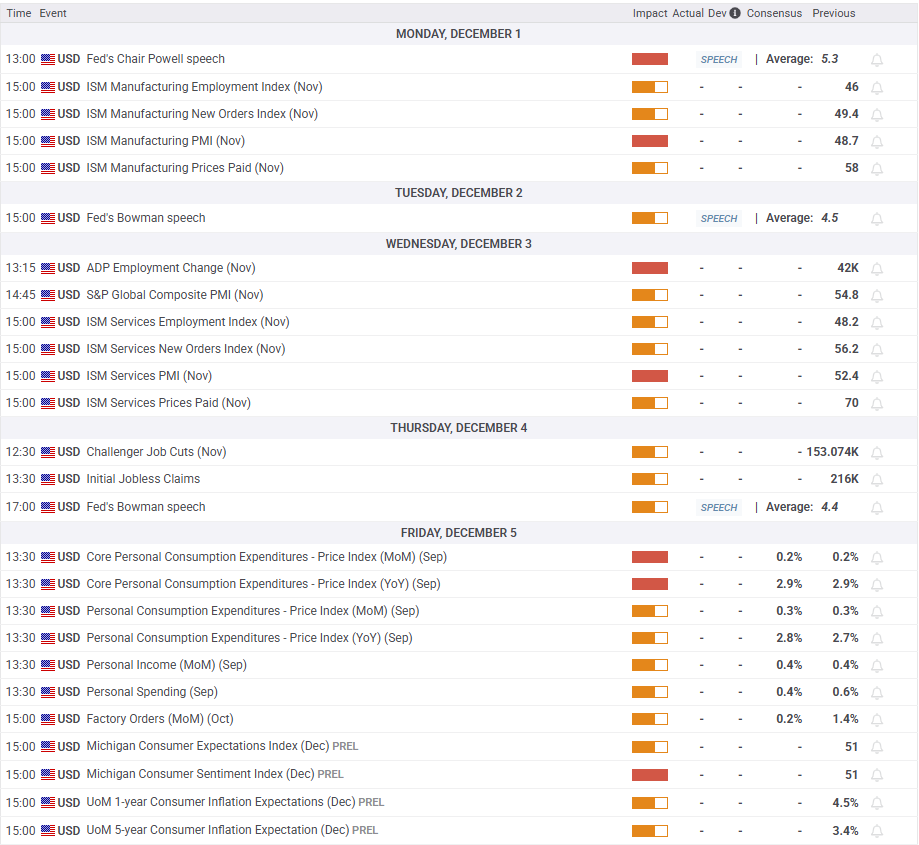
The US economic calendar will feature the Institute for Supply Management’s (ISM) Manufacturing Purchasing Managers’ Index (PMI) data on Monday. In case there is a noticeable improvement, with a reading above 50 in the Employment Index of the PMI survey, the USD could stay resilient against its rivals in the immediate reaction, making it difficult for XAU/USD to push higher.
The ISM Services PMI report will be published on Wednesday. If the headline PMI drops into contraction territory below 50, the USD could come under renewed selling pressure and allow XAU/USD to gain traction.
On Thursday, market participants will pay close attention to the November Challenger Job Cuts data. In October, planned layoffs surged to 153,074, marking the highest level in 22 years. A significant decline in this figure could ease fears over worsening conditions in the labor market and support the USD.
The US Bureau of Economic Analysis (BEA) will release the Personal Consumption Expenditures (PCE) Price Index figures on Friday. However, this data is unlikely to trigger a significant market reaction because it will be for September, as part of the clearing of the data backlog that built up during the government shutdown.
Gold technical analysis
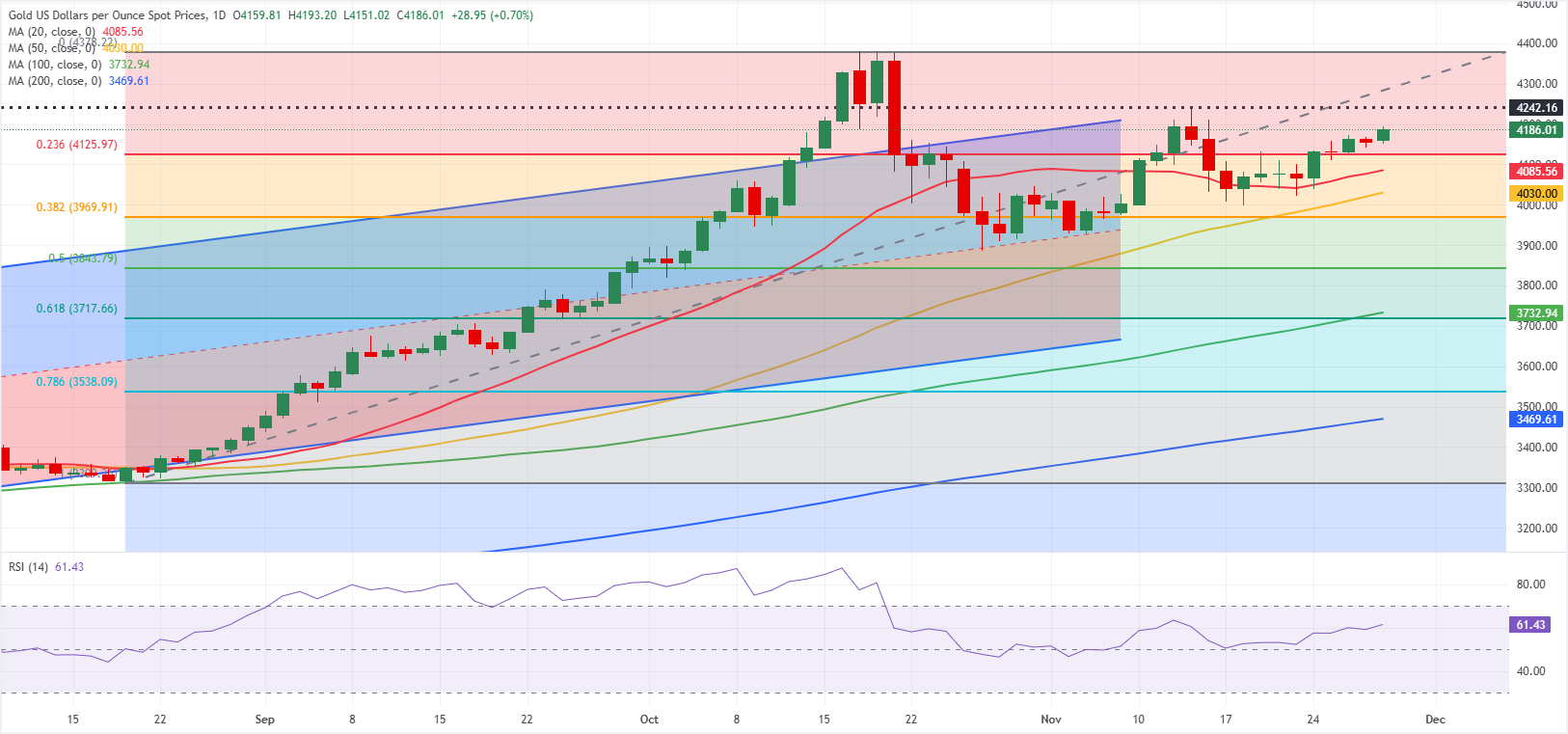
The technical outlook points to a bullish stance in the near term but doesn’t yet highlight a strengthening momentum. On the daily chart, Gold holds comfortably above the 20-day Simple Moving Average (SMA) and the Fibonacci 23.6% retracement level of the August-October uptrend, located at $4,125. Additionally, the Relative Strength Index (RSI) moves sideways near 60.
On the downside, $4,125 aligns as the first support level before $4,085 (20-day SMA), $4,030 (50-day SMA) and $3,970 (Fibonacci 38.2% retracement). Looking north, resistance levels could be spotted at $4,245 (November 13 high), $4,300 (round level) and $4,380 (end-point of the uptrend).
Gold FAQs
Gold has played a key role in human’s history as it has been widely used as a store of value and medium of exchange. Currently, apart from its shine and usage for jewelry, the precious metal is widely seen as a safe-haven asset, meaning that it is considered a good investment during turbulent times. Gold is also widely seen as a hedge against inflation and against depreciating currencies as it doesn’t rely on any specific issuer or government.
Central banks are the biggest Gold holders. In their aim to support their currencies in turbulent times, central banks tend to diversify their reserves and buy Gold to improve the perceived strength of the economy and the currency. High Gold reserves can be a source of trust for a country’s solvency. Central banks added 1,136 tonnes of Gold worth around $70 billion to their reserves in 2022, according to data from the World Gold Council. This is the highest yearly purchase since records began. Central banks from emerging economies such as China, India and Turkey are quickly increasing their Gold reserves.
Gold has an inverse correlation with the US Dollar and US Treasuries, which are both major reserve and safe-haven assets. When the Dollar depreciates, Gold tends to rise, enabling investors and central banks to diversify their assets in turbulent times. Gold is also inversely correlated with risk assets. A rally in the stock market tends to weaken Gold price, while sell-offs in riskier markets tend to favor the precious metal.
The price can move due to a wide range of factors. Geopolitical instability or fears of a deep recession can quickly make Gold price escalate due to its safe-haven status. As a yield-less asset, Gold tends to rise with lower interest rates, while higher cost of money usually weighs down on the yellow metal. Still, most moves depend on how the US Dollar (USD) behaves as the asset is priced in dollars (XAU/USD). A strong Dollar tends to keep the price of Gold controlled, whereas a weaker Dollar is likely to push Gold prices up.
Author

Eren Sengezer
FXStreet
As an economist at heart, Eren Sengezer specializes in the assessment of the short-term and long-term impacts of macroeconomic data, central bank policies and political developments on financial assets.

















