Gold Weekly Forecast: Lack of fundamental drivers could pave way for a technical correction
- Gold set a new all-time high for the third consecutive week.
- Investors will keep a close eye on geopolitics in the absence of high-tier data releases.
- The near-term technical outlook suggests that overbought conditions remain intact.

Gold’s (XAU/USD) relentless uptrend continued, carrying the price to a new record high above $2,940. The economic calendar will not offer any high-tier events that could impact Gold’s valuation, leaving the yellow metal at the mercy of political and geopolitical headlines.
Gold rally continues despite overbought conditions
Gold started the week on a bullish note and gained more than 1.5% on Monday. In the absence of high-impact data releases, the precious metal continued to shine as a go-to safe-haven asset while investors assessed the latest headlines surrounding US President Donald Trump’s trade policy. Trump said that he would announce "reciprocal tariffs" on many countries and noted over the weekend that he plans to impose 25% tariffs on all steel and aluminum imports into the US.
After Trump signed the proposed sweeping 25% tariffs on all steel and aluminum imports into an order late Monday, Gold extended its rally to a new all-time high above $2,940 in the Asian session on Tuesday. Later in the day, Federal Reserve (Fed) Chairman Jerome Powell’s comments helped the US Dollar (USD) find a foothold, causing XAU/USD to correct lower in the American trading hours. On the first day of his testimony before the Senate Banking Committee, Powell reiterated that the central bank does not need to be in a hurry to adjust the monetary policy. "The US economy is strong overall; inflation is closer to the 2% goal but still somewhat elevated," he noted in his prepared remarks.
The US Bureau of Labor Statistics announced on Wednesday that the annual inflation, as measured by the change in the Consumer Price Index (CPI), rose to 3% in January from 2.9% in December. Additionally, the core CPI, which excludes volatile food and energy prices, increased by 0.4% on a monthly basis following the 0.2% rise recorded in the previous month. This reading surpassed the market expectation of 0.3%. With the immediate reaction, the benchmark 10-year US Treasury bond yield shot higher, causing Gold to extend its correction toward $2,860. Later in the session, however, the USD came under renewed selling pressure and allowed XAU/USD to recover back above $2,900.
In the meantime, easing geopolitical tensions limited Gold’s upside early Thursday. Trump said that he had a "lengthy and highly productive" phone call with Russian President Vladimir Putin to begin negotiations to end the war in Ukraine. Nonetheless, the USD continued to weaken against its rivals in the second half of the day, helping XAU/USD regain its bullish momentum.
In the early American session on Thursday, President Trump hinted that they could announce reciprocal tariffs soon. Later in the day, the USD came under heavy selling pressure as Trump refrained from imposing fresh tariffs and explained that he signed a memo ordering his economics team to devise a plan for reciprocal tariffs on every country that charges duties on US imports. Major equity indexes in the US ended the day decisively higher, and the USD Index (DXY) lost more than 0.8% on the day.
Although Gold struggled to build on Thursday's gains on Friday, it held its ground, rising over 2% for the week.
Gold investors will continue to scrutinize political and geopolitical news
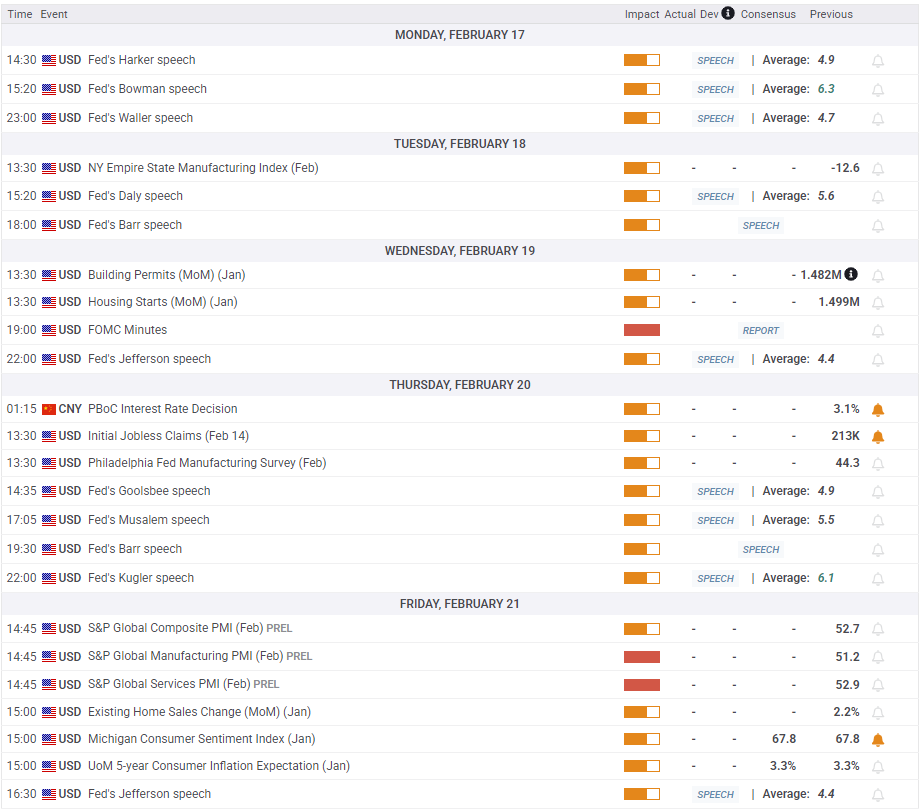
The economic calendar will offer only a few high-impact events. On Wednesday, the Fed will publish the Minutes of the January policy meeting. Following Powell’s testimony and the latest inflation report, investors are unlikely to pay much attention to this document. The CME Group FedWatch Tool currently shows markets virtually see no chance of an interest rate cut in March and price in around a 20% probability of a 25 basis points (bps) rate reduction in May.
On Friday, S&P Global will publish the preliminary Manufacturing and Services Purchasing Managers Index (PMI) data for February. In January, headline PMIs came in above 50, highlighting an expansion in the business activity of both sectors. A reading below 50 in either PMI could weigh on the USD with the immediate reaction, pushing XAU/USD higher.
In the absence of market-moving data releases, investors will continue to pay close attention to political headlines from the US and geopolitics. It is not an easy task to foresee what President Trump could announce next on trade policy. Since Trump took office, the USD has gathered strength against its rivals anytime he adopted an aggressive approach to tariffs, only to erase its gains once markets realized that there was more leeway than initially anticipated before finalizing trade terms. Hence, it could be risky to take positions based on the immediate reaction to Trump tariff talks.
Meanwhile, further progress in a potential resolution in the Israel-Gaza conflict or the Russia-Ukraine war could help geopolitical tensions continue to ease and make it difficult for Gold to gather bullish momentum.
Gold technical analysis
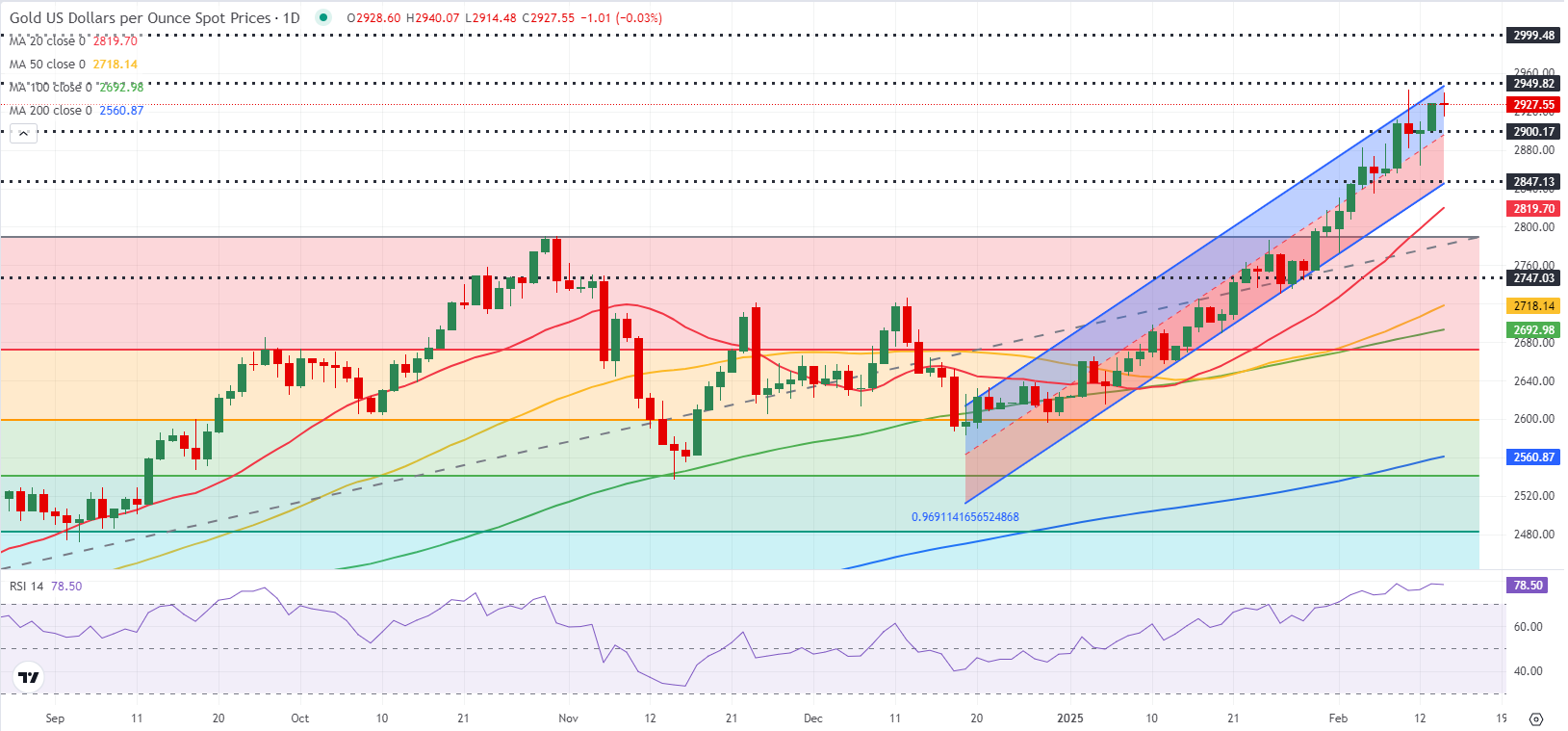
Gold remains technically overbought in the near term, with the Relative Strength Index (RSI) indicator on the daily chart holding near 80. Additionally, XAU/USD stands within a touching distance of the upper limit of the ascending channel in which it has been trading since mid-December, located at $2,950. In case Gold stages a technical correction, $2,900 (static level, mid-point of the ascending channel) could be seen as the first support level before $2,850 (lower limit of the ascending channel) and $2,820 (20-day Simple Moving Average).
Looking north, the first resistance could be spotted at $2,950 (upper limit of the ascending channel) ahead of $3,000 (psychological level). If this latter level proves to be a tough resistance to crack, buyers could book their profits and drag Gold prices lower in the near term. On the other hand, a decisive break above this resistance could trigger new long positions, opening the door for a continuation of the uptrend.
Gold FAQs
Gold has played a key role in human’s history as it has been widely used as a store of value and medium of exchange. Currently, apart from its shine and usage for jewelry, the precious metal is widely seen as a safe-haven asset, meaning that it is considered a good investment during turbulent times. Gold is also widely seen as a hedge against inflation and against depreciating currencies as it doesn’t rely on any specific issuer or government.
Central banks are the biggest Gold holders. In their aim to support their currencies in turbulent times, central banks tend to diversify their reserves and buy Gold to improve the perceived strength of the economy and the currency. High Gold reserves can be a source of trust for a country’s solvency. Central banks added 1,136 tonnes of Gold worth around $70 billion to their reserves in 2022, according to data from the World Gold Council. This is the highest yearly purchase since records began. Central banks from emerging economies such as China, India and Turkey are quickly increasing their Gold reserves.
Gold has an inverse correlation with the US Dollar and US Treasuries, which are both major reserve and safe-haven assets. When the Dollar depreciates, Gold tends to rise, enabling investors and central banks to diversify their assets in turbulent times. Gold is also inversely correlated with risk assets. A rally in the stock market tends to weaken Gold price, while sell-offs in riskier markets tend to favor the precious metal.
The price can move due to a wide range of factors. Geopolitical instability or fears of a deep recession can quickly make Gold price escalate due to its safe-haven status. As a yield-less asset, Gold tends to rise with lower interest rates, while higher cost of money usually weighs down on the yellow metal. Still, most moves depend on how the US Dollar (USD) behaves as the asset is priced in dollars (XAU/USD). A strong Dollar tends to keep the price of Gold controlled, whereas a weaker Dollar is likely to push Gold prices up.
Author

Eren Sengezer
FXStreet
As an economist at heart, Eren Sengezer specializes in the assessment of the short-term and long-term impacts of macroeconomic data, central bank policies and political developments on financial assets.