Gold Weekly Forecast: Bullish pressure builds on easing Fed rate hike bets
- Gold registered its biggest one-week gains since January.
- July CPI inflation data from the US will test bulls’ commitment.
- Technical outlook points to a bullish reversal in the near term.

Following a quiet opening to the week, Gold (XAU/USD) gathered bullish momentum and climbed to its highest level since mid-June above $4,300, supported by cooling geopolitical tensions and investors scaling back bets for a Federal Reserve (Fed) interest rate hike in September. As the near-term technical outlook highlights a buildup in bullish momentum, July inflation data from the United States (US) will test investors’ commitment to an extended rally.
Gold rallies as markets reassess Fed policy outlook
US President Donald Trump announced over the weekend that he held off a planned "massive attack" and said that negotiations with Iran will resume on Monday. Crude Oil prices declined sharply at the weekly opening, easing inflation fears and helping Gold hold its ground.
The bullish action seen in Wall Street made it difficult for the US Dollar (USD) to gather strength on Tuesday and allowed XAU/USD to continue to inch higher. With the USD coming under additional selling pressure midweek, the precious metal rose more than 4% and posted its largest one-day gain since early February on Wednesday.
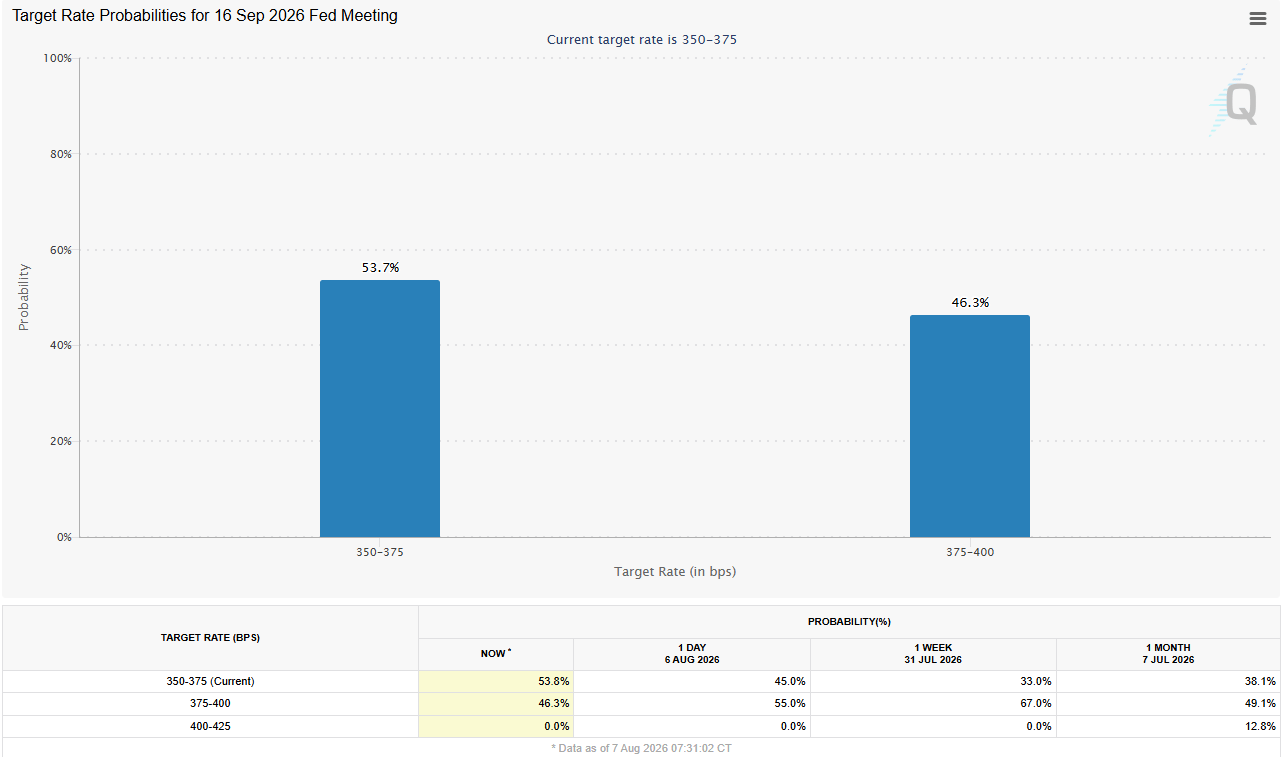
The Automatic Data Processing’s (ADP) monthly report showed that private sector payrolls increased by 44K in July, missing the market expectation of 70K. Additionally, the employment component of the Institute for Supply Management’s (ISM) Services Purchasing Managers’ Index (PMI) fell into the contraction territory at 47.4 from 51.2 in July. Falling Oil prices, combined with uninspiring US data, caused investors to reassess the probability of a Fed interest rate hike at the next meeting. With the CME FedWatch Tool’s probability for a September rate increase falling to about 55% from nearly 70% a week prior, US Treasury bond yields turned south and fuelled Gold’s impressive upsurge.
In the meantime, Minneapolis Federal Reserve (Fed) Bank President Neel Kashkari, who voted for a 25-basis-point (bps) rate hike at the July meeting, unexpectedly adopted a wary tone on policy tightening and further weighed on the USD.
The FXS Speechtracker scored Kashkari’s speech on Wednesday a 4.6/10, marking a notably softer tone relative to the historical average of 6.8/10. Kashkari’s emphasis that the goal is to bring down inflation without explicitly aiming to slow the economy, combined with the view that recent price pressure is largely supply-driven, and the remark about not calling for a dramatic increase in rates pointed to a nuanced, neutral posture rather than an aggressive tightening bias. The focus on the Committee’s communications stance and the value of explaining the reaction function suggested continued data-dependence and an openness to flexible policy signaling.
Commenting on Gold’s action, analysts at OCBC noted that Gold rose sharply as easing Middle East tensions pushed Oil prices lower, while US Treasury yields and the USD also eased. They added that “market expectations for Fed to hike in Sep has eased,” while the sharp move in the yellow metal “accelerated after prices cleared recent resistance, triggering technical buying and short covering.” According to OCBC, Gold’s strength now “suggests investors are increasingly pricing a de-escalation of the US-Iran conflict, a normalisation of Oil flows through the Strait of Hormuz, lower real interest rates and a softer USD,” providing a broad-based fundamental backdrop to the latest gains.
Following a consolidation phase on Thursday, Gold regathered its bullish momentum heading into the crucial US employment data and extended its weekly uptrend to further beyond $4,300.
Heading into the weekend, Gold advanced beyond $4,350 as the probability of a September rate hike declined further. The US Bureau of Labor Statistics (BLS) reported on Friday that Nonfarm Payrolls (NFP) declined by 23K in July. This print followed the 20K increase (revised lower from 57K) recorded in June and fell short of the market expectation for an increase of 80K by a wide margin.
Gold investors await US inflation data
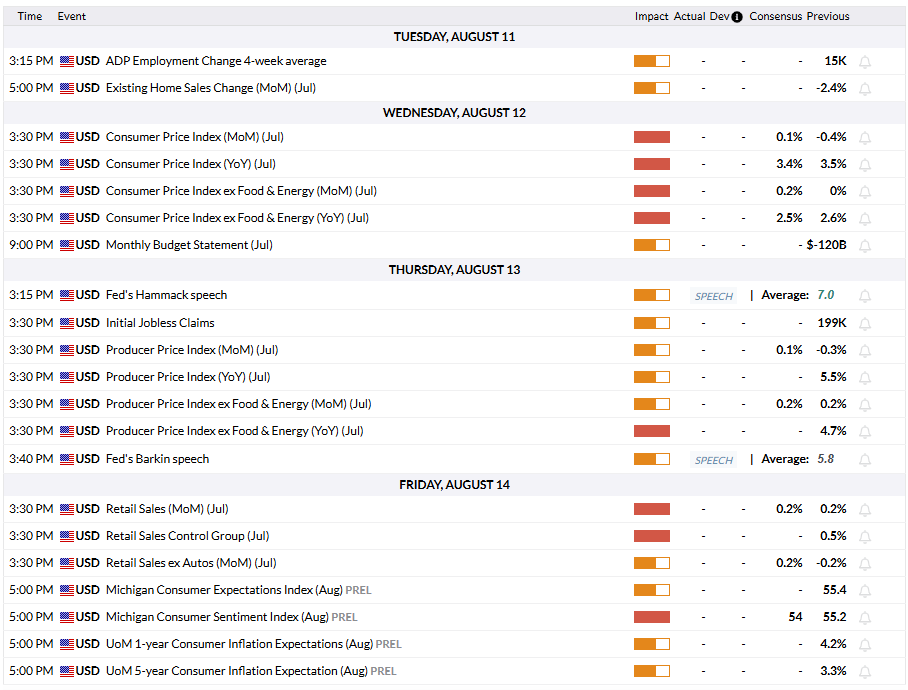
The BLS will publish July inflation data on Wednesday. Investors expect the Consumer Price Index (CPI) to rise by 0.1% on a monthly basis, and see the core CPI increasing by 0.2% after staying unchanged in June.
In case the monthly core CPI rises at a faster pace than anticipated, the immediate reaction could cause investors to second-guess the probability of a September Fed policy hold. In this scenario, US T-bond yields could edge higher and cause Gold to correct lower. Conversely, the USD is likely to remain under pressure and leave the door open for another leg higher in Gold, if the monthly core CPI comes in below the market forecast.
Analysts at Commerzbank argue that the Fed’s near-term policy path remains highly contingent on the incoming inflation data. They note that “at its next meeting in September, the Fed will likely refrain from raising interest rates if inflation has begun to ease by then, and the July figures would not contradict such a scenario.” However, they caution that “inflation would likely also have to remain low in August to prevent the Fed from raising rates in September,” underscoring how little room there is for upside surprises.
Against this backdrop, Commerzbank highlights the political sensitivity around further tightening, stressing that whether Fed Chair Kevin Warsh “can avoid an interest rate hike — which would certainly not be well-received by President Trump — depends heavily on whether inflation moves in the right direction soon,” and that “next week’s consumer price data will therefore attract a great deal of attention.”
At the same time, market participants will continue to pay close attention to developments in the Middle East. If the conflict between the US and Iran heats up again and Crude Oil prices turn north, with the US refusing to stop enforcing a naval blockade on Iranian ports or rejecting Iran and Oman’s joint effort to manage the Strait of Hormuz, Gold could have a difficult time preserving its bullish momentum.
Analysts at Rabobank caution that hopes for a swift resolution to shipping disruptions in the Strait of Hormuz may be misplaced. They argue that “a short-term deal to open up the Strait of Hormuz for commercial shipping is unlikely as both sides have very little common ground,” noting that such an arrangement “offers no permanent solutions for the key sticking points that the whole conflict centers around.” Even in the event that an agreement is reached, Rabobank stresses that it would merely “offer another 60-day window of free transits through Hormuz while further negotiations resume,” rather than a durable settlement. In their view, “if a deal is agreed, it could be a matter of time until either party expresses frustration with the negotiations again and markets are forced to price in another few weeks of geopolitical tension,” underscoring the potential for recurring bouts of volatility as the dispute drags on.
Gold technical analysis: Bulls dominate
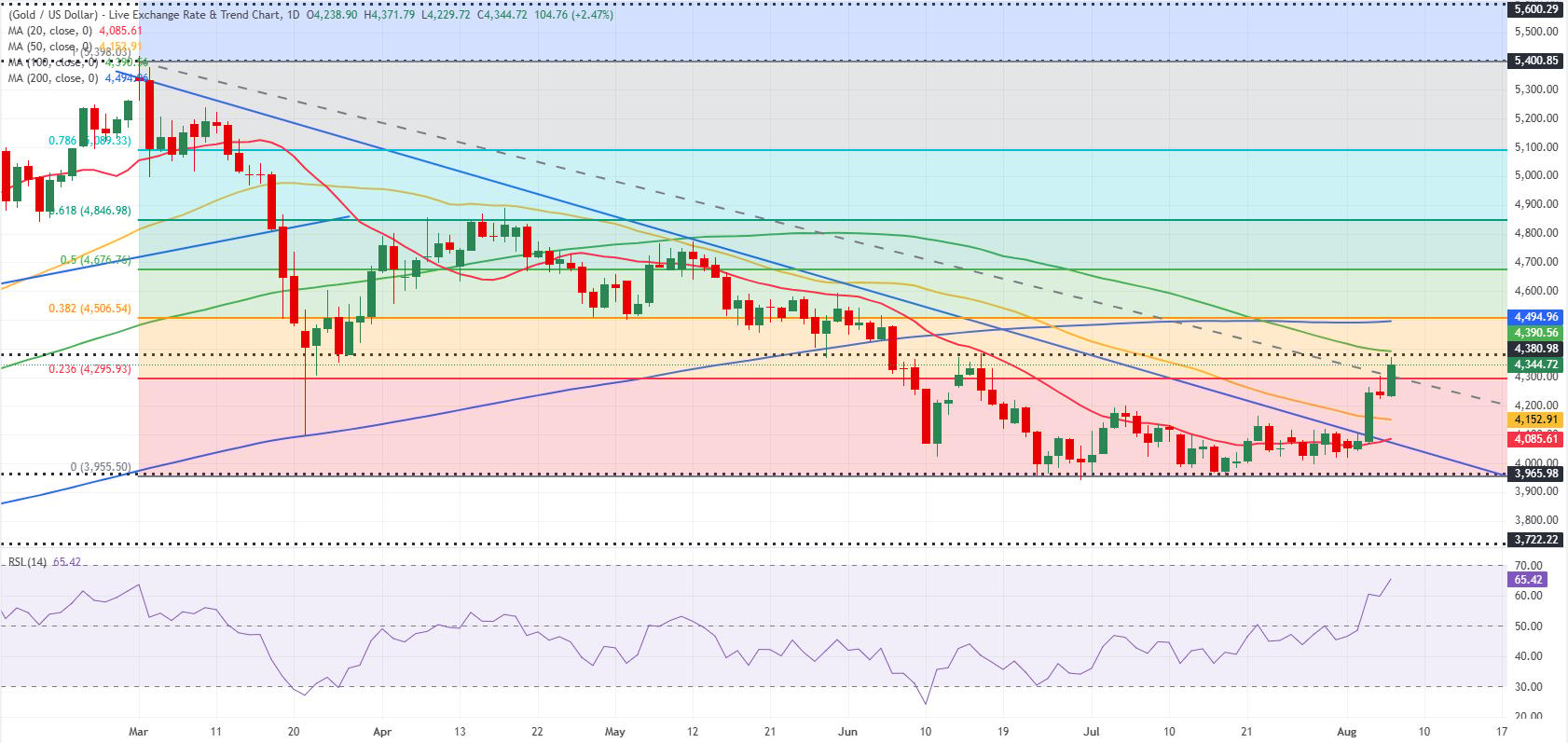
The Relative Strength Index (RSI) indicator on the daily chart climbed to its highest level since late January and Gold broke above the descending trend line drawn from early March, highlighting a buildup in bullish momentum.
On the upside, the 100-day Simple Moving Average (SMA) at $4,390 aligns as the next important resistance level ahead of $4,495-$4,510 (200-day SMA, Fibonacci 38.2% retracement of the March-August downtrend). If Gold manages to clear that latter resistance area, increasing technical buying pressure could pave the way for an extended rally toward $4,680 (Fibonacci 50% retracement).
Looking south, the immediate support area aligns at $4,300 (Fibonacci 23.6% retracement) before $4,150 (20-day SMA) and $4,100-$4,080 (broken descending trend line, 20-day SMA). If Gold returns below this area, the next line of defence before additional losses could be seen at $3,965 (static level, end-point of the downtrend).
Gold FAQs
Gold has played a key role in human’s history as it has been widely used as a store of value and medium of exchange. Currently, apart from its shine and usage for jewelry, the precious metal is widely seen as a safe-haven asset, meaning that it is considered a good investment during turbulent times. Gold is also widely seen as a hedge against inflation and against depreciating currencies as it doesn’t rely on any specific issuer or government.
Central banks are the biggest Gold holders. In their aim to support their currencies in turbulent times, central banks tend to diversify their reserves and buy Gold to improve the perceived strength of the economy and the currency. High Gold reserves can be a source of trust for a country’s solvency. Central banks added 1,136 tonnes of Gold worth around $70 billion to their reserves in 2022, according to data from the World Gold Council. This is the highest yearly purchase since records began. Central banks from emerging economies such as China, India and Turkey are quickly increasing their Gold reserves.
Gold has an inverse correlation with the US Dollar and US Treasuries, which are both major reserve and safe-haven assets. When the Dollar depreciates, Gold tends to rise, enabling investors and central banks to diversify their assets in turbulent times. Gold is also inversely correlated with risk assets. A rally in the stock market tends to weaken Gold price, while sell-offs in riskier markets tend to favor the precious metal.
The price can move due to a wide range of factors. Geopolitical instability or fears of a deep recession can quickly make Gold price escalate due to its safe-haven status. As a yield-less asset, Gold tends to rise with lower interest rates, while higher cost of money usually weighs down on the yellow metal. Still, most moves depend on how the US Dollar (USD) behaves as the asset is priced in dollars (XAU/USD). A strong Dollar tends to keep the price of Gold controlled, whereas a weaker Dollar is likely to push Gold prices up.
Author

Eren Sengezer
FXStreet
As an economist at heart, Eren Sengezer specializes in the assessment of the short-term and long-term impacts of macroeconomic data, central bank policies and political developments on financial assets.















