Gold Weekly Forecast: Bears shy away as US bond yields turn south
- Gold staged a decisive rebound following bearish action earlier in the week.
- In the absence of high-impact data releases, investors will stay focused on the bond market activity.
- The near-term technical outlook is yet to confirm a bullish reversal.

Gold (XAU/USD) started the week under bearish pressure but reversed its direction in the second half as United States (US) Treasury bond yields declined sharply. The economic calendar will not feature high-impact data releases next week and the Federal Reserve (Fed) will be in the blackout period, possibly limiting the precious metal’s volatility in the near term.
Gold finds support as US bond yields decline
Gold edged lower on Monday as geopolitical tensions in the Middle East escalated further following news of an unidentified projectile hitting a passenger terminal at King Khalid International Airport in Riyadh. The Houthis swiftly claimed the attacks, saying they were a response to “Saudi aggression.” Nonetheless, with US bond markets remaining closed in observance of the Columbus Day holiday, XAU/USD’s volatility remained limited.
Ahead of Wednesday’s critical September inflation data from the US, the market action turned subdued and Gold closed marginally lower.
The US Bureau of Labor Statistics reported that annual inflation, as measured by the change in the Consumer Price Index (CPI), climbed to 3.7% in September from 3.4% in August. This print came in above the market expectation of 3.6%. On a monthly basis, the CPI and the core CPI, which excludes volatile food and energy prices, increased by 0.6% and 0.3%, respectively.
With the immediate reaction to hot inflation prints, the probability of a Federal Reserve (Fed) rate hike climbed to about 40%, according to the CME FedWatch Tool. As a result, the USD gathered strength and XAU/USD came under bearish pressure, losing more than 1% on Wednesday to close near $4,100.
However, Gold gathered recovery momentum on Thursday and gained 1.6% to erase a large portion of its weekly losses as US T-bond yields declined sharply. Bloomberg reported that China seems to be moving US securities to non-US custodian banks in other countries, masking its role in financing US deficits. The report further added that Canada’s holdings of US debt securities have grown to nearly $600 billion of Treasuries and bonds despite a tariff war, indicating that China has shifted its holdings to Canada.
While speaking at an International Monetary Fund (IMF) event during the early trading hours of the Asian session on Friday, Fed Chair Kevin Warsh refrained from hinting at the possibility of a rate hike in October. In turn, US T-bond yields stretched lower with the CME FedWatch Tool’s probability of a rate hike in October falling to about 10% and allowed Gold to extend its recovery toward $4,200.
Fed Chair Warsh’s speech scored 5.6/10 on the FXS Speechtracker, below the historical average of 6.1/10. His admission of being “over-scarred from the global financial crisis” underscored a persistent risk-aware bias even as Warsh highlighted structural growth and an investment surge driven by “good policies,” and stressed that upcoming Federal Open Market Committee (FOMC) meetings will be the “crystalizing moment” for decisions on output, employment and inflation.
Warsh’s focus on AI as a near-term demand catalyst and a tool to strengthen data confidence, alongside attention to negative tailside risks, pointed to a cautious optimism that keeps the Fed open to tightening while avoiding pre-commitment on the policy path.
Gold investors will stay focused on bond markets
The Fed will be in its blackout period ahead of the October 27-28 policy meeting, and officials won’t be commenting on monetary policy. The only noteworthy data in the US economic calendar will be the preliminary S&P Global Manufacturing and Services Purchasing Managers Index (PMI) figures for October, scheduled to be released on Friday. Unless either of the headline PMIs unexpectedly drop into contraction territory below 50, the market reaction is likely to be muted.
Hence, investors will continue to pay close attention to Treasury bond yields and headlines coming out of the Middle East. In case US yields decline further, Gold could attract buyers and extend its recovery. On the other hand, the precious metal could have a hard time gathering bullish momentum in case bond yields rebound or stabilize.
In the meantime, a leg higher in crude Oil prices could feed into inflation concerns and cap Gold’s upside, even if bond yields continue to edge lower.
Commenting on Gold's near-term outlook, FX strategists at OCBC say they “remain cautiously constructive, particularly if the pullback in long-end yields and the USD extends,” but stress that the latest upswing in the metal is “another reminder that Gold is trading the bond market’s reaction to US data rather than the data itself.” They also caution that “underlying inflation pressures remain elevated, and the recent decline in yields has been partly driven by risk aversion rather than improving inflation fundamentals,” suggesting the current support for Gold may prove fragile if bond market dynamics reverse.
Meanwhile, TD Securities analysts note that the precious metals complex has received "much-needed support" as interest rates and US Dollar strength have moderated following the initial surge after the CPI release.
They explain that alongside this shift in macro conditions, "macro discretionary positions remain elevated, while ETF inflows and central bank demand also remain strong." Analysts further argue that these combined flows "have ultimately offered strong support for [G]old," and add that they expect them to "remain robust, especially in the $4,000-4,100/oz region."
Gold technical analysis: A bullish reversal is yet to be confirmed
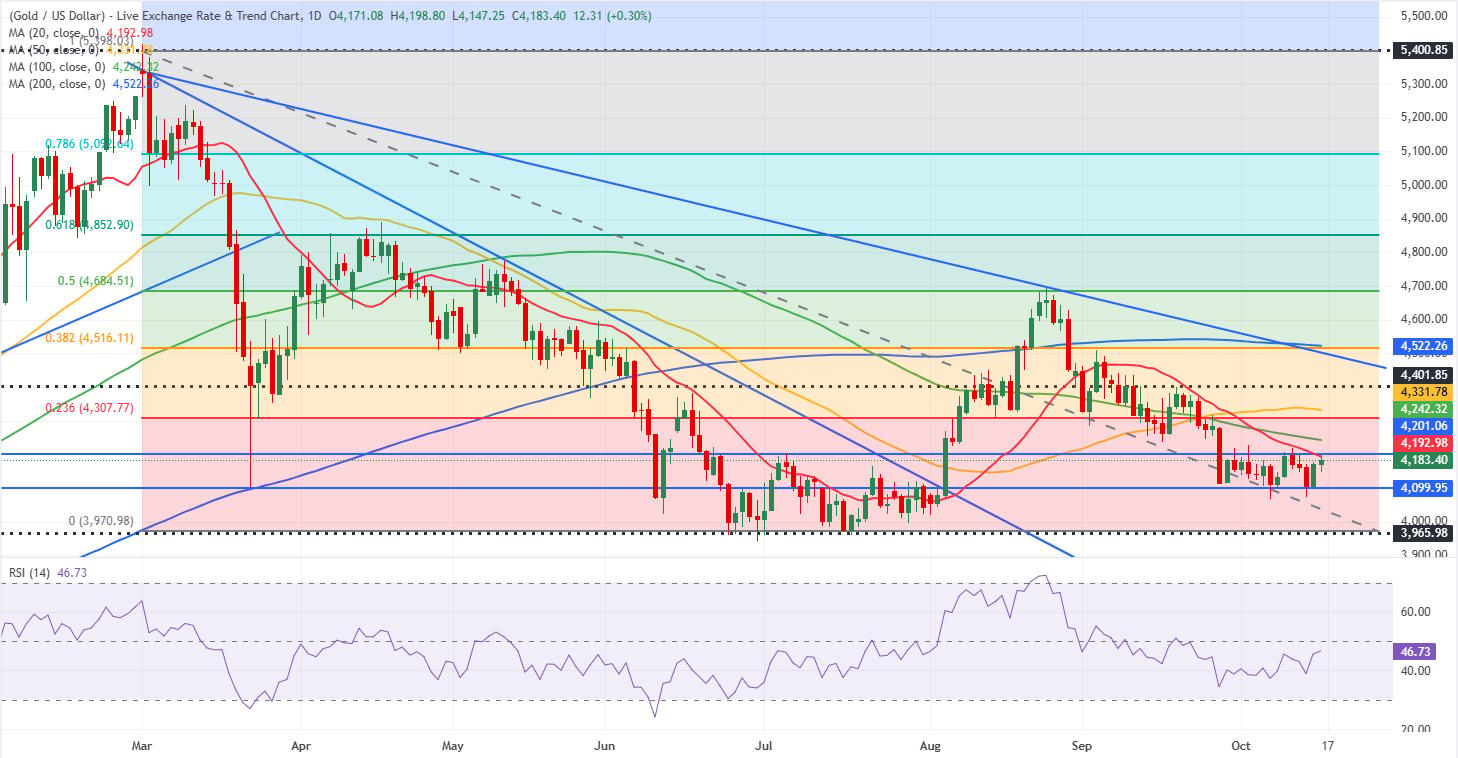
The Relative Strength Index (RSI) indicator on the daily chart stays below 50 despite the bullish action seen in the second half of the week, and Gold continues to trade below the 20-day, 50-day, 100-day and 200-day Simple Moving Averages (SMA), reflecting buyers’ hesitancy.
The immediate resistance is located in the $4,190-$4,240 region, where the static level meets the 20-day and the 100-day SMAs. Once Gold clears this hurdle, the Fibonacci 23.6% retracement of the March-August downtrend and the 50-day SMA could form the next resistance area at $4,300-$4,330 ahead of $4,510-$4,520 (Fibonacci 38.2% retracement, 200-day SMA, ascending trend line).
On the downside, a static support level seems to have formed at $4,100 ahead of $4,000-$3,970 (static level, round level, end-point of March-August downtrend).
Gold FAQs
Gold has played a key role in human’s history as it has been widely used as a store of value and medium of exchange. Currently, apart from its shine and usage for jewelry, the precious metal is widely seen as a safe-haven asset, meaning that it is considered a good investment during turbulent times. Gold is also widely seen as a hedge against inflation and against depreciating currencies as it doesn’t rely on any specific issuer or government.
Central banks are the biggest Gold holders. In their aim to support their currencies in turbulent times, central banks tend to diversify their reserves and buy Gold to improve the perceived strength of the economy and the currency. High Gold reserves can be a source of trust for a country’s solvency. Central banks added 1,136 tonnes of Gold worth around $70 billion to their reserves in 2022, according to data from the World Gold Council. This is the highest yearly purchase since records began. Central banks from emerging economies such as China, India and Turkey are quickly increasing their Gold reserves.
Gold has an inverse correlation with the US Dollar and US Treasuries, which are both major reserve and safe-haven assets. When the Dollar depreciates, Gold tends to rise, enabling investors and central banks to diversify their assets in turbulent times. Gold is also inversely correlated with risk assets. A rally in the stock market tends to weaken Gold price, while sell-offs in riskier markets tend to favor the precious metal.
The price can move due to a wide range of factors. Geopolitical instability or fears of a deep recession can quickly make Gold price escalate due to its safe-haven status. As a yield-less asset, Gold tends to rise with lower interest rates, while higher cost of money usually weighs down on the yellow metal. Still, most moves depend on how the US Dollar (USD) behaves as the asset is priced in dollars (XAU/USD). A strong Dollar tends to keep the price of Gold controlled, whereas a weaker Dollar is likely to push Gold prices up.
Author

Eren Sengezer
FXStreet
As an economist at heart, Eren Sengezer specializes in the assessment of the short-term and long-term impacts of macroeconomic data, central bank policies and political developments on financial assets.

















