EUR/USD Weekly Forecast: US Dollar future in the hands of Kevin Warsh
- United States inflation rose by more than anticipated in September.
- The Middle East crisis keeps fueling global inflation fears.
- EUR/USD latest recovery seems corrective, sellers await around 1.1300.

The EUR/USD pair fell to a fresh 2026 low of 1.1113 but managed to bounce back, finishing the week with gains in the 1.1250 region. The pair was all about the US Dollar (USD) and how investors feel about the Federal Reserve (Fed) monetary policy path.
Hot US inflation boosts USD demand
The USD soared on Wednesday, following the release of the September Consumer Price Index (CPI). Annual inflation, as measured by the CPI, was up 3.7% from a year earlier, up from August’s 3.4% increase. The core figure, which excludes food and energy prices, rose 2.6% in the year to September, following the 2.4% posted in the previous month. The hotter-than-anticipated figures fueled rate hike speculation, hence pushing the Greenback higher.
Further concerns arose on Thursday, after the Producer Price Index (PPI) climbed to 6.3% YoY in September from 5.6% in August, the biggest gain since 2022. However, the USD pared gains and began retracing, turning definitively negative on Friday after Fed Chair Kevin Warsh refrained from hinting at upcoming decisions. Speaking with International Monetary Fund (IMF) Managing Director Kristalina Georgieva at a Fireside Chat, Warsh said he would deliver price stability, but decisions will be made meeting by meeting.
Treasury yields and their impact on the Greenback
Government bond yields also had their say in the USD behavior. Treasury yields edged sharply lower on Thursday amid resurgent safety demand. Bonds surged as stocks eased, with the tech sector taking the hit amid fears of higher inflation and rates and their effect on the outrageous AI spending. As a result, the 10-year Treasury yield stands at around 5.10% at the end of the week, down from a multi-decade peak of 5.31% achieved in early October.
Yields soared as investors continue to price in mounting inflationary pressures that could lead to higher interest rates. Fed funds futures are pricing in at least one more 25 basis points (bps) before year-end. The likelihood of no change in October stands at roughly 85%, while the odds of a 25 bps hike in December hold near 80%. Earlier in the week, speculative interest was betting on a 50 bps hike in September, although such odds decreased by Friday, adding some extra pressure on the Greenback.
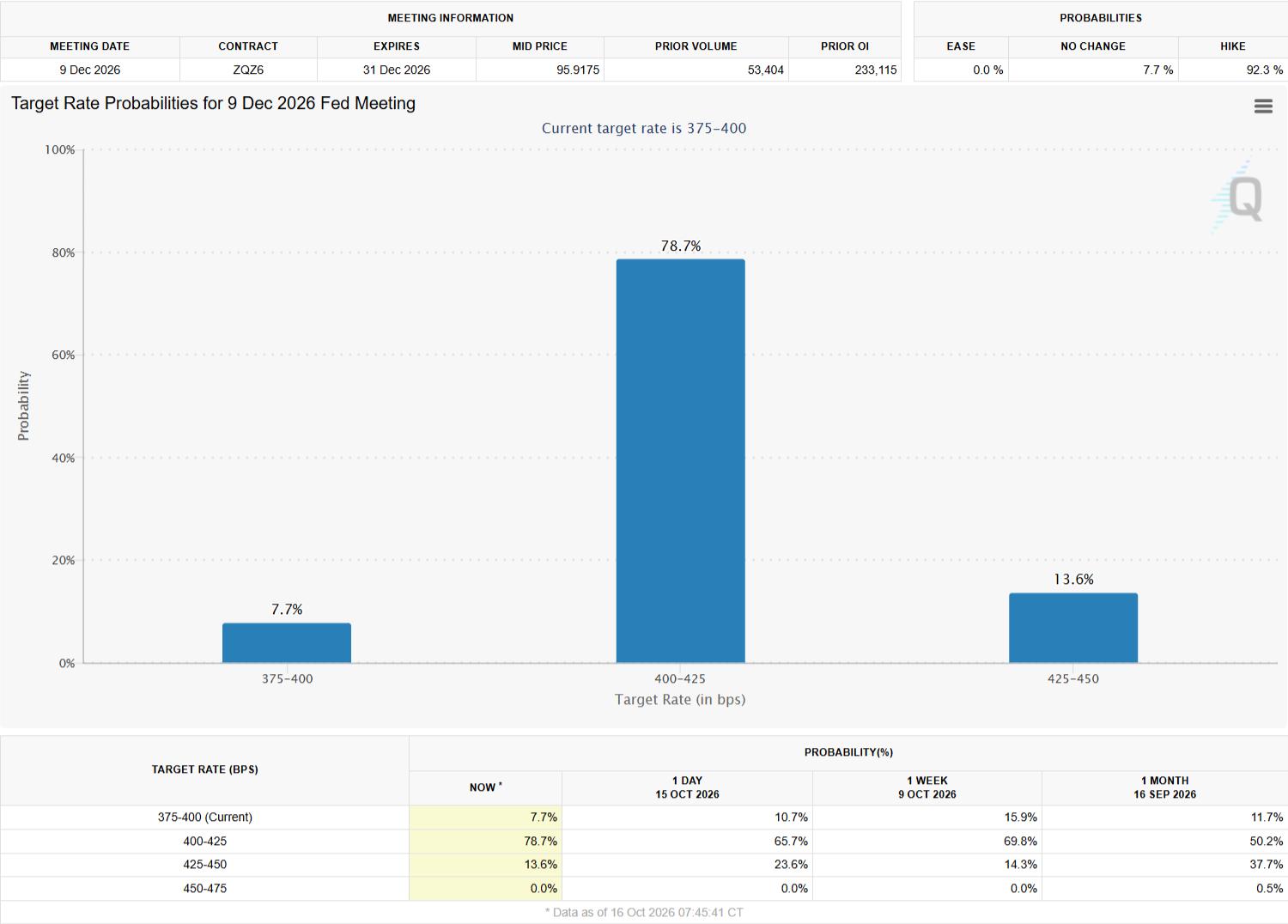
At the end of the day, financial markets are all about the USD and what the market believes Fed Chair Kevin Warsh and co will decide on monetary policy.
European inflation is also hot
Inflation in the Old Continent also stands at concerning levels, despite the fact that the European Central Bank (ECB) has delivered two rate hikes throughout 2026 while investors anticipate at least one more 25 bps hike before year-end. Germany confirmed that the annual Harmonized Index of Consumer Prices (HICP) was 3.3% YoY in September, while for the Eurozone, it reached 3.8%, its highest in three years.
ECB President Christine Lagarde spoke at an Atlantic Council GeoEconomics Center event in Bangkok, Thailand, and noted that inflation has been rising predominantly, but not exclusively, because of energy prices. She added that the European Union (EU) has yet to see second-round effects from higher energy prices, but signaled that the ECB cannot wait until they are in full view before responding.
“Our monetary policy is data dependent, and is determined on a meeting-by-meeting basis,” Lagarde said. “We will be looking very carefully at all the data that come in. We will be focused on the 2% medium term, which, by the way, is still in the cards at the moment.” Her hawkish words failed to boost the Euro.
Middle East war
Meanwhile, the Middle East war continues. Despite having limited impact on intraday market moves, the reality is that crude Oil prices remain near $100 a barrel, which, in the end, keeps feeding inflation-related fears. US President Donald Trump anticipated a few days ago that no attacks would take place before the mid-term elections on November 3, but recently threatened to drop the “mother of all bombs” on Iran afterward. Additionally, the US Treasury announced new sanctions targeting financial networks suspected to be used by Iran to circumvent international restrictions, while Iranian President Masoud Pezeshkian said sanctions are “beyond humanitarian frameworks.”
What’s next in the docket
The macroeconomic calendar will be lighter in the next few days, with Germany grabbing some attention at the beginning of the week. The country will publish the September Producer Price Index (PPI) and the October ZEW Survey on Economic Sentiment on Tuesday. Several ECB officials will be on the wires, while the Fed’s policymakers will enter the blackout period ahead of the Federal Open Market Committee (FOMC) meeting later in the month.
Things could turn a bit more interesting on Friday, as S&P Global, alongside local banks, will release the preliminary estimates of October Purchasing Managers’ Indexes (PMIs) for most major economies.

EUR/USD Technical Outlook:
The latest EUR/USD bounce seems corrective, and the risk of lower lows ahead remains high.
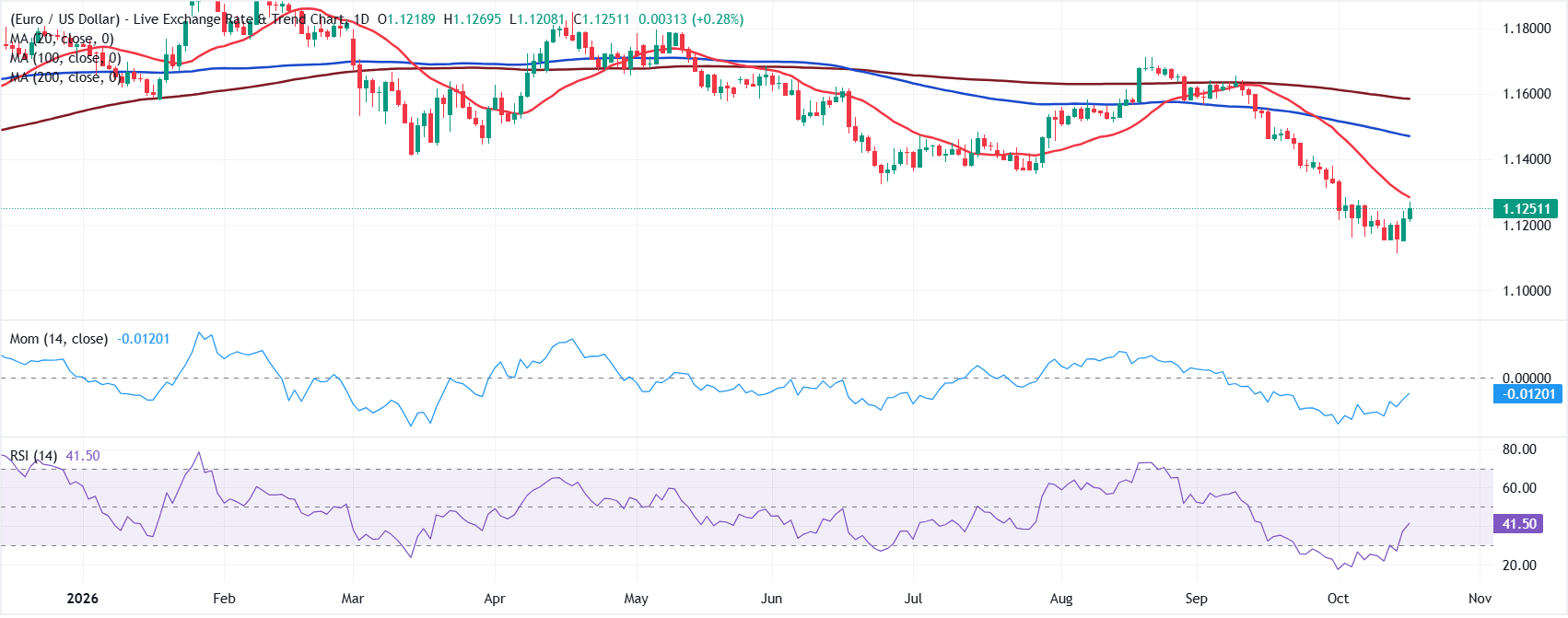
The daily chart for the EUR/USD pair shows that it keeps developing below all its moving averages. The 20-day Simple Moving Average (SMA) maintains its sharp downward slope below the longer ones, while providing dynamic resistance at around 1.1290, an immediate resistance. The same chart shows that technical indicators corrected extreme oversold conditions, heading higher yet below their midlines, reflecting the ongoing upward correction rather than suggesting further gains ahead.
The weekly chart shows that EUR/USD met buyers around a bullish 200-week SMA currently at 1.1100, the level to beat to confirm the continuation of the dominant bearish trend. Technical indicators in the same chart have turned directionless, yet remain within negative levels, maintaining the risk skewed to the downside.
Once below 1.1100, EUR/USD could extend its slump towards the psychological 1.1000 mark. Gains beyond 1.1290, on the contrary, could anticipate additional gains, initially towards 1.1360 and later up to 1.1470.
Author

Valeria Bednarik
FXStreet
Valeria Bednarik was born and lives in Buenos Aires, Argentina. Her passion for math and numbers pushed her into studying economics in her younger years.

















