Gold Weekly Forecast: Bulls show signs of life as focus shifts to US inflation data and tariff headlines
- Gold stabilized above $3,300 following a bearish start to the week.
- The near-term technical outlook suggests that sellers struggle to retain control.
- June inflation data from the US and tariff-related developments will be key market drivers in the near term.

Gold (XAU/USD) regained its traction following a bearish action seen earlier in the week and stabilized above $3,300. June inflation data from the US and fresh developments surrounding the United States’ (US) trade relations could drive XAU/USD’s action in the near term.
Gold capitalizes on safe-haven flows
Over the weekend, US President Donald Trump said that countries aligning themselves with the BRICS group, an intergovernmental organization comprising Brazil, Russia, India, China, South Africa (founding members), Iran, Egypt, Ethiopia, and the United Arab Emirates, will be subject to additional 10% tariffs. Late Monday, President Trump signed an executive order to push the deadline for the implementation of tariffs to August 1. However, Trump shared the letters that they sent to trading partners, which showed that they will be imposing 25% tariffs on Japan and South Korea.
Markets adopted a cautious stance to start the week, with investors gearing up for trade-related announcements from the US. After briefly dipping below $3,300, Gold staged a rebound in the American session and closed virtually unchanged on Monday.
On Tuesday, Trump noted that there will likely be a 50% tariff on copper. This headline weighed heavily on the commodity space and Gold lost more than 1% to close the day near $3,300.
Late Wednesday, Trump reiterated his threat of imposing additional tariffs on countries that align with BRICS and shared a new set of letters, which unveiled tariff rates of 20%-30% on minor trading partners, such as Algeria, Libya and the Philippines. Meanwhile, the minutes of the Federal Reserve’s (Fed) June policy meeting showed that most participants anticipated that rate cuts would be appropriate later this year, noting that any price shock from tariffs was expected to be "temporary or modest."
The data published by the US Department of Labor showed on Thursday that there were 227,000 first-time applications for unemployment benefits in the week ending July 5. This reading came in better than the market expectation of 235,000 and helped the US Dollar (USD) hold its ground. In turn, XAU/USD failed to gather recovery momentum and posted marginal gains.
After Trump announced late Thursday that they will impose a 35% tariff rate on Canadian imports from August 1 and said that they were planning to impose blanket levies of 15% or 20% on most trade partners, markets turned risk-averse. Gold capitalized on souring market mood on Friday and climbed to the $3,350 area, erasing its initial weekly losses in the process.
Gold investors await US inflation data, more tariff news
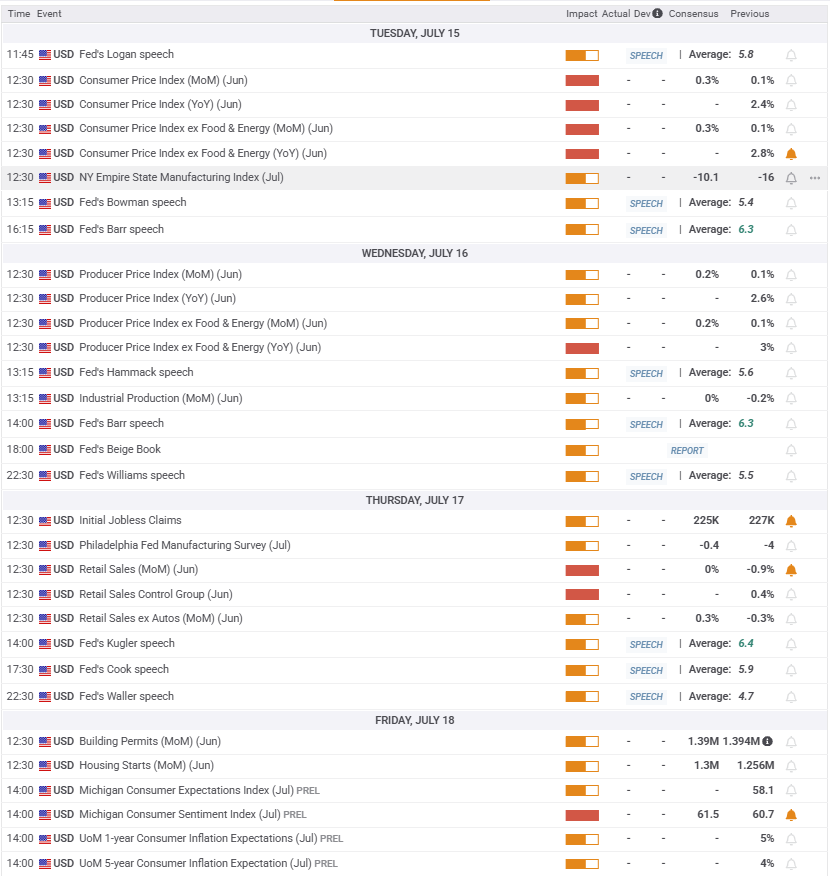
The US Bureau of Labor Statistics will publish the Consumer Price Index (CPI) data for June on Tuesday. According to the CME FedWatch Tool, markets see virtually no chance of a rate cut in July and price in about a 30% probability that the Fed will maintain the status quo in September as well. Hence, a significant increase of 0.4%, or more, in the monthly core CPI could cause market participants to reassess the probability of a September rate cut. In this scenario, the USD is likely to hold its ground and drag XAU/USD lower. It’s worth noting that the inverse correlation with Gold and the yield on the benchmark 10-year US Treasury bond has been showing signs of strengthening after remaining a non-factor in the first half of the year. Therefore, an increase in yields could put additional weight on XAU/USD’s shoulders.
The Producer Price Index (PPI) and Retail Sales data for June will be among the upcoming data releases from the US on Wednesday and Thursday, respectively, before the University of Michigan’s preliminary Consumer Sentiment Index report for July wraps up the week on Friday. Rather than the headline Consumer Confidence Index reading, markets could react to the 1-year Consumer Inflation Expectations component. A significant decline in this data could make it difficult for the USD to find demand heading into the weekend and support XAU/USD.
In the meantime, fresh developments regarding the US trade policy could ramp up market volatility. Although the US has officially announced tariff rates on some major trading partners, negotiations are likely to continue until August 1, when those rates go into effect. In case safe-haven flows start to dominate the action in financial markets, with investors growing increasingly concerned about a downturn in the US economy because of high tariff rates, Gold prices could push north in the short term. Conversely, Gold is likely to remain under pressure if markets turn risk-positive with the announcement of new trade agreements.
Gold technical analysis
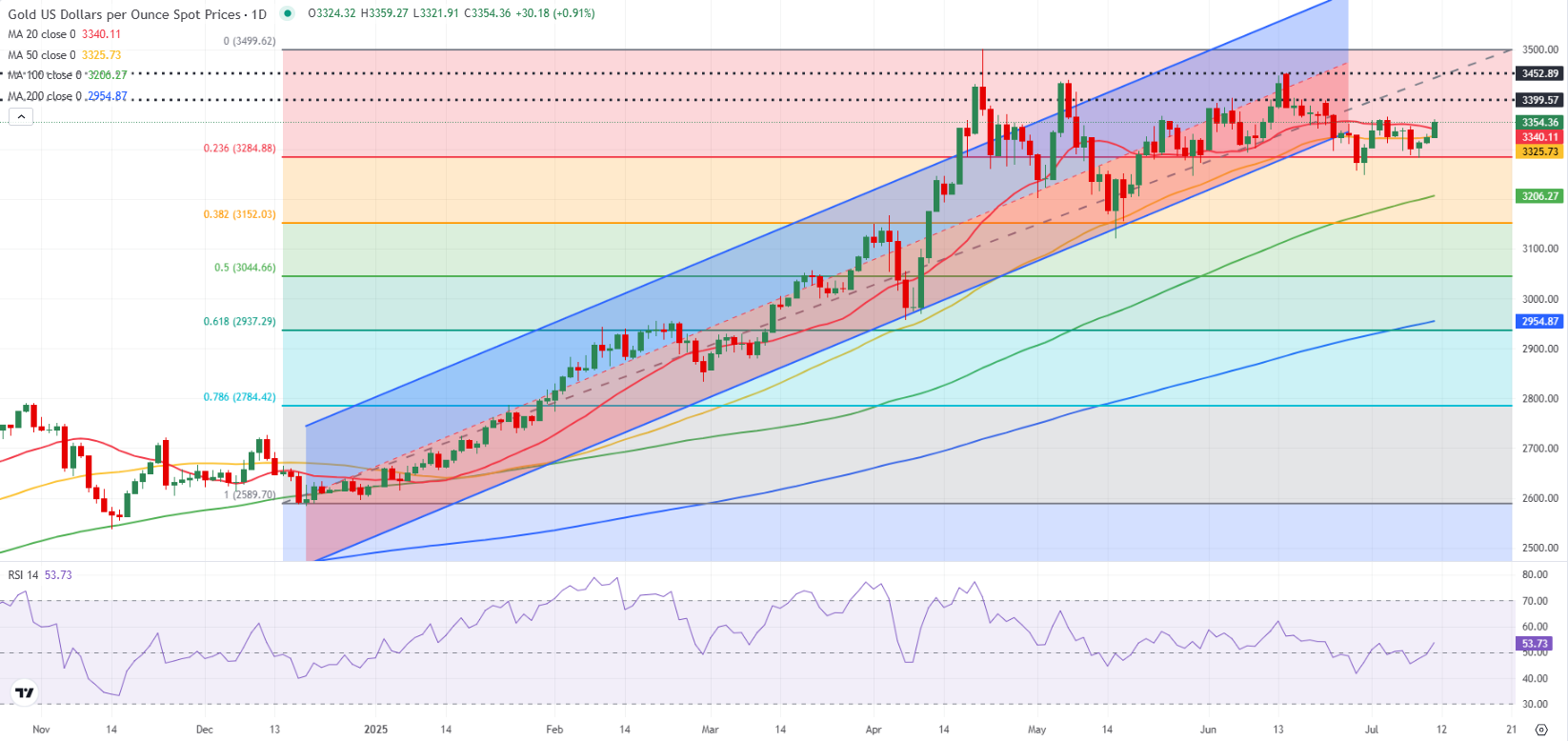
The Relative Strength Index (RSI) indicator on the daily chart recovered above 50, and Gold rose above the 50-day and the 20-day Simple Moving Averages (SMAs), reflecting sellers’ hesitancy.
On the upside, $3,400 (static level, round level) aligns as the next resistance level before $3,450 (static level) and $3,500 (all-time high, end-point of the January-June uptrend). Looking south, the first support level could be spotted at $3,285 (Fibonacci 23.6% retracement) before $3,200-$3,205 (round level, 100-day SMA) and $3,150 (Fibonacci 38.2% retracement).
Gold FAQs
Gold has played a key role in human’s history as it has been widely used as a store of value and medium of exchange. Currently, apart from its shine and usage for jewelry, the precious metal is widely seen as a safe-haven asset, meaning that it is considered a good investment during turbulent times. Gold is also widely seen as a hedge against inflation and against depreciating currencies as it doesn’t rely on any specific issuer or government.
Central banks are the biggest Gold holders. In their aim to support their currencies in turbulent times, central banks tend to diversify their reserves and buy Gold to improve the perceived strength of the economy and the currency. High Gold reserves can be a source of trust for a country’s solvency. Central banks added 1,136 tonnes of Gold worth around $70 billion to their reserves in 2022, according to data from the World Gold Council. This is the highest yearly purchase since records began. Central banks from emerging economies such as China, India and Turkey are quickly increasing their Gold reserves.
Gold has an inverse correlation with the US Dollar and US Treasuries, which are both major reserve and safe-haven assets. When the Dollar depreciates, Gold tends to rise, enabling investors and central banks to diversify their assets in turbulent times. Gold is also inversely correlated with risk assets. A rally in the stock market tends to weaken Gold price, while sell-offs in riskier markets tend to favor the precious metal.
The price can move due to a wide range of factors. Geopolitical instability or fears of a deep recession can quickly make Gold price escalate due to its safe-haven status. As a yield-less asset, Gold tends to rise with lower interest rates, while higher cost of money usually weighs down on the yellow metal. Still, most moves depend on how the US Dollar (USD) behaves as the asset is priced in dollars (XAU/USD). A strong Dollar tends to keep the price of Gold controlled, whereas a weaker Dollar is likely to push Gold prices up.
Premium
You have reached your limit of 3 free articles for this month.
Start your subscription and get access to all our original articles.
Author

Eren Sengezer
FXStreet
As an economist at heart, Eren Sengezer specializes in the assessment of the short-term and long-term impacts of macroeconomic data, central bank policies and political developments on financial assets.