Gold Weekly Forecast: Bears dominate even as US yields push lower ahead of midterm election
- Gold dropped to a fresh 2026-low below $3,900 despite starting the week on a bullish note.
- The near-term technical picture points to a bearish outlook.
- The US economic calendar will feature key data releases, midterm elections will be held on Tuesday.

Gold (XAU/USD) registered gains for the first three days of this week only to erase them in the second half and to drop to a fresh 2026-low below $3,900. Next week’s economic calendar will offer key macroeconomic data releases from the United States (US), which could trigger the next directional action in the precious metal.
Gold buyers fail to retain control despite falling US yields
Gold managed to close in positive territory on Monday and Tuesday as falling crude Oil prices helped markets adopt an optimistic stance about the inflation outlook. Still, investors refrained from taking large positions ahead of the Federal Reserve’s (Fed) policy announcements, causing the yellow metal’s upside potential to remain limited.
On Wednesday, the Fed announced that it kept its Fed Funds Target Range (FFTR) unchanged at 3.75%-4.00%, with two policymakers voting in favor of a 25 basis points (bps) rate hike. In the post-meeting press conference, Fed Chair Kevin Warsh refrained from confirming a rate increase in December but reiterated their commitment to delivering price stability. With the immediate reaction, the US Dollar (USD) weakened slightly and allowed XAU/USD to post small gains midweek.
On Thursday, the US Bureau of Economic Analysis’ (BEA) first estimate showed that US Gross Domestic Product (GDP) expanded at an annual rate of 3.4% in the third quarter. This print followed 2.2% growth recorded in the second quarter and came in better than analysts’ estimate of 3.2%. The BEA also reported that the Personal Consumption Expenditures (PCE) Price Index rose by 3.6% in September, compared to 3.4% in August. Additionally, the core PCE Price Index, the Fed’s preferred gauge of inflation, increased to 3.1% in this period, as anticipated.
Even though these data releases failed to influence the odds of a December rate increase in a meaningful way, the benchmark 10-year US Treasury bond yield lost more than 1% on the day and declined below 5%. However, Gold, which usually shows an inverse correlation with US yields, failed to attract buyers.
Strategists at OCBC note “Gold’s inability to benefit from lower yields suggests that fresh buying interest remains limited, even as earlier liquidation pressures may be easing.” They explain that “renewed weakness in technology equities also weighed on sentiment as it raises concerns over another bout of broader deleveraging.” Against this backdrop, the Singaporean bank says, “we remain cautious near term, with further consolidation or another test of recent lows not ruled out.”
In fact, Google’s parent company Alphabet’s shares plunged nearly 13% on Thursday and touched its weakest level since April, dragging the NASDAQ Composite lower. In its earnings report, the company noted that artificial intelligence summaries on search were hurting the ad revenue, as per BBC, and further reported negative free cash flow of about $9 billion.
After losing more than 1% on Thursday and erasing a large portion of its weekly gains, Gold extended its slide on Friday. With the $4,000 psychological level failing and the selloff in US tech stocks picking up steam, the precious metal came under renewed pressure and touched its weakest level since October 2025 below $3,900.
Gold investors await US data, midterm elections
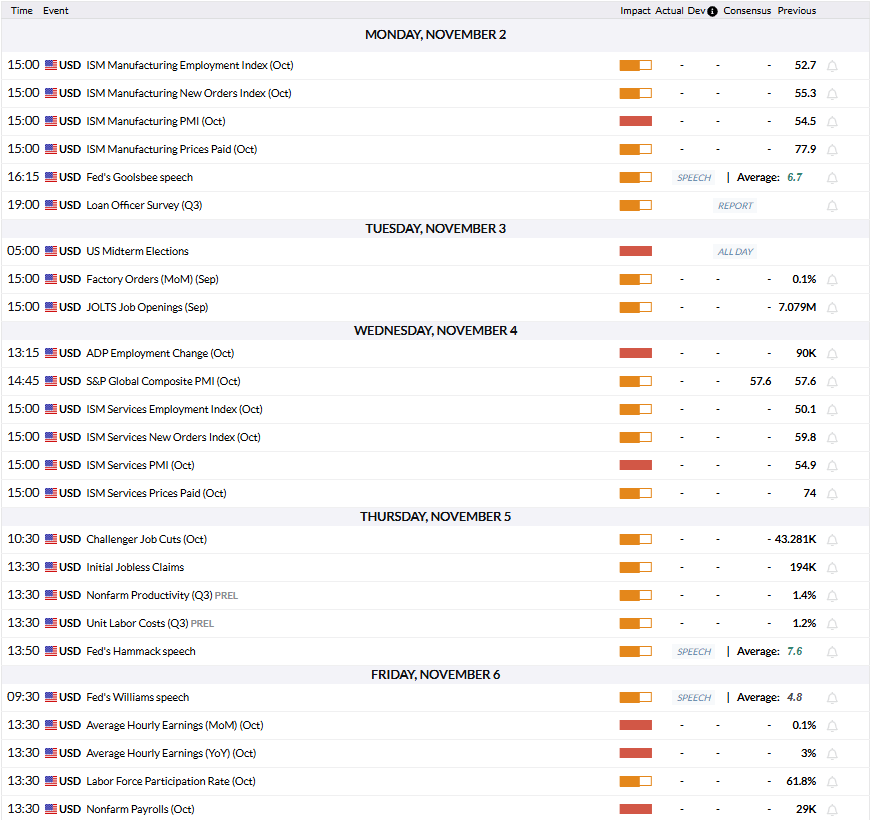
The US economic calendar will feature the Institute for Supply Management’s (ISM) Manufacturing Purchasing Managers Index (PMI) data on Monday. Unless the headline unexpectedly arrives in contraction territory below 50, the market reaction is likely to remain subdued ahead of the midterm elections, which will be held on Tuesday.
Commerzbank’s Nguyen argues that the US is “heading towards what is known as a ‘divided government’,” with the midterm outcome likely to leave the administration facing a more assertive Democratic Congress. The bank notes that the Democrats would probably “at least try to constrain the administration’s room for manoeuvre on issues of particular importance to the public, such as the current Iran conflict, which has pushed up the cost of living significantly,” even though executive authority in wartime limits how far those efforts can go.
It’s difficult to draw a direct relationship between the midterm election result and Gold’s valuation in the near term. However, a divided government could lead to limited war funding and potentially pave the way for a de-escalation of the crisis in the Middle East. Considering how rising Oil prices and their impact on inflation expectations have been weighing on Gold since the beginning of the conflict, a divided government could help XAU/USD gain traction. Such an outcome could also cause President Donald Trump to try to use his executive orders and emergency powers to push his agenda. In this scenario, heightened uncertainty could help Gold attract investors as a traditional safe-haven asset.
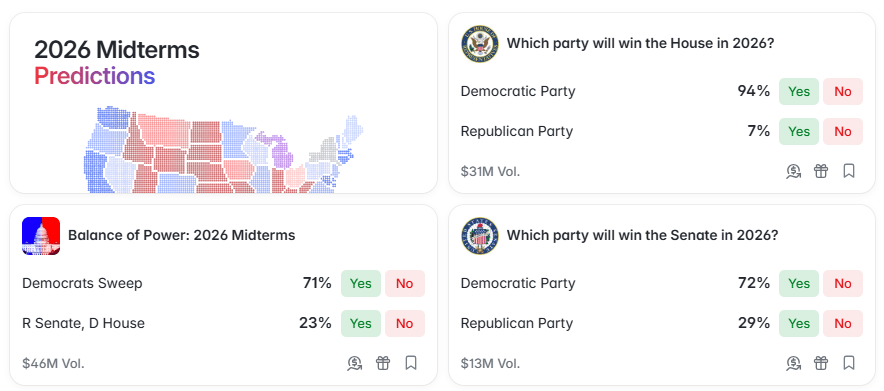
If Republicans manage to retain control of the House and the Senate, which seems to be the least likely outcome according to prediction markets, Gold could edge lower with a knee-jerk reaction.
On Friday, the US Bureau of Labor Statistics will publish the October employment report. A significant negative surprise, with a reading below 20K in Nonfarm Payrolls (NFP) could cause markets to refrain from confirming a Fed rate hike in December. In this scenario, the immediate reaction could hurt the USD and boost XAU/USD heading into the weekend.
On the other hand, even a modest increase of 40K in NFP could be seen as “good enough” for Fed policymakers to keep their attention on achieving price stability without worrying too much about the labor market. Finally, a positive surprise could reaffirm one more increase in interest rates before the end of the year and weigh on XAU/USD in the near term. According to the CME FedWatch Tool, markets are currently pricing in about a 75% chance of a 25 bps rate hike in December, suggesting there is room for additional USD strength until markets fully price in this move.
Gold technical analysis: Bearish pressure builds up
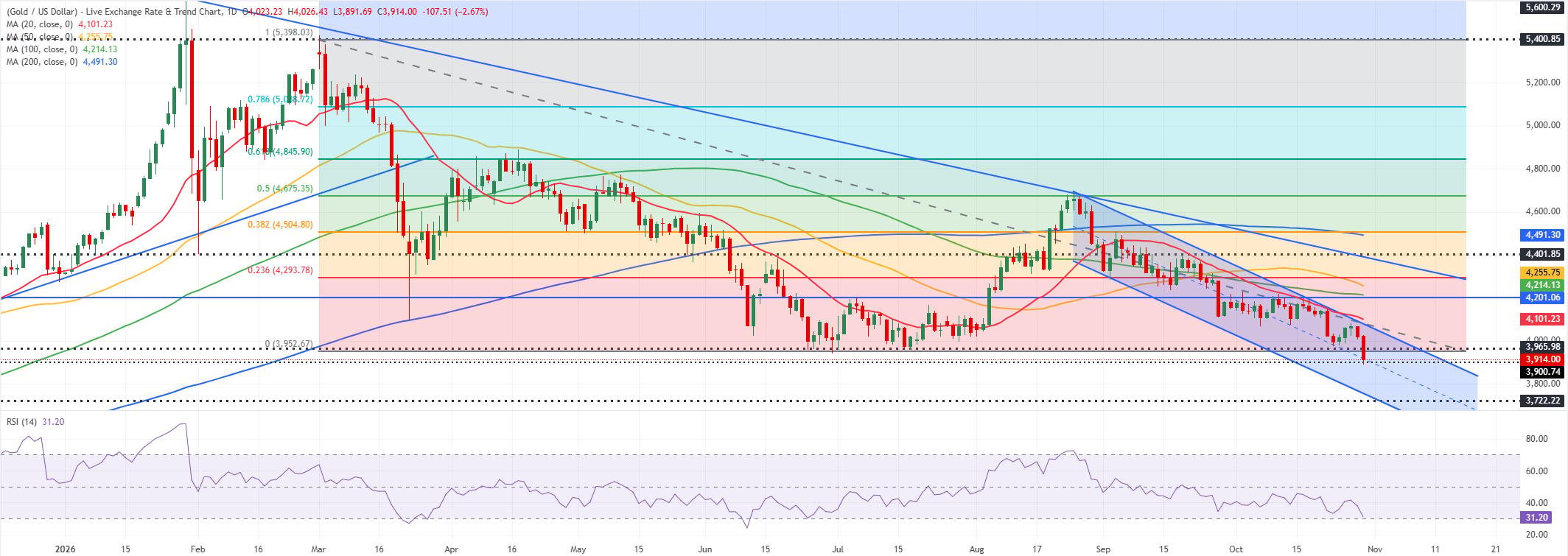
The Relative Strength Index (RSI) indicator on the daily chart stays slightly above 30, suggesting the bearish bias remains intact without oversold conditions. Additionally, Gold remains within a descending channel and sits well below the 20-day Simple Moving Average (SMA), reaffirming sellers’ dominance.
On the downside, $3,900 (static level) aligns as the immediate support level. If Gold stays below this level and fails to reclaim it, technical sellers could show interest and open the door for an extended slide toward $3,800 (static level, round level) and $3,720 (static level).
In case Gold manages to stabilize above $3,960-$4,000 (previous support area), the 20-day Simple Moving Average (SMA), currently located at $4,100, could act as a dynamic resistance level ahead of the 100-day SMA at $4,220, ahead of $4,300 (Fibonacci 23.6% retracement of the March-August downtrend).
Gold FAQs
Gold has played a key role in human’s history as it has been widely used as a store of value and medium of exchange. Currently, apart from its shine and usage for jewelry, the precious metal is widely seen as a safe-haven asset, meaning that it is considered a good investment during turbulent times. Gold is also widely seen as a hedge against inflation and against depreciating currencies as it doesn’t rely on any specific issuer or government.
Central banks are the biggest Gold holders. In their aim to support their currencies in turbulent times, central banks tend to diversify their reserves and buy Gold to improve the perceived strength of the economy and the currency. High Gold reserves can be a source of trust for a country’s solvency. Central banks added 1,136 tonnes of Gold worth around $70 billion to their reserves in 2022, according to data from the World Gold Council. This is the highest yearly purchase since records began. Central banks from emerging economies such as China, India and Turkey are quickly increasing their Gold reserves.
Gold has an inverse correlation with the US Dollar and US Treasuries, which are both major reserve and safe-haven assets. When the Dollar depreciates, Gold tends to rise, enabling investors and central banks to diversify their assets in turbulent times. Gold is also inversely correlated with risk assets. A rally in the stock market tends to weaken Gold price, while sell-offs in riskier markets tend to favor the precious metal.
The price can move due to a wide range of factors. Geopolitical instability or fears of a deep recession can quickly make Gold price escalate due to its safe-haven status. As a yield-less asset, Gold tends to rise with lower interest rates, while higher cost of money usually weighs down on the yellow metal. Still, most moves depend on how the US Dollar (USD) behaves as the asset is priced in dollars (XAU/USD). A strong Dollar tends to keep the price of Gold controlled, whereas a weaker Dollar is likely to push Gold prices up.
Author

Eren Sengezer
FXStreet
As an economist at heart, Eren Sengezer specializes in the assessment of the short-term and long-term impacts of macroeconomic data, central bank policies and political developments on financial assets.

















