EUR/USD forecast: Can ECB rate hike expectations and Lagarde’s exit halt the Euro’s decline?

The euro faces a challenging combination of monetary policy uncertainty, renewed inflationary pressure and a change at the top of the European Central Bank (ECB). Although policymakers have signalled that another interest rate increase could be on the cards in December, the prospect of tighter monetary policy has not provided a lasting boost to the single currency. Meanwhile, Christine Lagarde’s decision to leave the ECB presidency early adds another layer of uncertainty at a sensitive time for the eurozone. For the EUR/USD Forex pair, the key question is whether the prospect of higher European interest rates can outweigh concerns about the region’s economic outlook and the dollar’s relative appeal.
ECB keeps rates unchanged but leaves the door open to a December hike
The ECB kept its 3 key interest rates unchanged at its October 29 meeting, leaving the deposit facility rate at 2.50%. However, its assessment of the inflation outlook suggests that policymakers are not yet ready to rule out further monetary tightening. Eurozone inflation accelerated to 3.8% in September, up from 3.2% in August. Energy prices were a major contributor, with energy inflation rising to 18.9% from 14.3%. Price pressures also increased in services, while inflation excluding energy climbed to 2.3%.
The ECB is particularly concerned about the possibility that higher energy costs could spread to other parts of the economy. If elevated fuel and energy prices persist, businesses may pass higher production and transport costs on to consumers. Wage demands could also increase if households seek compensation for declining purchasing power, creating the risk of second-round inflation effects.
So far, however, there is limited evidence that these broader pressures are becoming entrenched. Compensation per employee increased by 3.3% year-on-year in the second quarter, down from 3.6% in the first quarter. The ECB’s wage tracker also points to negotiated wage growth of between 2.5% and 2.8% during the remaining months of 2026.
This helps explain why policymakers opted to wait rather than raise rates immediately. The Governing Council is balancing upside risks to inflation against downside risks to economic growth, particularly as higher energy prices and tighter financing conditions weigh on businesses and households.
Nevertheless, the possibility of a December rate increase remains significant. According to Reuters, three ECB policymakers consider a hike at the December 17 meeting likely, potentially taking the deposit rate to 2.75%, provided energy prices do not fall sharply. A subsequent pause could follow as higher bond yields are expected to restrain economic activity and inflation.
For the euro, this outlook offers some support. Higher interest rates can make euro-denominated assets more attractive relative to those in currencies where yields are lower. However, the currency’s reaction will depend on how much of the potential tightening is already reflected in market expectations and whether the ECB’s actions are viewed as a response to persistent inflation or an increasingly damaging energy shock.
Lagarde’s early departure adds uncertainty to the ECB outlook
The ECB’s monetary policy decision was accompanied by another major announcement: Christine Lagarde will step down as president on February 7, 2027, several months before her mandate was due to end in October. Lagarde said she wanted greater freedom to express her views on issues beyond monetary policy, explaining that the neutrality expected of an ECB president limited her ability to speak publicly on broader matters. Her departure comes as Europe faces heightened geopolitical tensions, economic uncertainty and political developments that could influence the debate over the institution’s independence.
The timing is particularly sensitive because European leaders will now have the opportunity to appoint her successor before France’s presidential election in spring 2027. Former central bank governors Klaas Knot and Pablo Hernández de Cos have been mentioned as potential candidates. For financial markets, the main concern is whether the leadership transition could affect the ECB’s independence or its approach to monetary policy.
This question is especially relevant given pressure on French public finances and calls from some political figures for central bank intervention to reduce the country’s borrowing costs. However, an immediate change in monetary policy direction should not be assumed. The ECB’s decisions are made collectively by its Governing Council, rather than by its president alone. Analysts quoted by Reuters have also suggested that the institution’s established policy framework is likely to remain in place after Lagarde’s departure.
Investors should monitor the succession process for signs of political pressure or uncertainty surrounding the ECB’s commitment to price stability. Any doubts about the central bank’s independence could weigh on confidence in the euro.
Energy prices and bond yields complicate the Euro’s recovery
The ECB’s policy dilemma is not limited to inflation. Higher energy prices threaten to weaken household purchasing power and increase operating costs for companies, while tighter financial conditions are already putting pressure on economic activity.
The rise in long-term government bond yields is an additional consideration. Higher borrowing costs can reduce demand and investment, potentially slowing growth and eventually easing inflationary pressure. Reuters reported that ECB estimates suggest the recent increase in bond yields could reduce cumulative economic growth by around 1 percentage point and inflation by approximately 0.9 percentage points in 2027–2028, compared with the central bank’s September baseline projections.
French bond market developments also remain relevant. Concerns about the country’s fiscal position have contributed to pressure on sovereign debt, with the spread between French and German 10-year yields around 155 basis points. Further deterioration in French borrowing conditions could tighten financial conditions across the eurozone and complicate the ECB’s policy decisions.
This creates a difficult environment for the single currency. A rate increase could support the euro through higher yields, but if it is needed because energy prices are damaging the inflation outlook, the accompanying economic risks could offset that benefit.
The Federal Reserve’s policy outlook will also matter. The EUR/USD reflects the relative attractiveness of the euro and the US dollar, meaning that expectations for US interest rates are just as important as the ECB’s next move. Rising US inflation and changing expectations for Federal Reserve policy could limit the euro’s ability to recover, even if the ECB adopts a more restrictive stance.
EUR/USD technical analysis: Can the pair break above 1.1258?
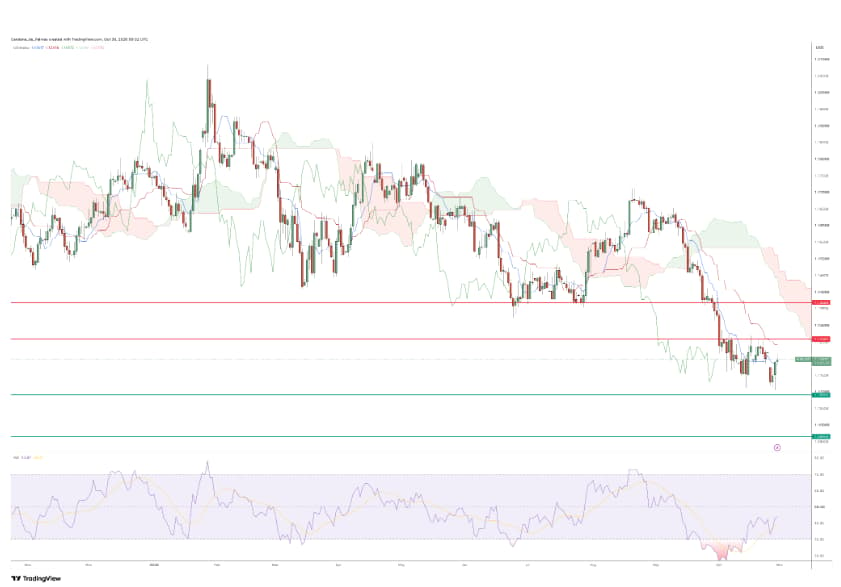
The EUR/USD remains within a broader bearish structure, despite a modest recovery from its recent low around 1.1103. The pair is trading below the Kumo cloud, which remains a significant area of resistance. The Tenkan-sen, near 1.1187, is marginally below the current price, while the Kijun-sen, around 1.1242, remains above it. This configuration suggests that short-term momentum has improved slightly, but the broader trend has not yet turned bullish.
The first resistance level to monitor is around 1.1258. A sustained daily close above this area could improve the short-term technical outlook and bring the upper resistance zone near 1.1368 into focus. However, a move towards this second level would need to be accompanied by stronger momentum and a break above the Ichimoku cloud to provide more convincing evidence of a trend reversal.
The Relative Strength Index (RSI) is trading at approximately 43.46. It has recovered from lower levels but remains below the neutral 50 threshold. Its position above its signal average, near 39.24, indicates some improvement in momentum, although buying pressure is not yet strong enough to confirm a sustained recovery.
On the downside, the recent low represents the first important support area. A daily close below this level would risk extending the broader decline and expose the next support near 1.0965. Such a move would reinforce the bearish technical structure and suggest that the latest rebound was corrective rather than the beginning of a new upward trend.
Stay up to date with what's moving and shaking on the world's markets and never miss another important headline again! Check ActivTrades daily news and analyses here.
Author

Carolane de Palmas
ActivTrades
Carolane graduated with a Masters in Corporate Finance & Financial Markets and got the AMF Certification (Financial Markets Regulator in France). Afterward, she became an independent trader, investing mostly in European and American stocks/indices.