Gold under pressure as risk sentiment improves ahead of us inflation data

Gold (XAUUSD) opened the week under pressure as improving risk sentiment reduced safe-haven demand. Hopes for US-China trade progress and signs of a potential chip policy deal boosted market optimism. Plans for US-Russia talks added to the positive sentiment. Weak Chinese producer prices added to the downside pressure. Profit-taking ahead of key US inflation data also weighed on prices. However, expectations of multiple Fed rate cuts and concerns over central bank independence may help limit losses.
Gold prices slip as trade progress and geopolitical talks lift risk appetite
Gold started the week with a bearish bias as hopes for US-China trade progress weighed on safe-haven appeal. Traders expect the August 12 tariff deadline to be pushed back, easing fears of immediate trade escalation. Sources suggest progress toward a US-China agreement on semiconductor policy. Nvidia and AMD might agree to share a portion of their China revenues with the US government. This would help them secure export permissions. This marks a step forward in a delicate area of technology.
Market sentiment further improved on news of a possible US-Russia meeting. A meeting between President Donald and Russian President Vladimir Putin is scheduled for August 15 in Alaska. The talks aim to pursue a resolution to the Ukraine conflict. This has strengthened global risk appetite. Meanwhile, weak Chinese economic data added to gold’s downside pressure. The Producer Price Index in July fell 3.6%, exceeding expectations of a 3.3% decline. Continued producer price weakness in China is casting doubt over the strength of upcoming gold demand.
Traders locked in profits ahead of Tuesday’s inflation report in the US. The report could influence the Fed’s next move on interest rates. Despite current weakness, downside may be limited by expectations of multiple Fed rate cuts. Weak US data and political uncertainty support this view. Fed Governor Michelle Bowman stated that recent labor market data strengthen her call for three cuts this year. Concerns over Fed independence and leadership changes could also keep gold appealing as a safe-haven asset.
Gold consolidates in symmetrical triangle pattern, eyeing potential breakout
The gold chart below shows a symmetrical triangle pattern, signaling a consolidation phase with converging trendlines. Since May, prices have formed lower highs and higher lows. This reflects coiling price action and building momentum for a decisive move. Support is defined by the ascending trendline from April lows, whereas resistance is marked by the descending trendline from the June top. Price has reached the apex of the triangle, an area that often precedes strong breakouts.
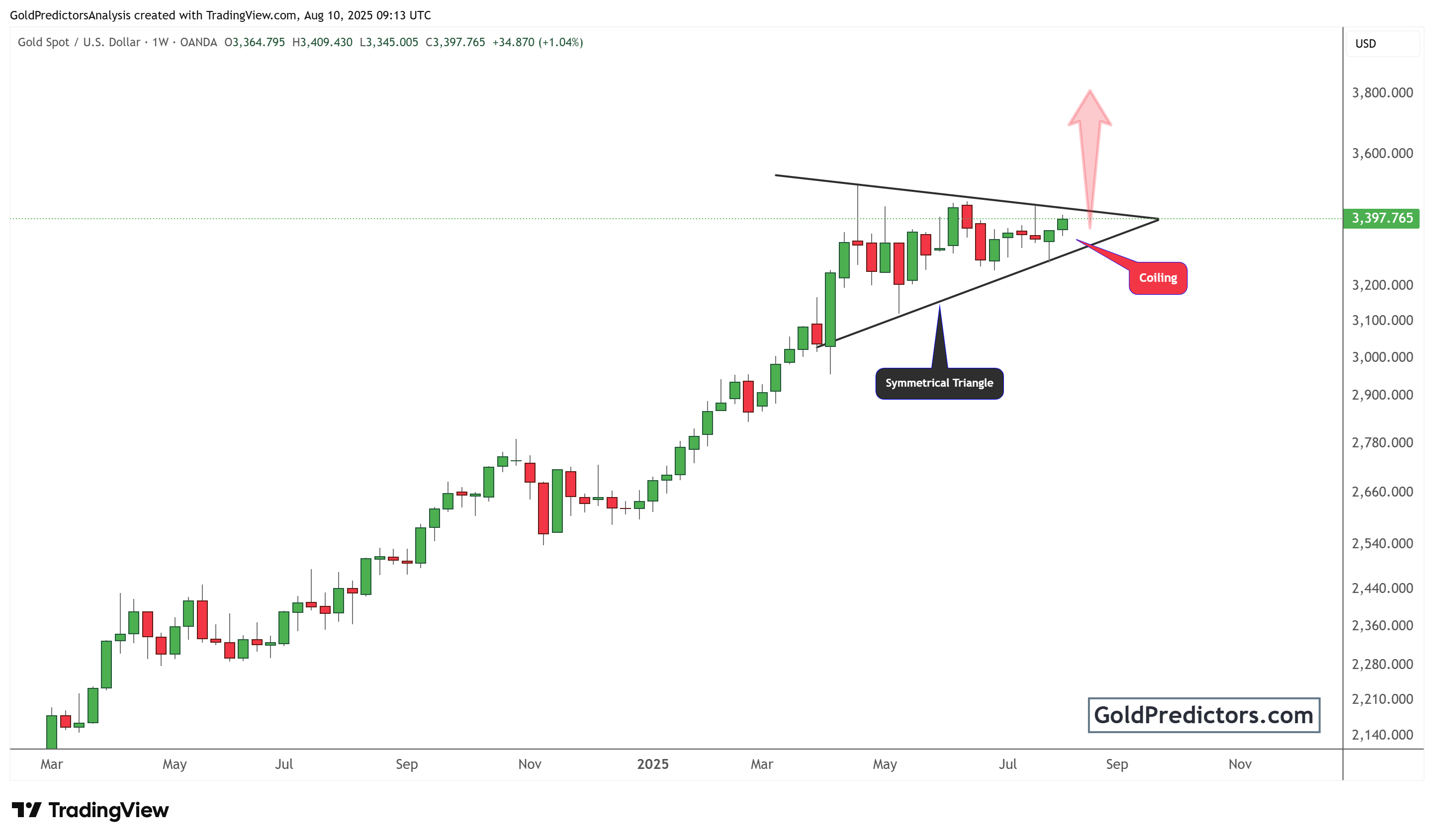
Currently, the weekly candle is testing resistance around $3,376. A confirmed breakout above this level could spark strong bullish momentum, with targets in the $3,700–$3,800 range. Failure to sustain the breakout could drag prices back toward the $3,220–$3,140 range. The support zone is located at the triangle’s base trendline. A breakdown below it could trigger a deeper decline toward $3,000.
Volume remains moderate during the consolidation phase, but a sharp increase on a breakout would confirm the move’s strength. Technical indicators remain neutral but lean bullish, backed by a series of higher lows. Still, macroeconomic factors and the upcoming US CPI report could be the key drivers for gold’s next major move.
Conclusion
Gold stays at a critical stage as risk-on sentiment, profit-taking, and weak Chinese data weigh on prices. The symmetrical triangle setup hints at an approaching breakout. A breakout above $3,376 could spark strong gains, while a drop below $3,220 risks deeper losses. Expectations of Fed rate cuts and concerns over central bank independence may help limit downside pressure. Traders should watch key levels closely as the US CPI report could set gold’s next direction.
Unlock exclusive gold and silver trading signals and updates that most investors don’t see. Join our free newsletter now!
Unlock exclusive gold and silver trading signals and updates that most investors don’t see. Join our free newsletter now!
Author

Muhammad Umair, PhD
Gold Predictors
Muhammad Umair is a financial markets analyst and investor who focuses on the forex and precious metals markets.