Gold is likely to rally this week, but what's likely next can surprise you


Gold is likely to rally this week (it's already underway), but what's likely next can surprise you.
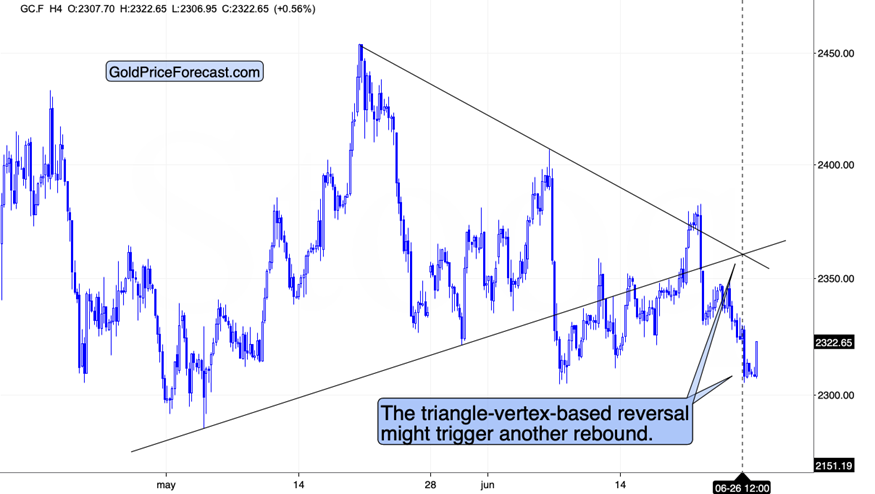
Gold is slightly up in the overnight trading, and it seems that it has indeed bottomed close to its previous June lows. Also, the price is higher than when it was while I was sending yesterday’s Intraday Alert, in which I was taking profits off the table in case of the short position in gold that I had opened on June 20, about $70 above the closing price.
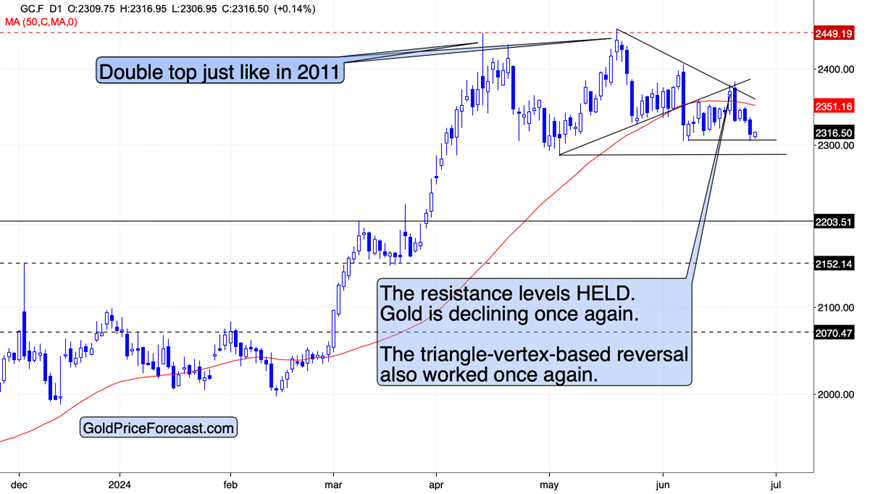
Both of the charts above show that gold has resistance at about $2,350 now, so while the upside is not tiny, it’s still quite limited.
The "New Gold"
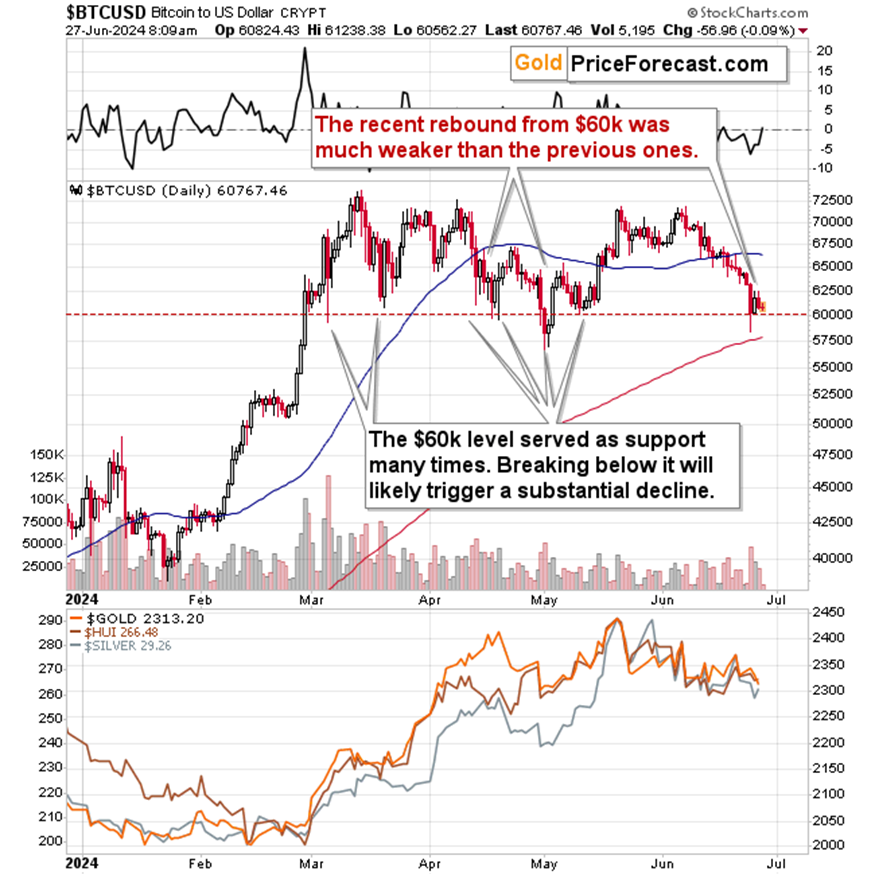
And speaking of small rebounds, did you notice how small the recent rebound in bitcoin was?
The mighty “new gold”. The famous anti-dollar asset.
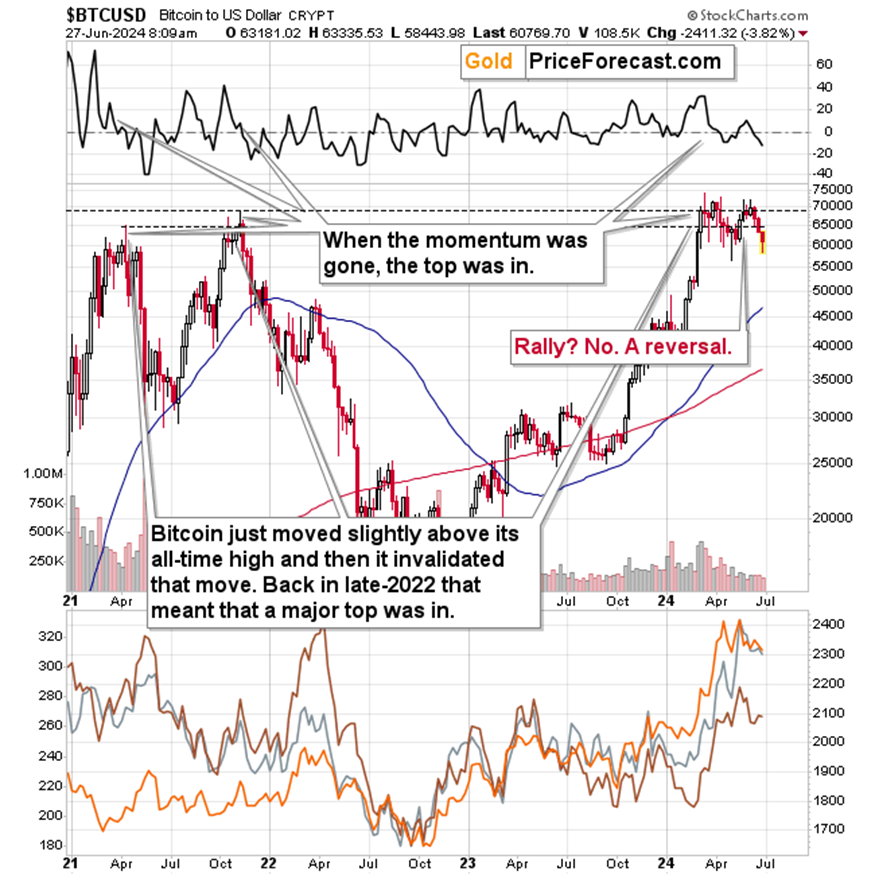
It wasn’t able to break above its 2021 highs, even the early 2021 one.
And now, bitcoin was able to launch only a tiny rebound after reaching a fairly strong short-term support at $60k. It was smaller than all previous rebounds from this level. The buyers’ strength is waning.
No wonder – people who were at least somewhat interested in buying bitcoin have already done so based on the “sure bet” scenario in which bitcoin soars after its halving (limiting the supply of new bitcoins). I warned about the key problem with “sure bet” events – they are discounted in the price before (!) the event, and when they happen, there are no more buyers left to keep pushing the price up.
What people sometimes don’t realize is that if there are no buyers and no sellers, the price doesn’t just stay the same. It starts to fall, and it continues to fall, until buyers emerge. And if based on this fall, people get scared out of their positions, we get waterfall selling and a massive plunge in prices.
That’s what likely ahead for the “new gold”.
Of course, I’m exaggerating to make a point. There will always be some buyers. The point is that there would not be enough of them to prevent the price from falling.
And with this anti-dollar asset declining, other anti-dollar assets like gold and silver would be likely to decline as well. As you can see in the charts above, bitcoin was early to rally in February. It’s likely to be early to slide this time.
Besides, it seems very much connected to the overall technology bubble right now. Yes, it’s a dot-com #2, in my view. Yes, AI will change the world. So did the Internet in general. But did it still cause a parabolic upswing and then a massive slide in the year 2000? Yes! The same is likely happening this time.
Do you remember the headlines from those times? Ridiculous things happened like non-Internet stocks were pumped just because they had something related to the Internet in their name.
The company’s shares were dumped after they “just met” the expectations. That makes no sense at the first sight. Shares should slide if given statistics (for example earnings) are worse than expected.
But no. The market is in the “ridiculous mode”, where exceeding expectations is actually expected.
Let me clarify. It’s about WHO it is that is expecting something, and who then reacts. “Expectations” as they are often reported are based on analysts’ estimates – those are the professionals. In most cases, and in normal markets in general, this works, and no additional explanation is needed.
This time, the investment public appears to be making large purchases, and they are not necessarily basing their decisions on logical estimates. No. Their way of thinking might (and likely is) be much simpler. Nvidia tends to outperform estimates, so let’s ASSUME that those estimates will be higher and buy based on that. In other words, those who actually buy, have their own expectations that are above the expectations of analysts, and if those (of the investment public) are not met, then the stock price falls.
This is ridiculous and unsustainable.
Forward-looking valuations
The article explains that it’s about the forward-looking price-to-earnings ratio. In other words, it’s based on the expected earnings of the company.
It’s a valuation based on something that doesn’t exist yet. If the AI-craze continues and the bubble continues, then the price is still cheap compared to where it’s likely to be in the future – that’s more or less what it means, in my view. A ratio of the current price to something expected is used to justify that, but since the key number is still an expectation, the final number of the ratio is still very subjective.
And we already know how market treats the analysts’ estimates right now – it’s no longer enough to beat them. You now have to beat the unrealistic expectations of the investment public. Of course, at some point, this won’t happen, and the price will fall likely triggering waterfall selling.
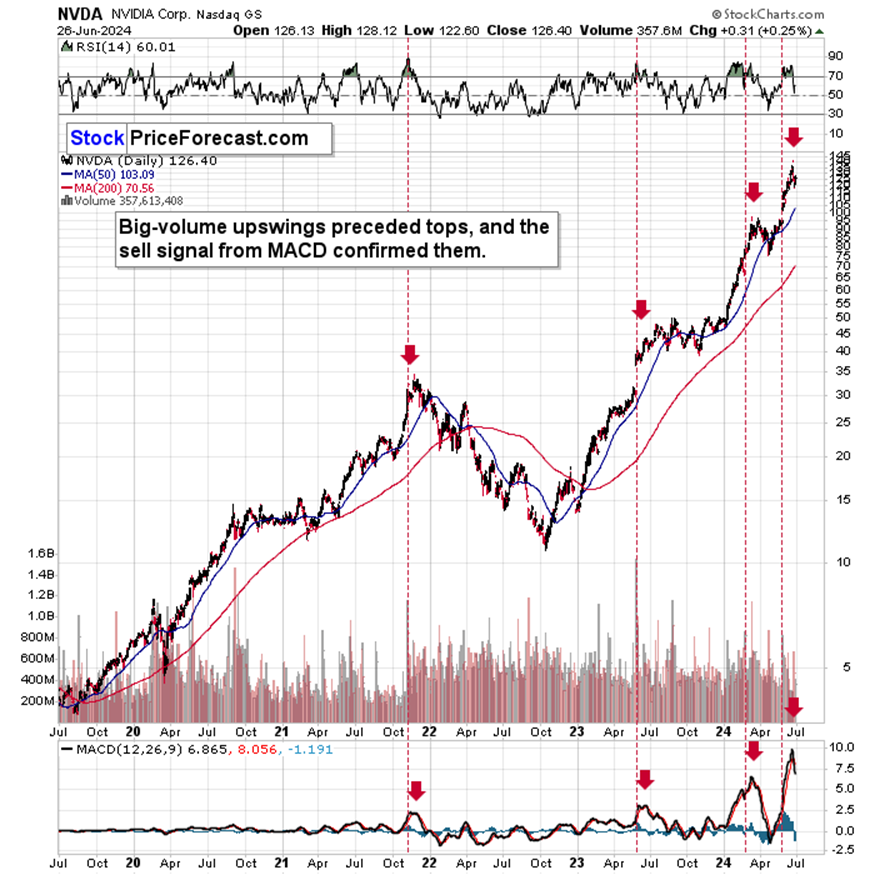
Nvidia is after a powerful sell signal from the MACD, and those signals used to trigger at least short-term declines – bigger than the one that we saw so far.
This time, the sell signal was clearer than all the previous indications from it, suggesting that this might be “it”.
So far, the S&P 500 is soaring…
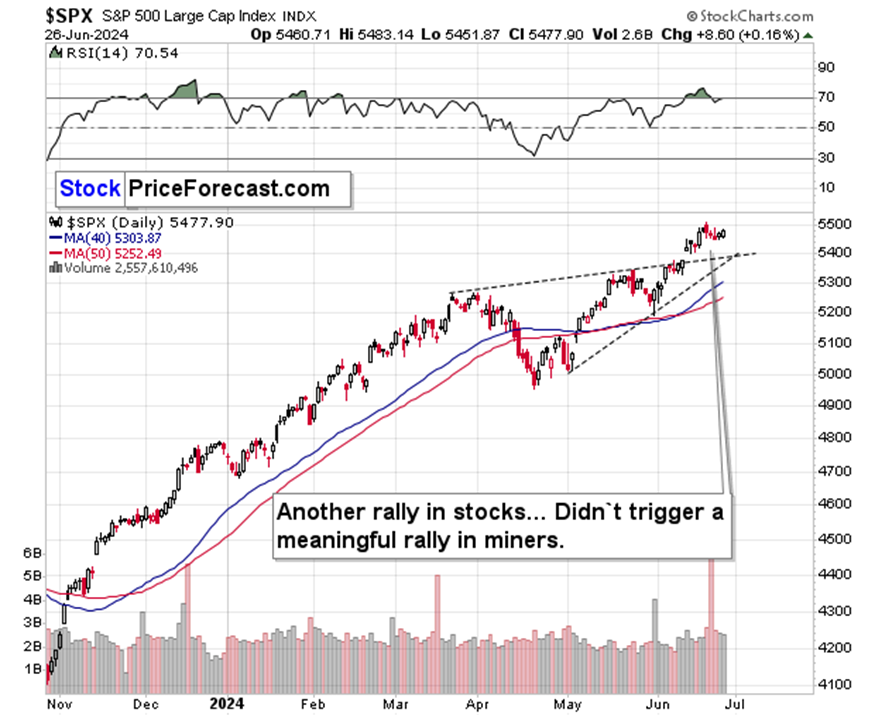
Given that its own triangle-vertex-based reversal is just around the corner, it seems that it could decline within a week or so.
However, the thing that I would like to emphasize today is that another flagship proxy for the U.S. stocks – the Dow Jones Industrial Average – is not at new highs.
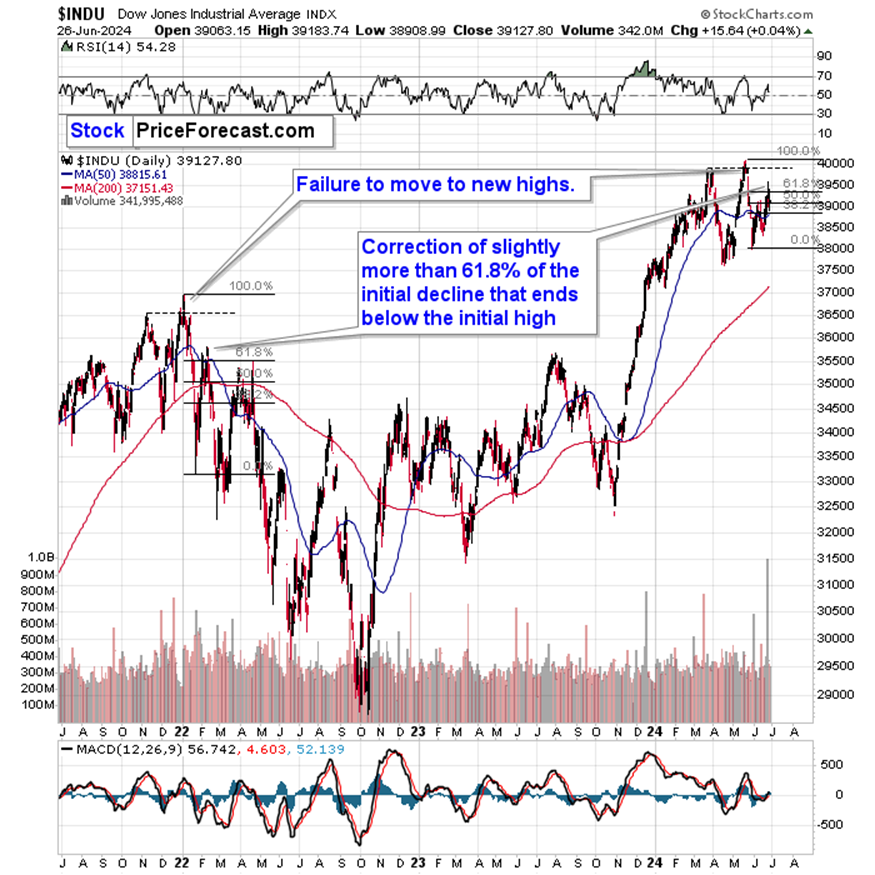
Dow tried to rally above 40k, and it failed. It also failed to hold above its previous 2024 high. It then declined and now it’s right after a correction slightly above the 61.8% Fibonacci retracement level, and above its 50-day moving average.
After exactly the same combination of events, the Dow then continued to decline for many months in 2022.
It’s really a tough call to say when exactly Nvidia and other stocks would top, but it seems that this moment is getting close. We have a triangle-vertex-based reversal just around the corner, and it could be the case that it triggers more than just a short-term decline.
Bitcoin is down, and it seems that this market doesn’t have enough strength to keep pushing higher without a huge decline first (or at all).
Where does this leave us with regard to the precious metals sector? It suggests that while we’re likely to see some kind of rebound in the following days, a really big move lower is coming. It’s probably just around the corner, and while I don’t want to sound like this has to start tomorrow, it’s quite likely that the decline will be resumed next week (or perhaps tomorrow after an intraday PCE-number-release-based top).
In my opinion, the following hours/days of the rebound will be excellent opportunities to enter or add to the existing short positions in junior mining stocks (or in gold if one can’t short junior miners for some reason). Of course, that’s just my opinion, not investment advice.
Want free follow-ups to the above article and details not available to 99%+ investors? Sign up to our free newsletter today!
Want free follow-ups to the above article and details not available to 99%+ investors? Sign up to our free newsletter today!
Author
Przemyslaw Radomski, CFA
Sunshine Profits
Przemyslaw Radomski, CFA (PR) is a precious metals investor and analyst who takes advantage of the emotionality on the markets, and invites you to do the same. His company, Sunshine Profits, publishes analytical software that any