|

Gold to rally in 2023? Watch the Elliott Wave pattern, COT data and US yields

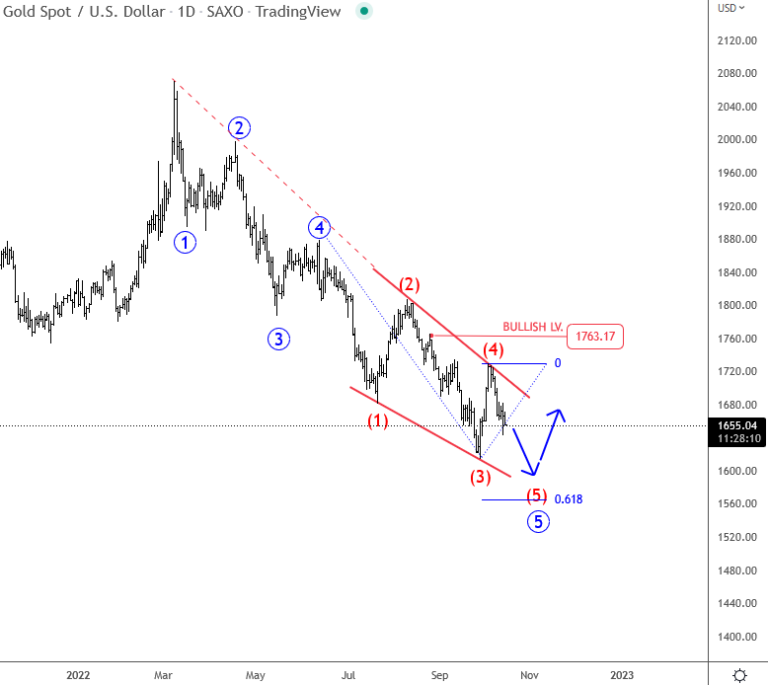
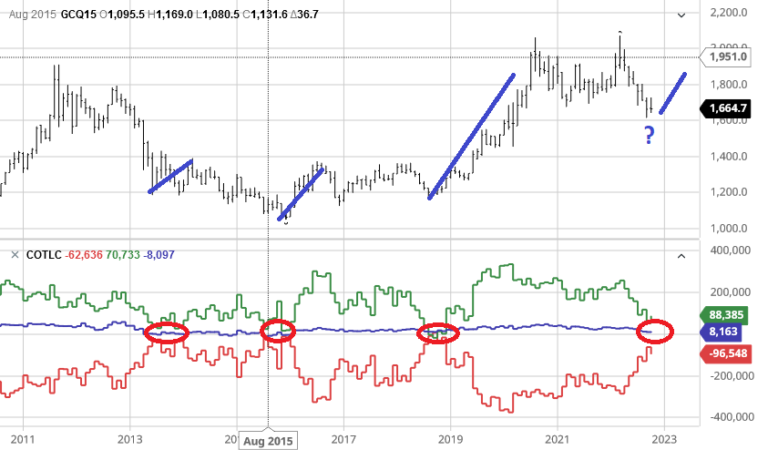
COT data is very important for gold as it’s tracked closely by a lot investors and speculators, especially for a longer-term approach. Looking at the Non-Commercials or Large Speculators, we can see that those are still heavily short, but they are approaching similar readings compared to 2013, 2015 and 2018. Notice that all of those extreme levels lead to a reversal, a rise in price, which can be very interesting now as well, especially when adding an Elliott wave count that shows a five wave drop from the high, now in late stages. In fact, there can be an ending diagonal with nice support at 1600/1610.
Chart

GOLD COT Data

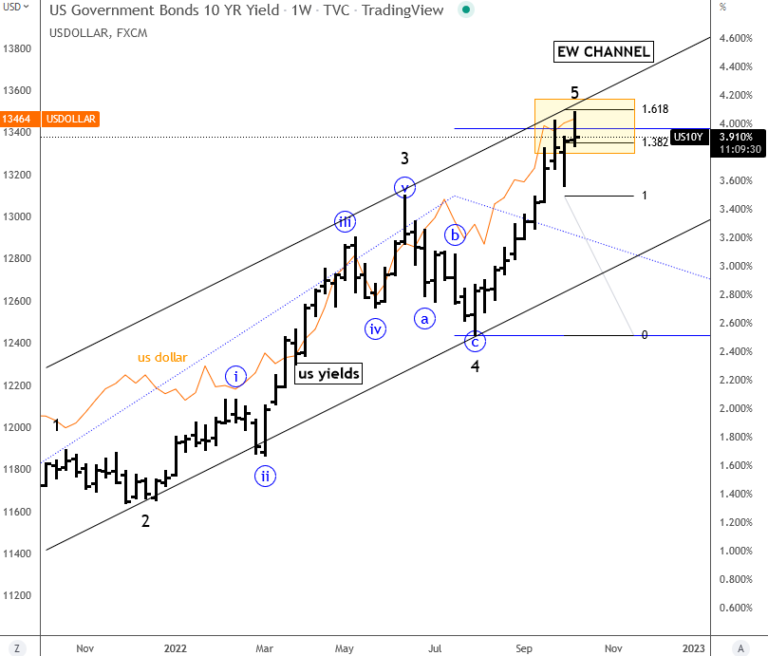
At the same time, we have to respect the US yields of course, which are still on the rise and that’s why we see gold coming down as USD trades higher in risk-off environment. So for gold to recover we also have to ask ourselves, what can trigger a turning point? Well, it can be the FED, if they will be forced to slow down the hawkish approach next year, possibly if jobs data gets worse, or if they will be successful fighting the inflation. From an Elliott wave perspective, we see 10 year US yields in late stages of an impulse, so a slow down of a bull run would not be a surprise, since we know that after every five waves market makes a minimum three wave retracement.
Chart

US10Y Weekly Chart

Chart

GOLD Daily Chart

So, will gold really slow down and turn higher next year? It’s too soon to tell, but so far we have some nice development here, which will be interesting to track from an intraday perspective as well. So if you like gold, silver or dollar, make sure to check our services where we offer Elliott wave updates on a daily basis.


Get Full Access To Our Premium Analysis For 14 Days. Click here!


Get Full Access To Our Premium Elliott Wave Analysis For 14 Days. Click here.

Author

Gregor Horvat

Gregor Horvat

Wavetraders

Experience Grega is based in Slovenia and has been in the Forex market since 2003.

More from Gregor Horvat
Share:

Editor's Picks

AUD/USD bulls regain control above 0.6950 amid USD retreat

AUD/USD regains traction and extends the previous day's bounce from the weekly low, aiming for 0.7000 in Asia on Friday. The overnight pullback in US bond yields keeps the US Dollar below an 18-month high, which in turn offers some support to the pair. Meanwhile, hawkish RBA expectations also keep the major underpinned.

USD/JPY holds gains near 158.00 after Japan's weak Household Spending data

USD/JPY clings to gains around 158.00 after data showed on Friday that Japan's Household Spending fell for the ninth straight month, undermining the Japanese Yen. Meanwhile, the US Dollar remains depressed as the overnight fall in US bond yields counters a hawkish Fed and geopolitical uncertainties, could cap any downside in the pair.

Gold remains range-bound below $4,200

Gold has given up some ground after an initial bullish attempt to reach weekly highs, returning to below the $4,200 mark per troy ounce on Friday. The US Dollar’s strong upside momentum, combined with rising US Treasury yields across the curve, seems to keep further gains in the yellow metal under scrutiny.

Has Bitcoin really escaped the macro forces it was built to fight?
Over 17 years ago, Satoshi Nakamoto designed Bitcoin (BTC) on the back of a global financial crisis as an alternative to the global monetary system outside the control of central banks, governments and traditional intermediaries. This raises a key question: has Bitcoin really become independent of the macroeconomic forces it was built to challenge?
The Euro is not the sick man of Europe. France's bond market is
EUR/USD remains under pressure, near the 17-month low of 1.1161 reached on Monday. The pair has lost more than 7% since its yearly peak, as concerns over France's public finances increasingly weigh on the single currency. But behind the weakness of the Euro (EUR), the problem does not necessarily lie with the European economy as a whole.
Has Bitcoin really escaped the macro forces it was built to fight?
Over 17 years ago, Satoshi Nakamoto designed Bitcoin (BTC) on the back of a global financial crisis as an alternative to the global monetary system outside the control of central banks, governments and traditional intermediaries. This raises a key question: has Bitcoin really become independent of the macroeconomic forces it was built to challenge?